
Luke momentarily interrupts the account of the persecutions to describe the organization and daily life of the young Church in Jerusalem (Acts 4.32-37). He stresses above all the remarkable unity that characterized this community: “The company of those who believed were of one heart and soul” (Acts 4.32).
This expression underscores the deep spiritual fellowship that united the believers and recalls the calls to unity found later in the epistles (Ephesians 4.1-6; Philippians 2.1-4).
2- A concrete solidarity
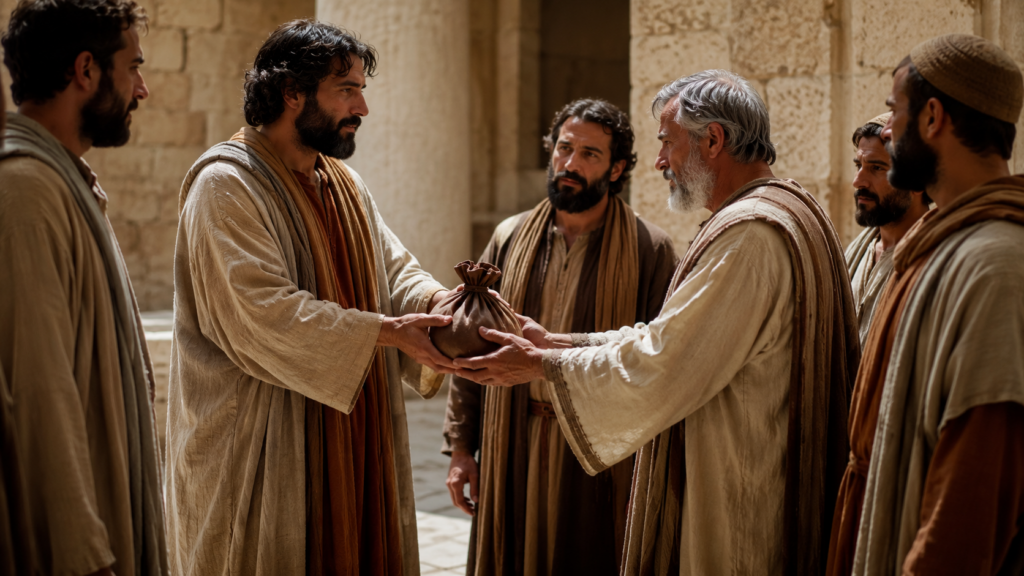
This spiritual fellowship was expressed concretely in a deep material solidarity. The believers no longer considered their possessions as belonging exclusively to them, but voluntarily put them at the service of the community. Luke specifies that there was no needy person among them (Acts 4.34), thus taking up a promise of the Law that was to characterize the people of God (Deuteronomy 15.4).
Some disciples owned lands or properties. They sold them freely and brought the proceeds of these sales to the apostles, who were responsible for redistributing them according to the needs of each (Acts 4.35). This was by no means a compulsory pooling of goods, but a voluntary step inspired by brotherly love. The needs to be met concerned mainly food, lodging and the daily necessities of the more modest families.
3- A change of priorities
Luke's account reveals great confidence in the apostles, to whom the management of these resources was entrusted. This generosity testifies to the transformation wrought by the Gospel in the lives of the believers. Material wealth no longer seems to occupy the central place it often holds in human societies.
Unlike the rich young man who could not bring himself to give up his possessions to follow Jesus (Matthew 19.16-22), several disciples were now willing to part voluntarily with some of their property in order to help their brothers and sisters in the faith.
4- A powerful testimony
This solidarity went hand in hand with the powerful testimony given by the apostles to the resurrection of the Lord Jesus. Luke stresses that they gave this testimony “with great power” and that great grace rested upon the whole community (Acts 4.33).
The action of God was therefore manifested not only by the miracles performed through the apostles, but also by the unity, brotherly love and generosity that characterized the believers. These qualities no doubt contributed to the steady growth of the Church (Acts 2.47).
5- The example of Barnabas
Finally, Luke introduces the figure of Joseph, called Barnabas by the apostles, a Levite from Cyprus (Acts 4.36). By selling a field he owned and handing the proceeds of the sale over to the apostles (Acts 4.37), Barnabas becomes a concrete example of this generosity.
This brief introduction is probably not accidental. This disciple, destined to become one of Paul's main coworkers, will play a major role in the expansion of Christianity. We will in fact devote a special study to this important figure of the early Church.
6- A work of the Holy Spirit that transforms human relationships
Thus, in Luke's eyes, the power of God was manifested not only through the miracles performed by the apostles or their testimony to the resurrection of the Messiah Jesus (Acts 4.33). It was also revealed in the deep transformation of human relationships, in the unity that reigned among the believers and in the generosity they showed toward one another.
This work of the Holy Spirit enabled the young Church to reflect concretely the Lord's teachings on brotherly love (John 13.34-35). However, Luke will soon show that this unity remained imperfect and that not everyone necessarily shared the same sincerity.
The account of Ananias and Sapphira (Acts 5.1-11) will recall that, despite the remarkable action of God within the community, the early Church was not immune to human weaknesses and temptations.
?