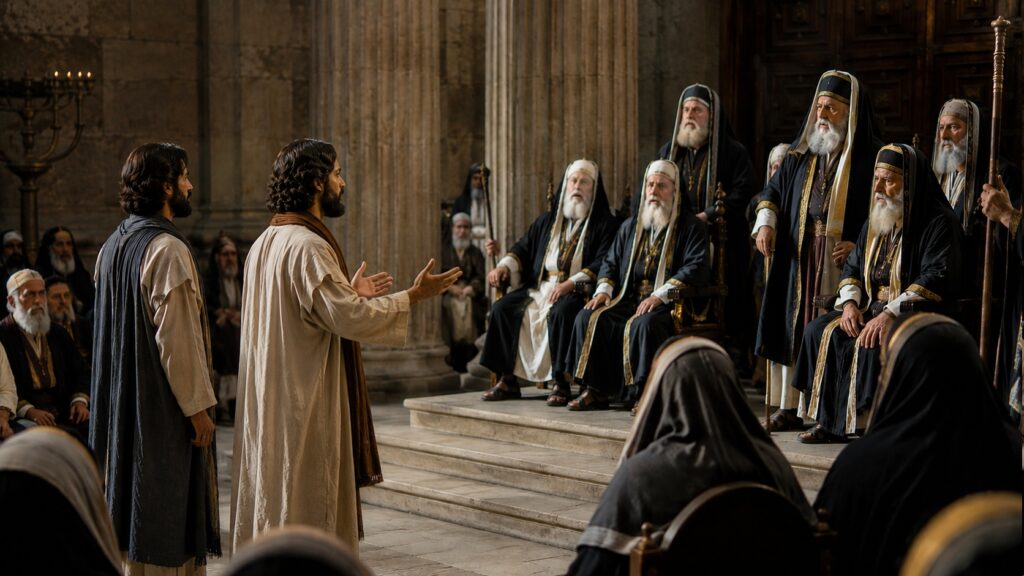

The members of the , with Annas and Caiaphas at their head, have Peter and John taken out in order to deliberate. Placed in an embarrassing situation, they seek above all a way to preserve their authority and credibility. The evidence of the miracle performed in the name of Jesus prevents them from openly condemning the two apostles (Acts 4.16).
Yet despite the facts that impose themselves on them, they refuse to draw the spiritual consequences and to recognize that God is working through these disciples.
2- An attitude already observed toward Jesus
Their attitude recalls the one they had already adopted toward the ministry of the Messiah Jesus. Despite the many miracles they had witnessed, they had refused to believe and had finally obtained His condemnation (John 11.47-53). A few weeks later, their position seems hardly to have changed.
However, not all the members of the Council probably shared this hostility. The Gospels mention Joseph of Arimathea, a member of the , who was waiting for the kingdom of God (Mark 15.43), as well as Nicodemus, who gradually showed his faith in Jesus (John 3.1-2; John 19.39). It is therefore not impossible that other members of this high assembly had begun to wonder and to reconsider a position that sometimes seemed motivated more by political than by spiritual considerations.
3- A decision that reveals their embarrassment
The decision of the reveals the impasse in which the authorities find themselves. Unable to deny the miracle and fearing the reaction of the people, who glorify God for what has just happened (Acts 4.21), they give up any condemnation and merely forbid Peter and John to speak and teach in the name of Jesus (Acts 4.18).
This decision shows that they can neither refute the facts nor silence the witnesses of the resurrection. They then hope that threats will be enough to put an end to the spread of the Christian message.
4- Obedience to God before men
The answer of the two apostles is immediate and unequivocal:
“Whether it is right in the sight of God to listen to you rather than to God, you must judge. As for us, we cannot but speak of what we have seen and heard” (Acts 4.19-20).
By these words, Peter and John do not dispute the existence of the religious authorities or their legitimacy in their own sphere of competence. They affirm, however, that no human authority can demand disobedience to an order received from God. Their faithfulness to the Lord now comes before every other consideration.
5- A remarkable transformation of the disciples
The threats of the authorities now seem to have lost all effect on Peter and John. A few weeks earlier, fear had led the disciples to hide (John 20.19). Now, filled with the Holy Spirit (Acts 4.8), the two apostles bear witness with an assurance that contrasts sharply with their attitude at the time of the Lord's arrest.
The fulfillment of Jesus' promises appears here in a particularly striking way. The One who had told His disciples that the Holy Spirit would give them the words they needed when they were brought before the courts (Matthew 10.19-20; Luke 12.11-12) now sees His words come true.
6- Recognition without repentance
Luke also highlights the embarrassment and inconsistency of the religious authorities. Unlike what happened during the ministry of Jesus, they do not claim that this miracle comes from Beelzebul (Matthew 12.24). On the contrary, they acknowledge that an undeniable sign has been performed (Acts 4.16).
However, this recognition of the facts does not lead to faith. Despite the evidence of the miracle, they refuse to accept the spiritual consequences of what they observe. Thus, the light granted to them produces not repentance, but an even more determined opposition.
7- The silent testimony of the former lame man
Luke finally adds a significant detail: the healed man was more than forty years old (Acts 4.22). Known for a long time as crippled from birth, he was a living witness to the reality of the miracle. His presence beside Peter and John made any contradiction particularly difficult.
After accompanying the two apostles before the court, this man silently disappears from the narrative. He utters no word and even his name is not known to us. Like many recipients of the miracles reported in the Scriptures, he remains anonymous, leaving all the room to the testimony given to the risen Christ.
8- An unexpected victory
The religious authorities probably thought they would intimidate the apostles and put an end to their preaching. In reality, this first confrontation ends in failure for the . Unable to condemn Peter and John, the leaders of the people are compelled to release them.
Thus, from the first chapters of Acts, Luke shows that the opposition of men cannot prevent the accomplishment of God's purpose. The newborn Church discovers that persecutions are not necessarily defeats, but often become the occasion to bear an even more striking testimony to the risen Christ.
?
The