

_23 The placing on the cross therefore takes place around 9 a.m. according to Mark's text. The imprecision of the measurement allows for the time needed to travel to Mount Golgotha. Mark 15.20-41 ; Matthew 27.31-56 ; Luke 23.26-49 ; John 18.17-30.
_24 All these members of the can now take part in the family Passover feast, rested in spirit after what they regard as a magnificent victory. But events are not going to unfold as they imagined!
You can consult the complete chronology in the study ANN026 : The hour of the crucifixion.
Commentary:
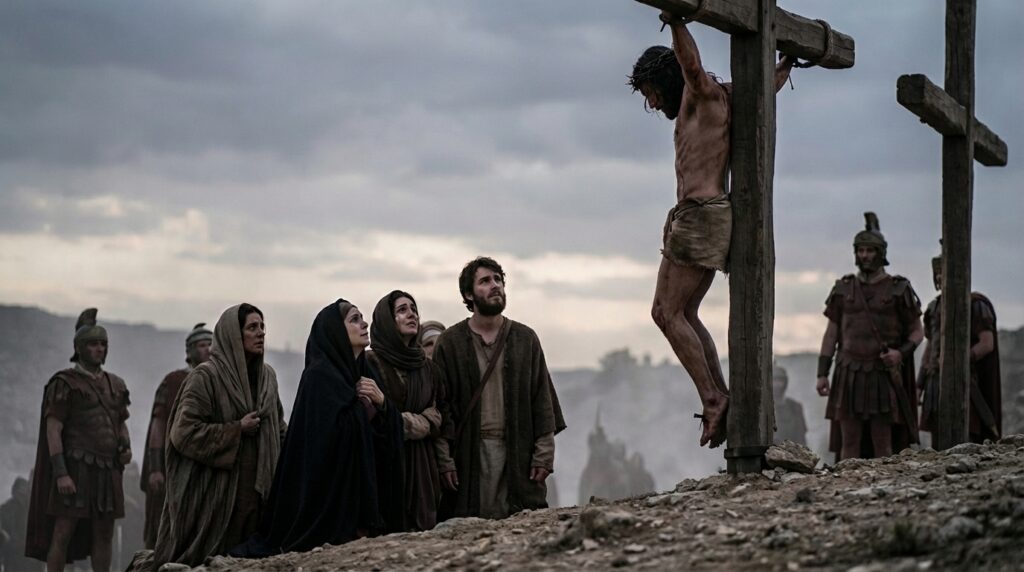
At the foot of the cross, John’s gospel presents a scene that is both restrained and deeply moving (cf. John 19.25-27). While all the disciples had fled at the arrest (cf. Matthew 26.56), John appears here present. This presence is remarkable: he is the only disciple explicitly mentioned at the time of the crucifixion. He doubtless took a real risk, even if his closeness to the high priest (cf. John 18.15) may have offered him some protection.
Around the cross stand several women: Mary, the mother of Jesus, her sister, Mary the wife of , and Mary Magdalene (cf. John 19.25). Unlike the other gospels, which mention a presence “at a distance” (cf. Matthew 27.55-56; Mark 15.40-41; Luke 23.49), John emphasizes their closeness. This highlights both their courage and their faithful devotion to the very end.
In this context of extreme suffering, Jesus speaks surprising words. Seeing his mother and the disciple whom he loved, he says: “Woman, behold your son,” and then to John: “Behold your mother” (cf. John 19.26-27). These words are not merely affectionate; they carry both a concrete and a symbolic significance.
On the human level, Jesus entrusts his mother to John. He thus shows remarkable filial care, even in the depths of agony. This shows that he does not turn away from earthly responsibilities. The fact that he does not entrust Mary to his brothers (cf. John 7.5) suggests that they did not yet believe in him at that time.
But this scene also has a spiritual dimension. By entrusting Mary to John, Jesus creates a new bond, founded not on blood but on faith. John becomes in a way the representative of the disciples, and Mary a figure of the community of believers. This gesture illustrates the birth of a new family, that of the disciples united around the Christ (cf. Mark 3.35).
The text specifies that “from that hour the disciple took her to his own home” (cf. John 19.27). This immediate obedience underscores John’s faithfulness and gives a concrete aspect to this word: it is not merely symbolic; it entails a real responsibility.
The presence of witnesses is also important. The women, and John himself, are direct sources of this testimony. This strengthens the credibility of the account. Other figures such as Joseph of Arimathea and Nicodemus will appear afterward (cf. John 19.38-39), showing that even among the notables, some were deeply marked by these events.
Finally, this passage reveals a striking contrast: while Jesus endures the humiliation and suffering of the cross, he continues to act with authority and compassion. He does not content himself with enduring; he organizes, he entrusts, he creates bonds. Even in death, he remains the one who gathers.
One strong idea emerges: in the midst of the most extreme suffering, Jesus does not cease to love or to care. The cross thus becomes not only a place of sacrifice, but also a place where a new relationship is born among those who belong to him.