
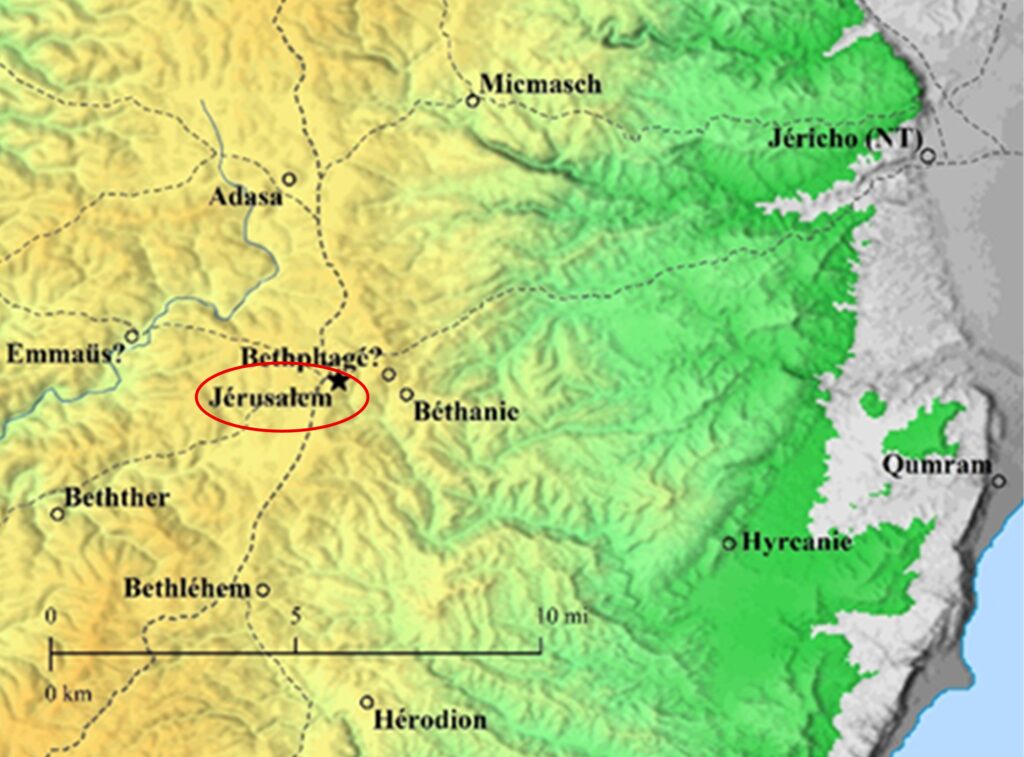

_8 They stop at the foot of the , in the Garden of Gethsemane. Matthew 26.36; Mark 14.32.
_9 They spend an hour in prayer, from 2 a.m. to 3 a.m. Matthew 26.40.
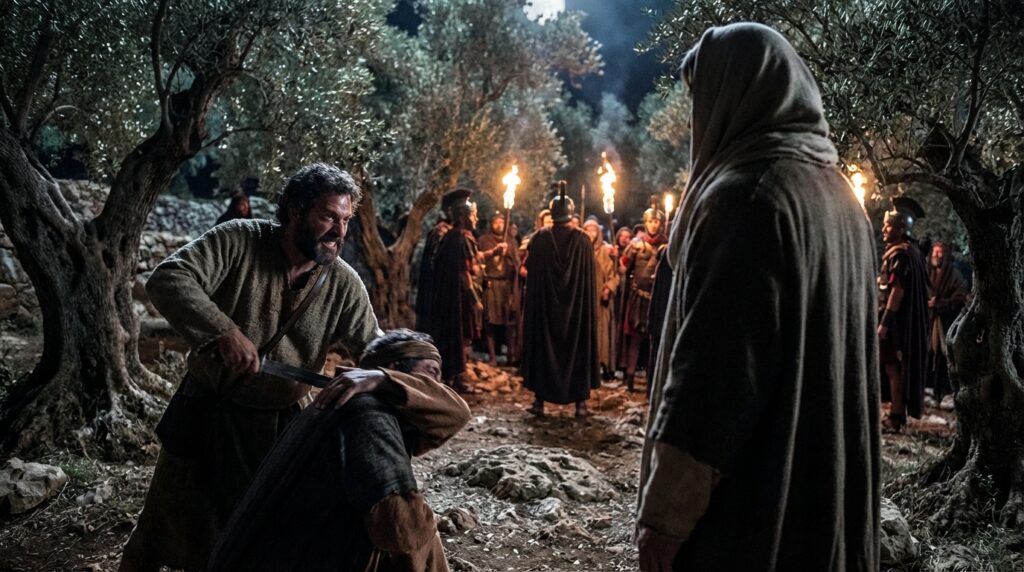
_10 The troop led by Judas Iscariot arrives. It is still Thursday night, before dawn on Friday, around 3 a.m. Mark 14.43-52; Matthew 26.47-56; Luke 22.47-53; John 18.2-12.
_11 The arrest takes place at that moment, around 3:30 a.m. We are about 1 km from the Temple. Matthew 26.47; Mark 14.43; Luke 22.47; John 18.3.
You can consult the complete chronology in the study ANN026 : The hour of the crucifixion.
Commentary:
In the tumult of the arrest, Simon Peter cannot help reacting. His gesture is impulsive, almost instinctive: he draws his sword and strikes the high priest's servant, cutting off his right ear (John 18.10). The servant, named Malchus according to John, narrowly escapes death. Peter is not joking: his blow was probably aimed at the head, and only a movement backward saved this man's life. The Synoptic Gospels mention the incident without naming Peter, no doubt to avoid bringing trouble on him at a time when the religious authorities were persecuting the disciples. John, writing later, can mention his name without risk, since Peter was already dead when it was written.
Jesus the Messiah intervenes immediately. According to Matthew, he helps Peter understand the situation by reminding him that violence is not the way of the Kingdom:
He also shows him that no one takes his life from him, but that he lays it down voluntarily, in accordance with the mission received from the Father (John 10.17-18). He could have called twelve legions of angels to defend him (Matthew 26.53), but he refuses all resistance, because the Scriptures must be fulfilled (Matthew 26.54).
Jesus the Messiah thus makes clear that his arrest is not a failure, but the necessary step of the plan of redemption, the supreme expression of God's love for the world (John 3.16-17).
Luke adds a moving detail: Jesus the Messiah immediately heals Malchus's ear, in front of all who can see the scene (Luke 22.51). This discreet but powerful gesture keeps the situation from degenerating into a bloodbath. Jesus the Messiah refuses to let his arrest become the trigger of a riot or an armed clash. He protects his disciples, but also his enemies.
In the tumult, the incident may well have gone almost unnoticed by most of the soldiers, but it is hard to imagine that Malchus ever forgot the moment when the one he had come to arrest healed him.
Jesus the Messiah also points out the inconsistency of those who come to arrest him: he taught every day in the Temple, and yet they come by night, armed as if for a robber (Mark 14.48-49). Their attitude reveals the fear of a popular uprising and the desire to avoid any witness. But despite their strength and their strategy, it is Jesus the Messiah who remains master of the situation. He steps forward freely, calms Peter, heals Malchus, and reminds them that everything is unfolding according to the divine plan.
Thus the four accounts show a striking contrast: Peter's impulsive violence, the fear of the authorities, the confusion of the soldiers, and at the center, the sovereign calm of the Messiah. Jesus does not merely avoid escalation; he displays an authority that is anything but military and everything spiritual. He gives himself up voluntarily, protects his own, does good to the one who wounds him, and advances toward the cross with a determination that reveals the depth of his love and the greatness of his mission.
This episode underlines the voluntary acceptance by Jesus the Messiah of his redemptive mission. His prayer in Gethsemane anticipates the sacrifice of the cross, where he will bear the sin of the world (Isaiah 53.5-6, 1 Peter 2.24). The submission of Jesus the Messiah also illustrates the perfect example for believers facing trial: to watch, to pray, and to accept God's will even in suffering (1 Peter 4.1-2).