

PER277

Mary of Bethany anoints the Messiah Jesus

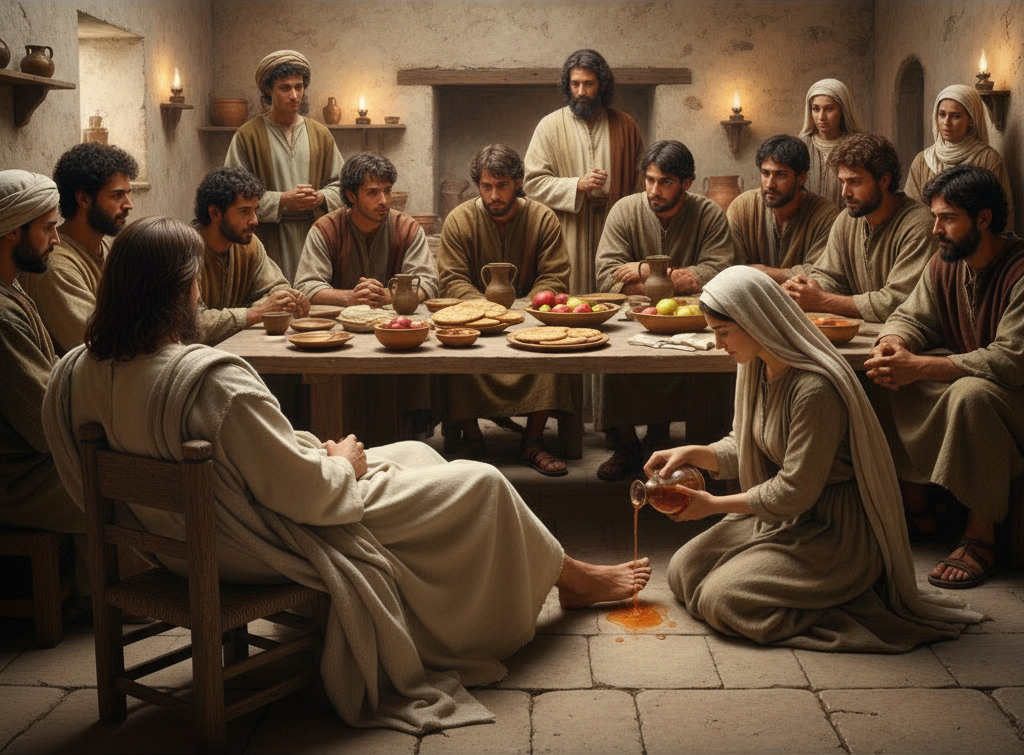
Mary of Bethany anoints Jesus with costly perfume at Bethany, symbolizing his coming burial. This act, criticized by Judas Iscariot and other disciples, is defended by Jesus and highlighted in the analysis of the Gospels according to Matthew, Mark and John. The text also discusses the chronological and communal implications of this biblical event.

5 min Mary of Bethany Jesus perfume Judas Iscariot teachings 4 verses 4 books

Resources

Biblical texts

Matthew
Matthew 26.6-13 (King James Version)

Now when Jesus was in Bethany, in the house of Simon the leper,

There came unto him a woman having an alabaster box of very precious ointment, and poured it on his head, as he sat at meat.

But when his disciples saw it, they had indignation, saying, To what purpose is this waste?

For this ointment might have been sold for much, and given to the poor.

When Jesus understood it, he said unto them, Why trouble ye the woman? for she hath wrought a good work upon me.

For ye have the poor always with you; but me ye have not always.

For in that she hath poured this ointment on my body, she did it for my burial.

Verily I say unto you, Wheresoever this gospel shall be preached in the whole world, there shall also this, that this woman hath done, be told for a memorial of her.

Mark
Mark 14.3-9 (King James Version)

And being in Bethany in the house of Simon the leper, as he sat at meat, there came a woman having an alabaster box of ointment of spikenard very precious; and she brake the box, and poured it on his head.

And there were some that had indignation within themselves, and said, Why was this waste of the ointment made?

For it might have been sold for more than three hundred pence, and have been given to the poor. And they murmured against her.

And Jesus said, Let her alone; why trouble ye her? she hath wrought a good work on me.

For ye have the poor with you always, and whensoever ye will ye may do them good: but me ye have not always.

She hath done what she could: she is come aforehand to anoint my body to the burying.

Verily I say unto you, Wheresoever this gospel shall be preached throughout the whole world, this also that she hath done shall be spoken of for a memorial of her.

Luke
Luke (King James Version) not cited in the book
John
John 12.2-8 (King James Version)

There they made him a supper; and Martha served: but Lazarus was one of them that sat at the table with him.

Then took Mary a pound of ointment of spikenard, very costly, and anointed the feet of Jesus, and wiped his feet with her hair: and the house was filled with the odour of the ointment.

Then saith one of his disciples, Judas Iscariot, Simon’s son, which should betray him,

Why was not this ointment sold for three hundred pence, and given to the poor?

This he said, not that he cared for the poor; but because he was a thief, and had the bag, and bare what was put therein.

Then said Jesus, Let her alone: against the day of my burying hath she kept this.

For the poor always ye have with you; but me ye have not always.

Technical details

Year AD 33

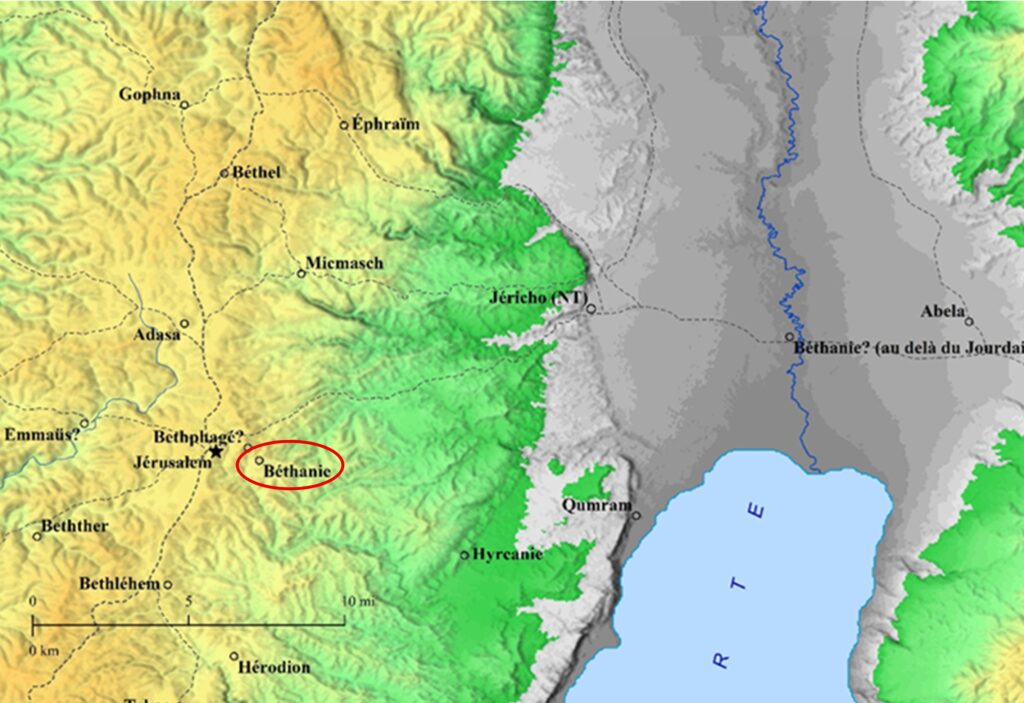
Location: The village of Bethany near Jerusalem

Date: Saturday, March 26, AD 33

Method: We continue with John

Note on the method: Matthew and Mark confirm John’s account

Village of Bethany
Saturday bar graph

The Messiah Jesus and his disciples take part in a great meal given by Simon, a former leper.

Comments

The main meal of the day in this region took place in the late afternoon, when the heat subsided. It was often held outdoors or in a ventilated space, so that the guests could rest and enjoy the cool air.

Simon, called “the former leper,” who had certainly been healed by the Messiah Jesus, had invited him and his disciples. helped with the serving, since the guests were numerous. This meal was not a private gathering between Jesus, Simon and a few close friends: a good number of the inhabitants of Bethany were probably present.

The event thus took on a communal dimension, going beyond the family circle, which magnified the impact of the gesture that was about to follow.

Mary (Mary of Bethany) owned a very costly perfume, set aside for burial. Hearing the Messiah Jesus speak of his approaching death, she understands that the moment has come: she pours this perfume on him, offering what she has most precious to the one who means everything to her. Her gesture is public, solemn and deeply personal.

Matthew and Mark report that several disciples murmured among themselves that this money could have been given to the poor. John specifies that Judas Iscariot was the origin of this criticism, and that he drew other disciples into his judgment. He also adds a piece of information that the apostles understood only later: Judas, who kept the common purse, was embezzling money.

There is therefore no contradiction between the accounts: Matthew and Mark describe the collective reaction, while John reveals the instigator of this reproach.

Faced with the opposition stirred up against Mary, the Messiah Jesus steps in with authority to defend her. He points out that her gesture has a prophetic significance, directly linked to his imminent burial. Luke, for his part, does not see fit to include this episode in his gospel, although he reports another, unrelated one, in which a sinful woman anoints Jesus (Luke 7.36-50.

In the light of later events, we understand that none of the apostles suspected Judas’s dealings at that moment. If they had had the slightest doubt, they would not have let him manage the purse. One can easily imagine how Peter would have reacted.

When did this event take place? 6 days before Passover as John 12.1 indicates, or on Wednesday as Mark 14.1 and Matthew 26.2 state?

?