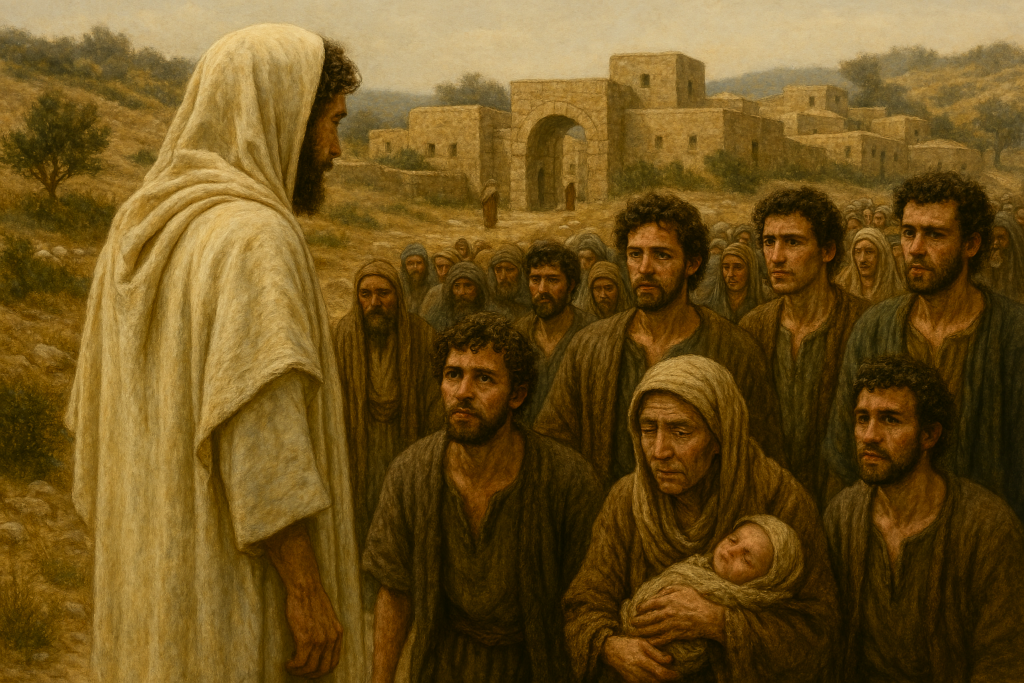

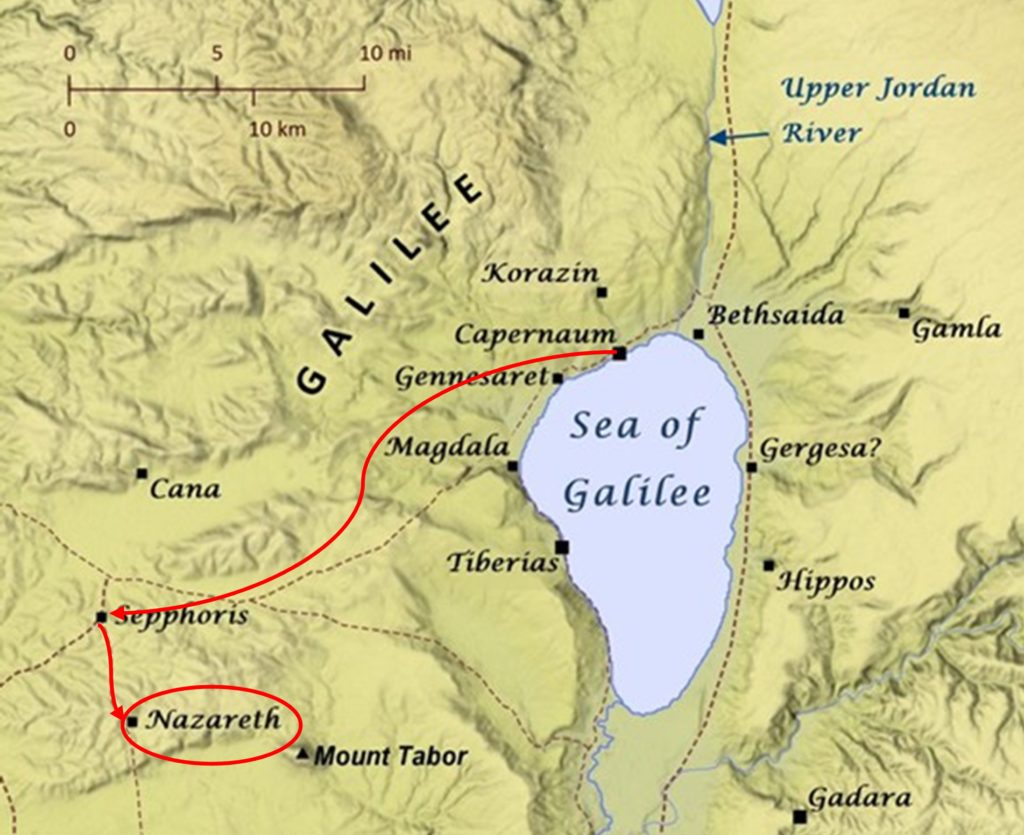
This is therefore the second time that Jesus the Messiah returns to Nazareth, according to the information given by the Gospels. It is possible, however, that he returned there without the authors of the Gospels having thought it necessary to mention it.
On the first occasion (PER050), Jesus was the target of an assassination attempt that failed unexpectedly.
This time, even though the welcome is not cordial, at least the extremists did not try to kill him. He can even proclaim his message in the on the day of the . But Mark and Matthew nevertheless stress that Jesus the Messiah was an obstacle to his family; they use the same expression. This is not surprising, since Mark and the apostle Peter take up the Gospel of Matthew to adapt it for non-Jews.
The expression used in Mark 6.5 is particularly intriguing: “He could do no miracle there, except that he healed a few sick people by laying his hands on them.” This statement can be interpreted as follows: Jesus the Messiah performed some miracles, but not as many as he would have wished. These people were truly in need of deliverance and were not healed because of their lack of faith. This situation must have affected Jesus the Messiah, given the elements mentioned earlier (PER160).
The words of Jesus the Messiah, “A prophet is despised only in his own country and in his own family,” proved to be true. This saying has become well known and is often quoted without people knowing that it comes from Jesus the Messiah.
The miracles referred to in Mark 6.2 must have taken place in Capernaum and not in Nazareth.
We see that part of the population was reluctant to accept the words of Jesus the Messiah despite the miracles he had performed.
Let us now compare these two passages.
Matthew 13.54-58
• Context: Jesus returns to his hometown, Nazareth.
• Reaction of the townspeople: They are amazed at his wisdom and his miracles, but they reject him because they know him as the carpenter’s son and know his family. Their familiarity with Jesus prevents them from believing in him.
• Theme: Jesus performs only a few miracles there because of their lack of faith.
Mark 6.1-6
• Context: Jesus returns to his hometown, accompanied by his disciples.
• Reaction of the townspeople: As in Matthew, they are surprised by his teaching and his miracles, but they reject him because they know him and know his family.
• Theme: Jesus is astonished at their lack of faith and can perform only a few miracles there, except to heal a few sick people by laying on hands.
Comparison
1. Reaction of the townspeople:
Matthew and Mark both describe the astonishment of the townspeople at the wisdom and miracles of Jesus, followed by their rejection of him because of their familiarity with him and his family.
2. Jesus and the miracles:
Matthew specifies that Jesus performs only a few miracles because of their lack of faith.
_Mark adds that Jesus is astonished at their lack of faith and mentions that he heals a few sick people by laying on hands. He also mentioned having visited other villages in the surrounding area.
3. The presence of the disciples:
Mark specifies that Jesus is accompanied by his disciples, whereas Matthew does not mention their presence.
Both passages show the difficulty that Jesus the Messiah met in being accepted in his own town, stressing that the townspeople’s familiarity with him and his family hindered their faith in him. Mark provides additional details about the reaction of the townspeople and the presence of the disciples.