ANN083

The family of Jesus the Messiah

This article examines the importance of Jesus’ family in the development of the early Church. It highlights the roles of his mother Mary, of John the Baptist, and above all of his brothers James and Jude. The study reveals the influence of this family on nascent Christianity, as analyzed from the Gospels and the apostolic letters.

35 min Jesus’ family James Jude early Church 45 verses 9 books

Further information

Introduction

The study of the family of the Messiah Jesus helps us better understand how his work continued after his death and resurrection. The Gospels show that Jesus was not isolated, but part of a very real family setting. His brothers and sisters are mentioned (cf. Matthew 13.55-56), as well as broader family ties, notably with Elizabeth and her son John the Baptist (cf. Luke 1.36).

These elements raise several important questions. Did members of his family take an active part in the development of the nascent Church? Did they hold responsibilities? Did their initial attitude toward Jesus change? To answer these questions, we need to examine the biblical texts carefully.

The aim of this study is therefore to determine, from the biblical texts, to what extent the family of the Messiah Jesus took part in the continuation of his work.

In this study, the term “brothers” will be used to refer to the half-brothers of Jesus, that is, the children of Mary and Joseph mentioned in (cf. Mark 6.3).

As demonstrated previously in the appendix ANN018: Jesus’ brothers and sisters, Mary and Joseph had other children.

I. The family bond with John the Baptist

The Gospel of Luke states that the angel announces to Mary that her “relative” Elizabeth is pregnant (cf. Luke 1.36). The term used is deliberately broad, but it clearly establishes a family tie. John the Baptist and Jesus therefore belong to the same extended family.

This bond sheds light on their relationship: John prepares the way of the Messiah (cf. Matthew 3.3) and recognizes in Jesus the one who was to come (cf. John 1.29). Even though their roles differ, their family closeness is part of a spiritual and historical continuity.

Although this family closeness may help to shed light on John’s unique role, whose ministry directly prepares that of the Messiah, it remains true that God directed the ministry of John the Baptist.

We have carried out research on this theme, the results of which are presented in the appendix ANN007: The family relationship between Mary and Elizabeth.

II. James, brother of Jesus and leader of the Church

The Gospels explicitly mention the brothers of Jesus, among whom is James (cf. Mark 6.3). After the resurrection, this same James appears as a central figure of the Church in Jerusalem.

In the book of Acts, Peter asks that the news of his deliverance be passed on to James (cf. Acts 12.17), which already shows his importance. At the Council of Jerusalem, it is again James who speaks to propose an authoritative decision (cf. Acts 15.13-19). Finally, Paul goes to his house, where the elders are gathered (cf. Acts 21.18).

Moreover, Paul explicitly mentions “James, the Lord’s brother” (cf. Galatians 1.19), which clearly establishes his family tie with Jesus. This same James is traditionally identified as the author of the epistle of James (cf. James 1.1).

Thus, the texts show that the brother of Jesus did not remain in the background, but exercised major authority in the early Church.

We develop this theme in the appendix ANN018: Jesus’ brothers and sisters.

III. Jude, brother of James and relative of Jesus

The epistle of Jude begins with these words: “Jude, a servant of Jesus Christ and brother of James” (cf. Jude 1.1). This introduction is significant. Jude does not directly claim his tie with Jesus, but links himself to James, a recognized figure.

If James is indeed the brother of Jesus, then Jude also belongs to that same family. The Gospels moreover mention a “Judas” among the brothers of Jesus (cf. Mark 6.3).

We therefore observe that several members of Jesus’ family took an active part in the teaching and organization of the first Christian communities.

IV. An initial unbelief

One important element qualifies this observation:

John 7.5 (King James Version) :
For neither did his brethren believe in him.

During the ministry of Jesus, his brothers therefore seem to remain at a distance, even in incomprehension. Their later commitment then raises an essential question: what brought about their change?

The Gospels give no detailed account of their conversion. However, several elements can be taken into consideration:

  • The events of the crucifixion, accompanied by striking signs in the Gospel accounts;
  • The testimony of the apostles after the resurrection;
  • The dynamic of the group of disciples gathered after Easter.

One can reasonably think that the resurrection of Jesus was the decisive factor in their transformation.

After the death of Jesus, the situation changes radically. Paul states that the risen Jesus appeared to James (cf. 1 Corinthians 15.7). This mention is essential, for it suggests a decisive moment in the life of the latter.

Moreover, the book of Acts shows that the brothers of Jesus are present with the apostles in prayer, after the ascension (cf. Acts 1.14). They now fully belong to the community of believers.

It is therefore consistent to think that the resurrection was the determining factor in their conversion, turning their initial unbelief into active commitment.

It also seems probable to us that several brothers and sisters of Jesus accompanied their mother Mary on the last Passover pilgrimage. According to our analyses, they witnessed the great events that took place on Friday, April 1, AD 33: the arrest, the trial, the condemnation and the crucifixion.

V. Were the siblings present at the crucifixion?

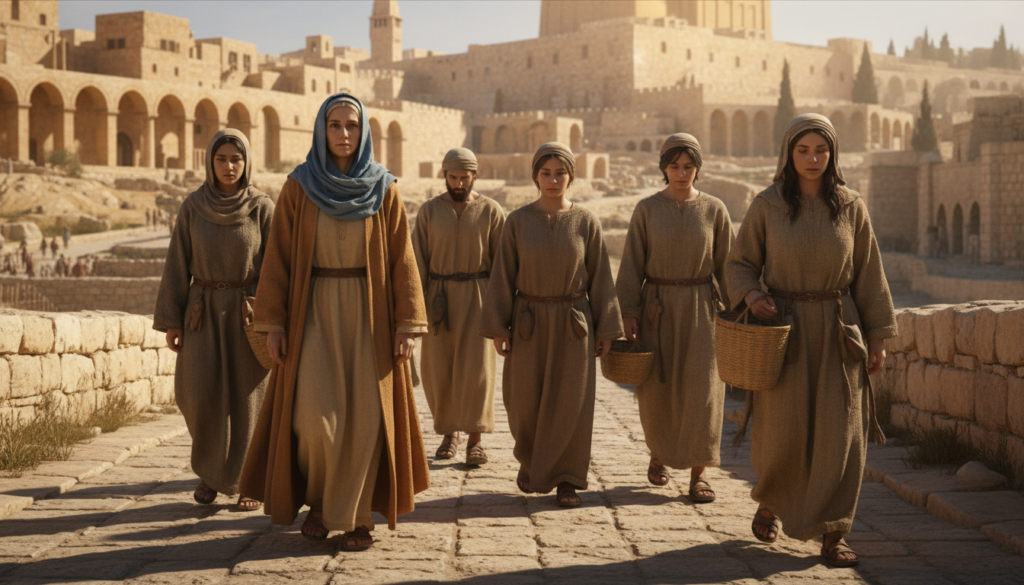
It is quite conceivable that the brothers and sisters of Jesus accompanied Mary on the pilgrimages to Jerusalem, including for the feast of Passover, even if their presence is not explicitly mentioned in the accounts.

Luke indicates that the parents of Jesus went up to Jerusalem every year for the feast of Passover (cf. Luke 2.41). This detail shows that the family faithfully observed the religious requirements and regularly took part in the great feasts.

This observation is confirmed by another passage: at the time of the , the brothers of Jesus are also on their way to Jerusalem (cf. John 7.2-10). This text clearly shows that the siblings of Jesus took part in the pilgrimages, regardless even of their personal faith in him at that time (cf. John 7.5).

In the Jewish context of the 1st century, these journeys were generally made in extended family groups, for reasons both practical and social. It is therefore consistent to think that Mary did not travel alone with Jesus, but was surrounded by her whole family, including her other children (cf. Mark 6.3).

Thus, even though the Gospels do not explicitly mention the presence of the brothers and sisters at the last Passover, several elements converge:

  • the family’s faithfulness to the pilgrimages (cf. Luke 2.41);
  • the attested participation of the brothers in other feasts in Jerusalem (cf. John 7.2-10);
  • the existence of a large set of siblings (cf. Mark 6.3).

We can therefore consider it highly probable that the brothers and sisters of Jesus were present in Jerusalem during the great feasts, including the last Passover. However, in the absence of an explicit mention in the Passion accounts, this remains a coherent reconstruction, but not a textual certainty.

VI. Gospel writing and caution before the authorities: an explanatory hypothesis

We observe that the authors of the Gospels of Matthew, Mark, and to some extent Luke, show a certain reserve in specifying some narrative details. This aspect was examined above (chapter 1: the Gospels). It is appropriate, however, to place this characteristic in the historical and political context of the 1st century.

After the crucifixion of the Messiah Jesus, the religious authorities see that the movement he began does not disappear, contrary to their expectations, but on the contrary tends to grow (cf. Acts 5.36-37). This phenomenon belongs to a broader context in which several messianic or prophetic movements had already emerged and then disappeared after the death of their leader, which explains the authorities’ heightened vigilance.

The first decades of Christianity were indeed marked by a series of arrests targeting the apostles and those close to them:

  • Arrest of Peter and John (Acts 4.1-3)
  • Collective arrest of the apostles (Acts 5.17-18)
  • New arrest and appearance (Acts 5.26-40)
  • Arrest of Stephen (Acts 6.8-15)
  • Arrest of Peter by Herod (Acts 12.1-5)

To these arrests are added more extreme acts of violence: Stephen is put to death by (Acts 7.54-60) and James, the brother of John, is executed (Acts 12.1-2). This climate of persecution helps create an environment of lasting insecurity for the disciples.

The Gospels themselves bear witness to the fear that seized the disciples after the death of Jesus: they gather behind closed doors “for fear” (John 20.19; John 20.26), while the Passion accounts also mention their scattering (Matthew 26.56; Mark 14.50). These elements suggest a situation in which caution was not only understandable, but necessary.

In this context, it is plausible that the writing of the Gospel testimonies was marked by a form of deliberate restraint. Matthew, Mark, and even Luke — though later — may have avoided mentioning certain names, precise places or family ties, so as not to needlessly expose members of the first Christian communities to possible reprisals.

This hypothesis is reinforced by the fact that the first communities often met in private houses (cf. Acts 12.12), which already implied a certain discretion in their organization. Moreover, the use of sometimes general or indirect wording in the accounts can be interpreted as a protective strategy.

Finally, the Gospel according to John, generally dated to the end of the 1st century, seems to reflect a different context. The time elapsed since the events, as well as the probable disappearance of many direct witnesses, could explain a greater freedom in mentioning certain details.

From this perspective, it is not implausible that the religious authorities sought to identify the relatives of Jesus and the influential members of the movement, in order to halt its progress. Such an intention would fit their evident desire to make the work of the Messiah Jesus disappear for good.

Thus, the relative discretion observed in certain Gospel passages can be understood not as a gap, but as the reflection of a historical context marked by caution and by the need to protect believers.

Conclusion

The study of the biblical texts reveals a remarkable development: the family of Jesus, initially in the background during his ministry (cf. John 7.5), later becomes an important actor in the early Church. This transformation does not rule out their concrete closeness to him during the great stages of his life. In light of Jewish family practices and the indications of the Gospels, it is indeed plausible that his brothers and sisters accompanied Mary on the pilgrimages to Jerusalem (cf. Luke 2.41; John 7.2-10), including the last Passover, even if their presence is not explicitly mentioned in the Passion accounts.

After the resurrection, several members of this family take on a central place. James emerges as a major figure of the Church in Jerusalem (cf. Acts 15.13; Galatians 1.19), while Jude takes part in the teaching of the first communities (cf. Jude 1.1). Their authority does not rest solely on their family tie, but on their commitment and their recognition among the believers.

This path highlights a profound transformation: those who did not believe in him during his ministry later become witnesses and leaders. The appearance of the Risen One to James (cf. 1 Corinthians 15.7) probably constitutes a decisive element in this turnaround.

Thus, even if the texts remain discreet on certain details, all the clues converge toward one and the same reality: the family of the Messiah Jesus, present in his surroundings during his ministry but often in the background and in incomprehension (cf. John 7.5), fully takes its place after Easter in the continuation of his work, actively taking part in its transmission and its rooting in the history of the Church.