ANN060

The city of Sepphoris

The article examines the key role of Sepphoris in Galilee, near Nazareth, and its cultural and historical significance, even though it is not mentioned in the Gospels.

28 min Sepphoris Nazareth Jesus Herod Antipas Gospels 30 verses 4 books

Further information

Introduction

Sepphoris

Some readers may be surprised that a study is devoted to the city of Sepphoris when its name never appears explicitly in the Gospels. It is precisely this silence that deserves our attention. Indeed, several historical, geographical and economic factors suggest that this city probably held an important place in the daily surroundings of Joseph, Jesus and their family.

Nazareth, in the time of Jesus, seems to have been a modest rural village made up of only a few dozen dwellings. Such a place could hardly have offered enough work for craftsmen like Joseph and Jesus, described in the Gospels by the Greek term tekton (Matthew 13.55 ; Mark 6.3). This word does not refer only to a carpenter in the modern sense, but more broadly to a building craftsman or a worker in wood, stone or various construction materials.

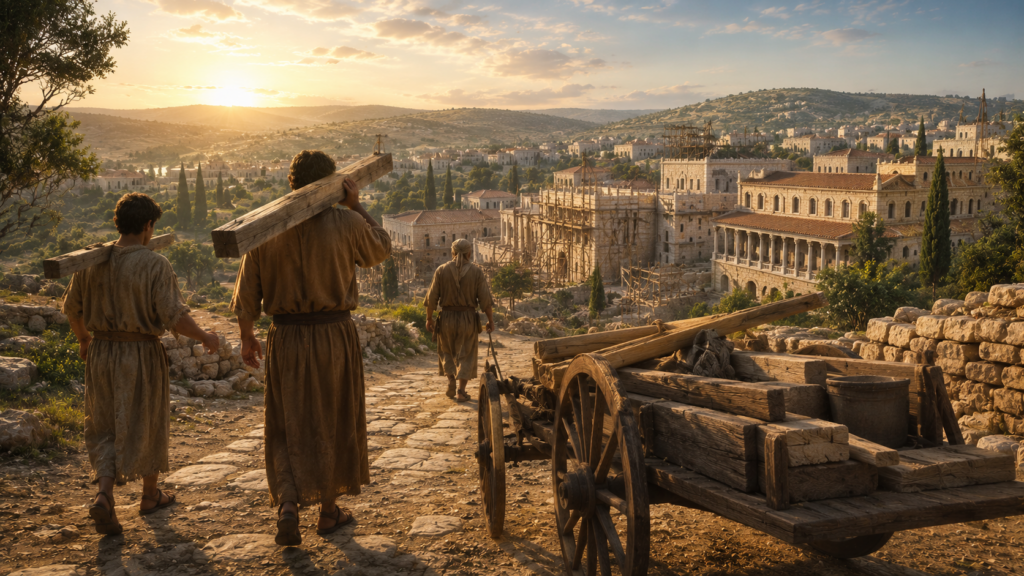
Now, only a few kilometers from Nazareth, the city of Sepphoris was going through a major phase of reconstruction under the authority of Herod Antipas, after the unrest that followed the death of Herod the Great. This city, regarded as one of the principal cities of Galilee and probably its administrative capital during part of Jesus’ youth, was a vast building site capable of attracting many workers and craftsmen. Under these conditions, it seems reasonable to consider that Joseph, Jesus and perhaps other members of their family may have gone there regularly to work.

The geographical proximity of Sepphoris, however, raises an important question: why do the Gospels never mention this city when it held such a major place in the region? This absence is all the more surprising because the Gospel writers sometimes cite much more modest localities such as (John 2.1), (Luke 7.11) or (Mark 6.45). Moreover, if Jesus traveled through the towns and villages of Galilee to proclaim the Kingdom of God (Matthew 4.23 ; Luke 8.1), we may legitimately ask why no episode of preaching in Sepphoris has been preserved in the Gospel accounts.

The aim of this study is therefore to examine this apparent absence. We will seek to understand whether the silence of the Gospels concerning Sepphoris results from a simple narrative choice, from a particular theological orientation, or from historical factors related to the mission of Jesus the Messiah. This reflection will also help us better understand the cultural, economic and social environment in which Jesus grew up before the beginning of his public ministry.

I. The greatness of Sepphoris

Sepphoris was the principal city of this region of Galilee in the time of Jesus, yet neither the authors of the Gospels nor the apostle Paul mention it explicitly in their writings. This absence may come as a surprise when we consider the importance of this city in the political, economic and cultural landscape of the time.

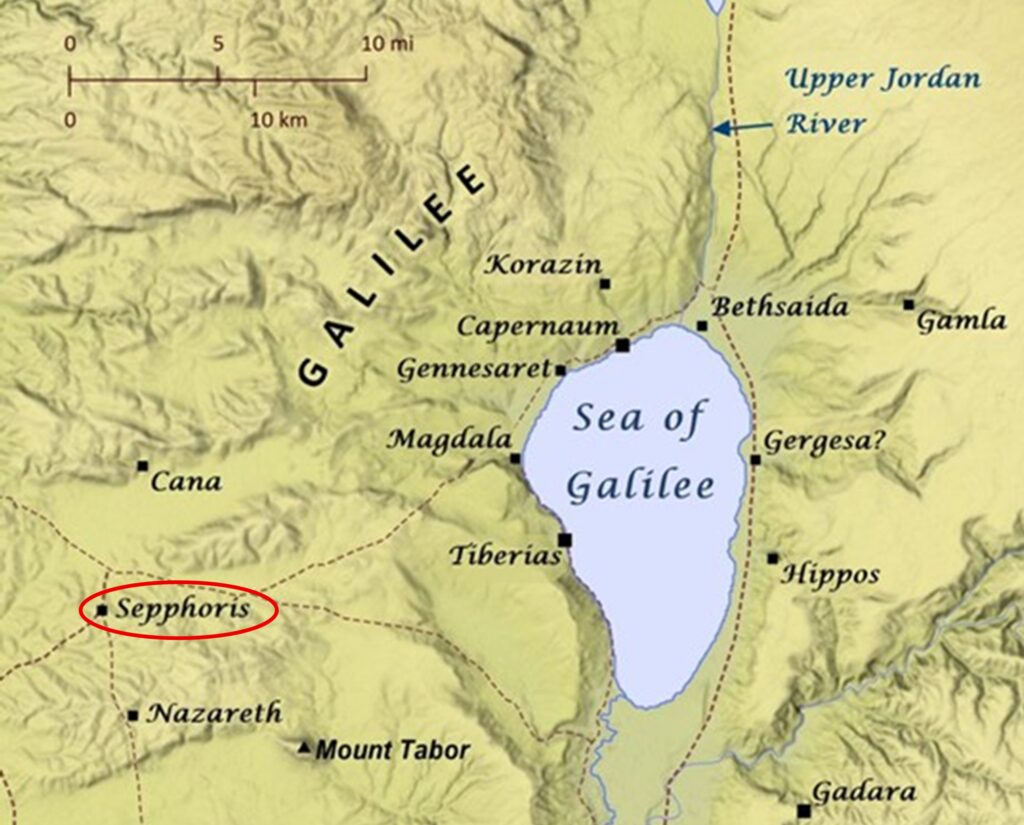
Located about 8 kilometers north of Nazareth, Sepphoris was visible from the heights of the village of Joseph and Mary. Under the reign of Herod Antipas, it became one of the main administrative cities of Galilee and underwent significant urban development. Rebuilt after the unrest that followed the death of Herod the Great, it gradually took on the characteristics of a city strongly influenced by Greco-Roman culture. Greek held an important place there in commercial and administrative exchanges.

This situation contrasts sharply with that of Nazareth, which at that time seems to have been only a modest rural village made up of a few dwellings, some of them hollowed out of the rock. Work opportunities there were probably limited for craftsmen like Joseph and Jesus, described by the Greek term tekton (Matthew 13.55 ; Mark 6.3). It therefore seems plausible that Joseph had to turn to the large building projects of Sepphoris in order to provide for his family’s needs. The relatively short distance — about two hours’ walk — makes this hypothesis particularly credible.

In this context, it is not unreasonable to think that Jesus himself accompanied Joseph and took part in this craft activity during his youth. Such an experience could have brought him into contact with a more cosmopolitan urban environment, where Greek and Roman influences were more marked than in Nazareth. This might also explain, at least in part, a certain familiarity with the Greek language and with the more varied social realities that are sometimes found in his teachings and his .

Sepphoris, called Tzippori in Hebrew, also held an important place during the Second Temple period and the Roman era. The numerous archaeological excavations carried out on the site have uncovered public buildings, wealthy residential districts, shops, a theater and remarkable mosaics. These discoveries help us better understand the cultural, social and political context of Galilee in the time of Jesus.

Certain late traditions, although not attested by the Gospels, also associate Sepphoris with Mary’s family. However, no biblical text allows us to confirm this hypothesis with certainty.

An important question remains: why does a city so close and so influential remain absent from the Gospel accounts? Several explanations may be considered. The Gospels often seem to favor the villages and modest populations of Galilee over the large centers strongly marked by Greco-Roman influence. It is also possible that Jesus deliberately limited part of his ministry to small Jewish towns, in keeping with the primary orientation of his mission toward “the ” (Matthew 15.24). The silence of the Gospels concerning Sepphoris therefore does not necessarily mean a total absence of contact with this city, but may reflect a narrative and theological choice on the part of the biblical authors.

II. The carpenter’s son

Joseph worked as a carpenter or, more broadly, as a building craftsman, as indicated by the Greek term tekton used in the Gospels (Matthew 13.55 ; Mark 6.3). In first-century Jewish society, it was natural for a father to pass on his skills to his sons in order to ensure the continuity of the family business.

Jesus therefore seems to have learned this trade very early from Joseph and to have gradually taken part in the family’s daily work.

This craft activity probably involved regular trips to the neighboring cities that were then developing rapidly, notably Sepphoris. We have already considered the hypothesis that Joseph owned a cart for transporting wood, tools or the materials needed for his work. Such a construction would not have been a major difficulty for a craftsman skilled in woodworking.

Moreover, one element in the Gospel accounts is particularly striking: while Mary is frequently mentioned, either by name or as “the mother of Jesus” (John 2.1 ; John 19.25), Joseph disappears entirely from the accounts after the episode of Jesus’ stay in the Temple at the age of twelve (Luke 2.41-52). This absence has led many exegetes to consider that Joseph died relatively early, before the beginning of Jesus’ public ministry.

If this hypothesis is correct, Jesus, as the eldest son, would probably have assumed for several years the material and social responsibility for the family. In the Jewish culture of the time, this role naturally fell to the eldest son after the father’s death. Such a situation could explain why Jesus began his public ministry only at about thirty years of age (Luke 3.23), a relatively late age compared with other religious movements of the time.

This family responsibility also helps us better understand certain details in the Gospels. The inhabitants of Nazareth know Jesus above all as “the carpenter” (Mark 6.3) or as “the carpenter’s son” (Matthew 13.55). These expressions show that before being recognized as a preacher and a wonder-worker, Jesus was identified as a craftsman integrated into the local economic life.

Thus, far from being insignificant, this silent period of Jesus’ life seems to reveal an existence marked by manual labor, family responsibilities and probably trips to the large neighboring centers such as Sepphoris. This context sheds new light on the social and human environment in which Jesus the Messiah grew up before the beginning of his public ministry.

III. Why is the name of Sepphoris not mentioned in the Gospels?

If, as we suppose, Jesus the Messiah frequented the city of Sepphoris during his youth or in the course of Joseph’s professional activity, it is remarkable that no event reported by the Gospels explicitly takes place there. This absence can be explained in several ways.

First of all, the authors of the Gospels seem to have selected places mainly according to their importance in the course of Jesus’ public ministry and their theological significance. Thus, some cities that were important politically or economically are never mentioned, while much more modest localities occupy a central place in the Gospel accounts (John 2.1 ; Luke 7.11).

Moreover, Sepphoris had a strongly Hellenized and character. Although a Jewish population was present there, the city was largely influenced by Greco-Roman culture. Greek held an essential place there in commercial and administrative exchanges, unlike the Jewish villages of Galilee where Aramaic remained the dominant everyday language.

This cultural situation could partly explain the silence of the Gospels. The ministry of Jesus the Messiah seems indeed to have developed mainly in the villages and rural regions of Galilee, among modest Jewish populations (Matthew 4.23 ; Matthew 15.24). The large cities marked by the Roman presence appear relatively rarely in the Gospel accounts, with the exception of unavoidable centers such as Jerusalem or Caesarea.

It should also be remembered that relations between practicing Jews and pagan or strongly Hellenized populations often remained limited at that time. Although not entirely nonexistent, cultural and religious contacts were sometimes marked by a certain mutual distrust (John 4.9). In this context, cities like Sepphoris could be perceived by some devout Jews as cultural centers less favorable to the preservation of Jewish religious identity.

Finally, the silence of the Gospels concerning Sepphoris does not necessarily mean that Jesus never went there. The biblical authors do not claim to report all the travels or activities of Christ (John 21.25). It is therefore possible that this city simply formed part of the daily setting of his youth without having played a direct role in the events retained by the evangelists.

Conclusion

We therefore conclude that Joseph was probably compelled to look for work in Sepphoris, simply because the craft activity of the small village of Nazareth was not enough to provide for his family’s livelihood. In this context, it seems likely that Jesus too took part in this work for many years, in keeping with the family customs of the time (Matthew 13.55 ; Mark 6.3).

Such a situation would have enabled Jesus to acquire not only solid experience in manual labor, but also a certain familiarity with the cultural and linguistic environment of Hellenized Galilee. The proximity of Sepphoris, a city largely influenced by Greco-Roman culture, makes a practical knowledge of Greek plausible, a language commonly used in commercial and administrative exchanges. This skill may have been useful to him later, notably during his trial before Pontius Pilate (John 18.33-38).

Moreover, several journeys mentioned in the Gospels probably led Jesus to pass through or alongside the region of Sepphoris. The route linking Nazareth to (John 2.1) most likely passed in the immediate vicinity of this great Galilean city. Yet, despite this geographical proximity, no important scene of Jesus’ public ministry is explicitly set there.

This silence of the Gospels can be explained by several factors. Sepphoris was above all a city strongly marked by Roman and Hellenistic influence, even though a large Jewish population also lived there. Now, the ministry of Jesus the Messiah seems to have been oriented mainly toward the Jewish villages and populations of Galilee (Matthew 15.24). The evangelists probably favored the places directly connected with the proclamation of the Kingdom of God and with the events they considered theologically significant.

Furthermore, the Gospels remain very discreet about the greater part of Jesus’ life before the beginning of his public ministry (Luke 2.52). It is therefore not surprising that a city like Sepphoris, even though important in his daily surroundings, is never mentioned explicitly.

Finally, the absence of any reference to Sepphoris in the apostolic writings is not surprising. The New Testament does not seek to draw up an exhaustive geography of Galilee, but to transmit the events considered essential for understanding the mission of Christ. Thus, the anonymity of this great Galilean city does not in any way diminish its probable importance in the historical, economic and cultural setting of Jesus’ youth.