John’s prologue differs markedly from Luke’s. He draws on his memories and also has documents at his disposal. It is clear that he took notes on key moments in the ministry of Jesus the Messiah. He was familiar with the accounts of Matthew, Mark and even Luke. What we have here is testimony, but also an argument intended to demonstrate that Jesus the Messiah is the Son of God, foretold since the foundation of the world.
Unlike Luke, John does not merely recount episodes from the life of Jesus the Messiah; he pursues a specific purpose: to persuade his readers that this Jesus the Messiah, alongside whom he lived for three and a half years, truly is the Son of God who came to save humanity. His reasoning goes further, categorically affirming that Jesus the Messiah is God himself. We can therefore expect this writing to defend that claim throughout.
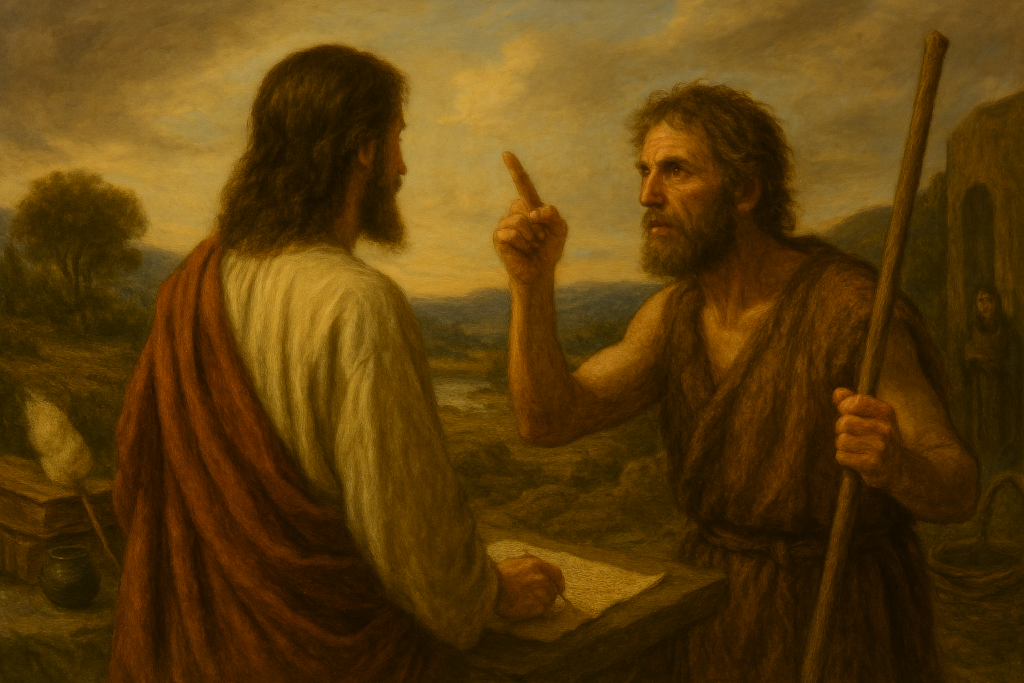
John clearly affirms that Jesus is the Word made flesh, existing from all eternity, and presents John the Baptist as the forerunner, the one who proclaims the coming of the Messiah in the wilderness. The author, John, takes care to distinguish their roles clearly: there is the light, and there is the one who bears witness to that light.
By the time John writes these lines, Jesus the Messiah and John the Baptist are no longer present. It is impossible to ignore the tensions that existed between the disciples of John the Baptist and those of Jesus the Messiah (John 3.25-29). Addressing everyone, including the disciples of John the Baptist, the apostle John emphasises that John was a great prophet, but that Jesus is the Messiah as king, and that he is therefore the one to follow.
The Qumran manuscripts reveal that the Jews of that time were expecting two messianic figures: a priestly messiah and a royal messiah. The clarifications John provides thus make perfect sense.