ANN113

The multiplication of the loaves

This article analyzes the Gospel accounts of the multiplication of the loaves, in which Jesus feeds thousands of people with little food. The differences and similarities between Matthew, Mark, Luke and John are examined to demonstrate the agreement of the Gospels regarding the divine power and compassion of Jesus.

17 min Jesus multiplication of the loaves miracle Gospels 17 verses 4 books

Further information

Introduction

The Gospels contain accounts that resemble one another but also present significant differences, which some critics regard as contradictions. The example of the anointing of Jesus illustrates this phenomenon (see the appendix ANN088 : The two anointings). How should these divergences be interpreted? Is it possible that the authors made mistakes?

The episode of the merchants driven out of the Temple (see the appendix ANN075 : The merchants driven out of the Temple) has given rise to many conflicting discussions.

In this study, we will analyze the multiplication of the loaves and fishes, showing that the Messiah Jesus performed two similar miracles on distinct occasions. We will also provide irrefutable proof that this event took place at two different times.

We maintain our position that there are neither errors nor contradictions in our Gospels. The studies carried out so far increasingly confirm this conclusion.

I. The first multiplication of the loaves and fishes

You can read the Pericope PER169 : The multiplication of the loaves for the 5,000 people.

Matthew 14.15-21, Mark 6.33-44, Luke 9.12-17, John 6.5-13.

This event clearly made an impression on the apostles, and all four Gospel authors report it. This first event takes place near , on the other side of the Jordan River, in the Decapolis.

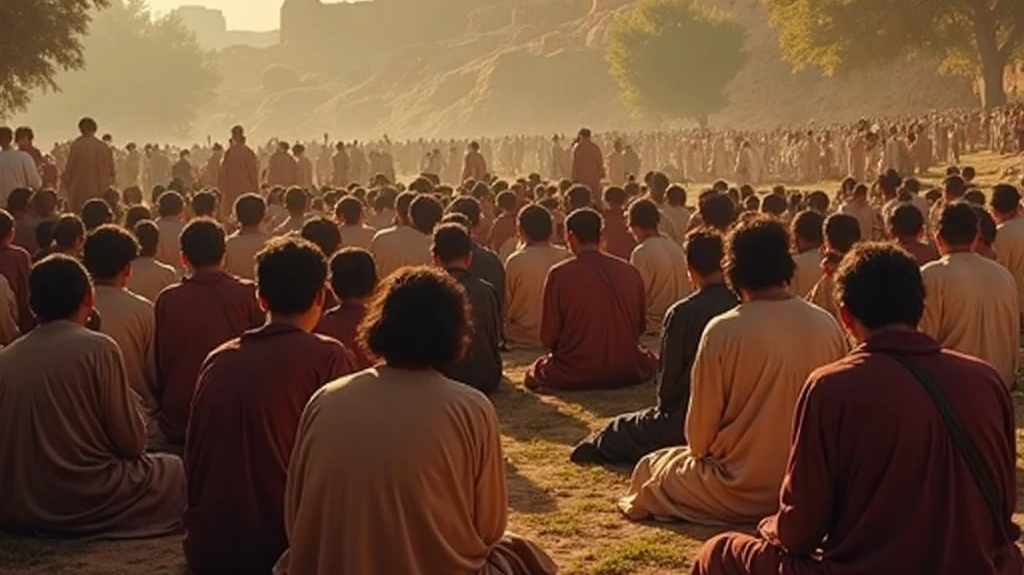
  • Matthew 14.15-21 : The Messiah Jesus, after hearing of the death of John the Baptist, withdraws to a desert place. A crowd follows him, and he heals the sick. When evening comes, the disciples suggest that he send the crowd away so that they can find food, but Jesus tells them to give them something to eat themselves. With five loaves and two fish, he feeds about 5,000 men, besides women and children.
  • Mark 6.33-44 : The Messiah Jesus and his disciples try to rest, but the crowd joins them. Moved with compassion, he teaches them at length. In the evening, the disciples tell him about the lack of food. Jesus has the people sit down in groups, blesses the loaves and the fish, and distributes them. Everyone eats until satisfied, and twelve baskets of pieces are left over.
  • Luke 9.12-17 : The Messiah Jesus teaches the crowd near . The disciples suggest that he send the people away so that they can find food, but Jesus tells them to feed them. With five loaves and two fish, he feeds 5,000 men, and twelve baskets of pieces are left over.
  • John 6.5-13 : The Messiah Jesus asks Philip how to feed the crowd. Andrew mentions a boy who has five barley loaves and two fish. Jesus has the people sit down, blesses the food and distributes it. Everyone eats as much as they want, and twelve baskets of pieces are left over.

Comparison

  • Similarities :
    • The Messiah Jesus feeds 5,000 men with five loaves and two fish.
    • He blesses the food before distributing it.
    • Twelve baskets of leftovers are gathered.
    • The event takes place in a desert place.
    • Jesus acts with compassion toward the crowd.
  • Differences:
    • John mentions a boy who has the loaves and the fish.
    • Mark specifies that the people are seated in groups on the green grass.
    • Matthew and Luke emphasize the healing of the sick before the meal.
    • John emphasizes the interaction between the Messiah Jesus and Philip.

This miracle highlights the divine power of the Messiah Jesus and his concern to feed spiritually and physically those who follow him. It also shows the compassion of the Messiah Jesus toward this crowd. We think that not all these individuals fully grasped the magnitude of the miracle performed by the Messiah Jesus. They simply ate the food, perhaps wondering how the disciples of Jesus could have had such a large quantity of it.

So this is the first multiplication of the loaves. After this extraordinary event, the apostles will set off again by boat toward Gennesaret. They surely never forgot that crossing (read the Pericopes PER170- The conclusion of the crowd ; PER171- The Messiah Jesus and Peter walk on the water and PER172- The reaction of the apostles).

II. The second multiplication of the loaves and fishes

You can read the Pericope PER169 : The multiplication of the loaves for the 5,000 people.

Matthew 15.32-38 and Mark 8.1-9.

This time only Matthew and Mark report this other event. It takes place on the shores of the in the region of Capernaum.

  • Matthew 15.32-38 : The Messiah Jesus, seeing the crowd hungry after three days, expresses his compassion. The disciples doubt that they can feed so many people. Jesus takes seven loaves and a few fish, blesses them and distributes them. Everyone eats until satisfied, and seven large baskets of pieces are left over.
  • Mark 8.1-9 : The Messiah Jesus, moved by the hunger of the crowd, asks the disciples what they have. With seven loaves and a few small fish, he blesses the food and distributes it. 4,000 men are fed, and seven large baskets of leftovers are gathered.

Comparison

  • Similarities :
    • The Messiah Jesus feeds 4,000 men with seven loaves and a few fish.
    • He blesses the food before distributing it.
    • Seven large baskets of leftovers are gathered.
    • The event takes place in a desert place.
    • Jesus acts with compassion toward the crowd.
  • Differences :
    • Matthew specifies that the crowd stayed three days with Jesus.
    • Mark mentions that the fish are small.
    • Matthew emphasizes the disciples' doubt about the possibility of feeding the crowd.

In this particular case we note that, while Matthew and Mark describe the same event, they also communicate different but complementary information.

So this is the second time, according to our analyses, that the Messiah Jesus performs a multiplication of the loaves and fishes.

III. Some observations

These two accounts present similarities, notably regarding the basic food. This is hardly surprising, since these were common foods for the population of the time, namely dried fish and bread. In the region of Capernaum, there were fish-processing plants where the fish were dried and salted to preserve them, this method being the only one available at that time.

When the Master asks his disciples to check their provisions in order to feed the crowd, they answer immediately without needing to inquire. This reaction raises a question: did they anticipate this request, or do the accounts, which are often summaries of the situation, not mention this preparatory step?

We understand the dismay and lack of faith at the first event, but at the second miracle, the disciples should have remembered the first. The doubts expressed by Matthew 15.33, who was present, are surprising. They should have made the connection between the two miracles.

Even Mark, Peter's scribe, expresses reservations and specifies that the fish were small. This detail seems out of place on the lips of the disciples, since even if they had been large, they would not have been enough to feed the 4,000 people present, not counting the women and children.

We found that this intervention became indispensable because of the crowd's presence for three days. The men, women and children listened to the Master during this period, sleeping on the spot. Although they had brought supplies of food, these were almost exhausted after the three days, making the intervention of the Messiah Jesus absolutely necessary.

IV. The irrefutable proof

The Messiah Jesus clearly refers to the in:

Matthew 16.9-11 (King James Version) :
Do ye not yet understand, neither remember the five loaves of the five thousand, and how many baskets ye took up?Neither the seven loaves of the four thousand, and how many baskets ye took up?How is it that ye do not understand that I spake it not to you concerning bread, that ye should beware of the leaven of the Pharisees and of the Sadducees?

This passage shows that the Messiah Jesus clearly distinguishes the two miracles, confirming that this is not a repetition of the same event but two distinct multiplications.

It is worth reflecting on the potential implications of the absence of the testimony of Matthew 16.9-10. It would probably have led some to conclude that there were contradictions, thus generating many debates. However, Matthew's statements have provided clarification of this situation.

Conclusion

We have easily demonstrated that this event occurred twice, based on the statements of Matthew 16.9-10. The words of the Messiah Jesus thus constitute irrefutable proof, although it is the only example identified in the Gospels. In all other cases, it is necessary to examine each detail carefully in order to determine whether the reported facts are distinct or identical.

This fact shows that similar events may in reality represent distinct facts. This should not surprise us, because according to John 21.25, the number of miracles reported in the Gospel texts, which is 40 according to our research, is an insignificant fraction of what actually took place.

It is regrettable that some commentators mention contradictions or errors in the texts of the Gospels, which are an integral part of the Bible, regarded as the Word of God for all.