
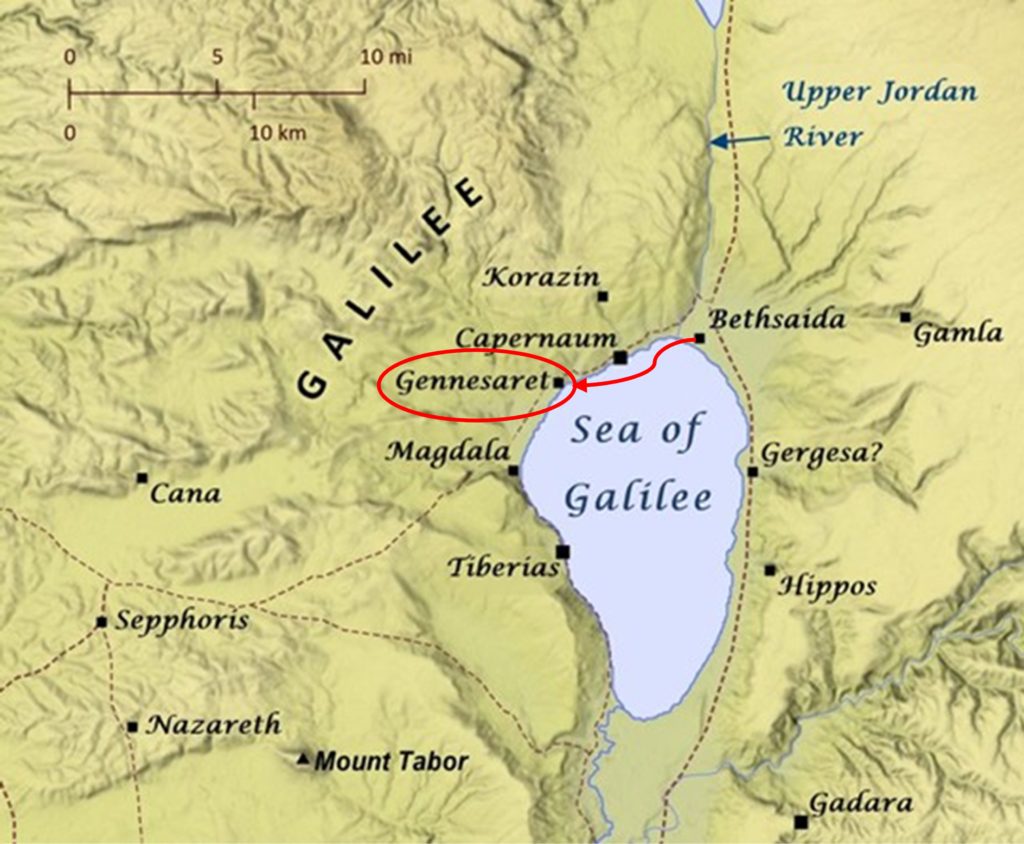
The day had been marked by extraordinary events, drawing a considerable crowd. The crowd pressed upon the Messiah Jesus and his apostles, so much so that at one point the Master invited his disciples to get into a boat to return to Capernaum, while he would see to dispersing the crowd. The apostles probably assumed that he would take another boat afterward.
Let us now compare the three texts, Matthew 14.22-32, Mark 6.45-52, John 6.16-21.
Matthew 14.22-32
This passage is found in the Gospel according to Matthew and is the most detailed of the three accounts. Here are the key points:
- Context and Introduction : After feeding the five thousand, Jesus orders his disciples to get into a boat and cross the lake while he sends the crowds away.
- The Messiah Jesus praying : The Messiah Jesus goes up on the mountain to pray alone.
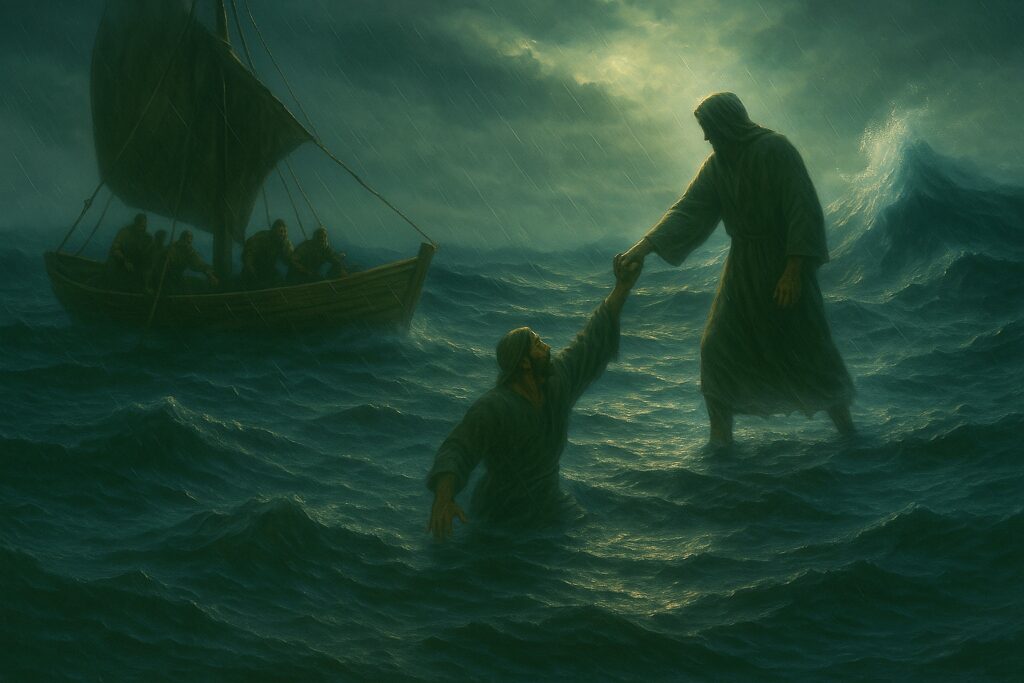
- Storm on the lake : The disciples struggle against a sea churned up by the wind.
- The Messiah Jesus walking on the water: Toward the end of the night, the Messiah Jesus walks on the water to reach the disciples.
- Reactions of the disciples: At first they think they see a ghost and cry out in fear.
- Invitation to Peter: Peter asks the Messiah Jesus to command him to walk on the water to come to him. The Messiah Jesus agrees.
- Peter walks on the water: Peter walks on the water but begins to sink as he doubts. The Messiah Jesus catches him and says: “You of little faith, why did you doubt?”
- Return to the boat: When they get into the boat, the wind falls calm.
Mark 6.45-52
Mark’s account is more concise and focuses on the essentials:
- Context: After the , the Messiah Jesus makes his disciples get into the boat and go ahead to while he sends the crowd away.
- The Messiah Jesus praying : The Messiah Jesus goes up on a mountain to pray.
- Storm on the lake : The boat is in the middle of the lake and the disciples strain against the wind.
- The Messiah Jesus walking on the water: Around the fourth watch of the night, the Messiah Jesus comes toward them, walking on the water.
- Reactions of the disciples : They take him for a ghost and cry out.
- Reassurance from the Messiah Jesus: The Messiah Jesus speaks to them immediately and reassures them: “Take courage, it is I; do not be afraid!”
- Getting into the boat : The Messiah Jesus gets into the boat with them, and the wind subsides. The disciples are utterly amazed, for they had not understood the miracle of the loaves.
John 6.16-21
The Gospel of John also offers a concise version, but with interesting variations:
- Context: After feeding the five thousand, the disciples go down to the lakeshore and get into a boat to cross over to Capernaum.
- The Messiah Jesus absent: It is already dark and the Messiah Jesus has not yet joined them.
- Storm on the lake: The sea is stirred up by a strong wind.
- The Messiah Jesus walking on the water : When they have rowed about twenty-five or thirty stadia, they see the Messiah Jesus walking on the water and approaching the boat.
- Reactions of the disciples : They are afraid, but the Messiah Jesus tells them: “It is I; do not be afraid.”
- Getting into the boat: They want to take him into the boat, but immediately the boat reaches the land to which they were going.
Comparison and Analysis
- Context and Setting of Prayer: The three accounts agree that the event follows the , and that the Messiah Jesus withdraws alone to pray.
- Storm and the Disciples’ Struggle: All mention a rough sea and the disciples meeting with difficulty.
- Appearance of the Messiah Jesus : In all three accounts, the Messiah Jesus walks on the water and the disciples think they see a ghost before he reassures them.
- Peter walking on the water: This detail, unique to Matthew, highlights Peter’s faith and doubts.
- Calming of the storm: After the Messiah Jesus gets into the boat, the wind falls calm in Matthew and Mark. John omits this detail.
- Amazement of the disciples : Mark stresses that the disciples do not yet fully grasp the meaning of the miracles of the Messiah Jesus, whereas this point is less explicit in Matthew and John.
- Immediate destination: John adds a further miraculous detail: the boat immediately reaches the land when they receive the Messiah Jesus.
Each gospel brings specific nuances that enrich the overall account and highlight different aspects of the disciples’ experience and of the divine nature of the Messiah Jesus. Matthew emphasizes Peter’s faith, Mark the disciples’ lack of understanding in the face of the miracles, and John the sovereignty of the Messiah Jesus over nature.
John then reports that the crowd was looking for the Messiah Jesus and his disciples. It is noted that they had clearly observed that the disciples had left in the only boat available, while the Messiah Jesus had not gone with them.
John also mentions the arrival of several boats from Tiberias, which testifies to the great attraction the Messiah Jesus held for the crowds of the surrounding area, all of whom longed to meet him.
Finally, John indicates that all these people decided to go to Capernaum, aware that this town was the residence of the Messiah Jesus and his disciples.
John probably obtained this information from people who had arrived in Capernaum.