
The first account of a and fish is found in: Matthew 14.15-21, Mark 6.33-44, Luke 9.12-17 and John 6.5-13.
You can consult the pericope PER169 : The multiplication of the loaves for the 5,000 people
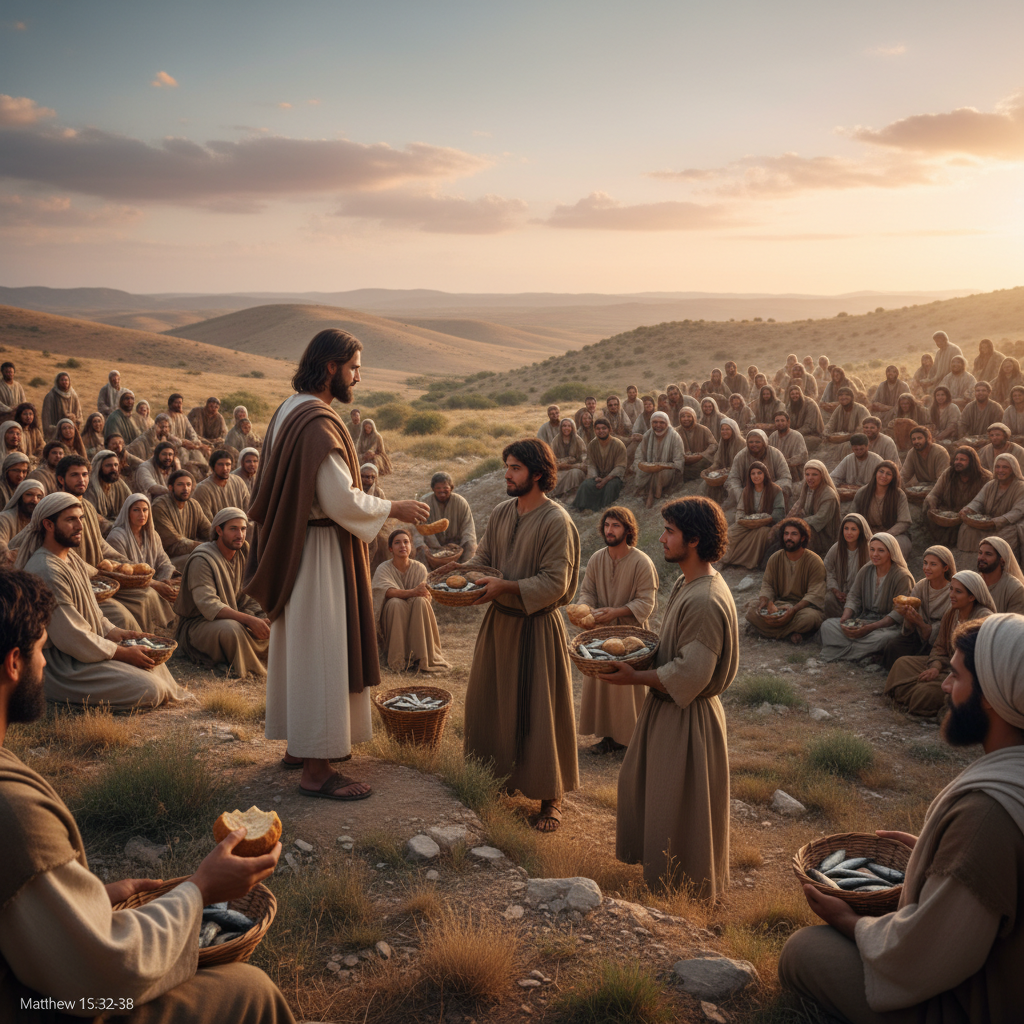
The passages of Matthew 15.32-38 and Mark 8.1-9 relate the account of the second performed by the Messiah Jesus to feed a great crowd that had come to listen to him. Although these two texts describe the same event, they present nuances that deserve to be analyzed.
Summary of the texts
In Matthew 15.32-38, the Messiah Jesus expresses his compassion for the crowd that has been following him for three days and is suffering from hunger. He asks his disciples how much food is available, and they answer that they have only seven loaves and a few small fish. Jesus then orders the crowd to sit down, takes the food, blesses it, and then distributes it, thus feeding about four thousand men, not counting women and children. At the end of the meal, seven baskets of leftovers are gathered.
Mark 8.1-9 reports a similar scene, with a crowd that is hungry after three days spent with the Messiah Jesus. As in Matthew, the Messiah Jesus shows his concern for these people before acting. The disciples answer in the same way when he asks them whether they are able to feed the multitude. The Messiah Jesus then takes the seven loaves and a few small fish, blesses them and distributes them, thus feeding about four thousand people. The leftovers are likewise gathered in seven baskets.
Comparison of the texts
In substance, the two accounts are almost identical and highlight the Messiah Jesus' concern and his power to multiply food. However, a few differences of form and style can be noted:
- The expression of Jesus' compassion : In Matthew, the Messiah Jesus takes the initiative by first expressing his concern, whereas in Mark this concern is emphasized more in the structure of the account.
- The role of the disciples : In Mark, they seem more perplexed by the Messiah Jesus' request, expressing their doubt as to how to feed such a large gathering. In Matthew, their answer is more matter-of-fact.
- The narrative style : Mark often stands out for a more dynamic and concise style, whereas Matthew offers a slightly more detailed narrative.
- The numbers and details : Both accounts agree on the number of loaves and fish available, the number of people fed, and the number of baskets collected after the meal.
These passages, taken from the synoptic Gospels, reflect a faithful transmission of the event while preserving the particular features of each evangelist. They illustrate the power of the Messiah Jesus and his ability to provide for those who follow him, while highlighting the importance of trusting in him despite the apparent insufficiency of resources.
It should be noted that neither Luke nor John included this event in their accounts. This is probably because they had already covered the first multiplication and considered the two events too similar. They were bound to observe space limitations in their testimonies because of the publishing constraints of the time.
Please consult the appendix ANN046 : The technical requirements of publishing in the first century for additional information.