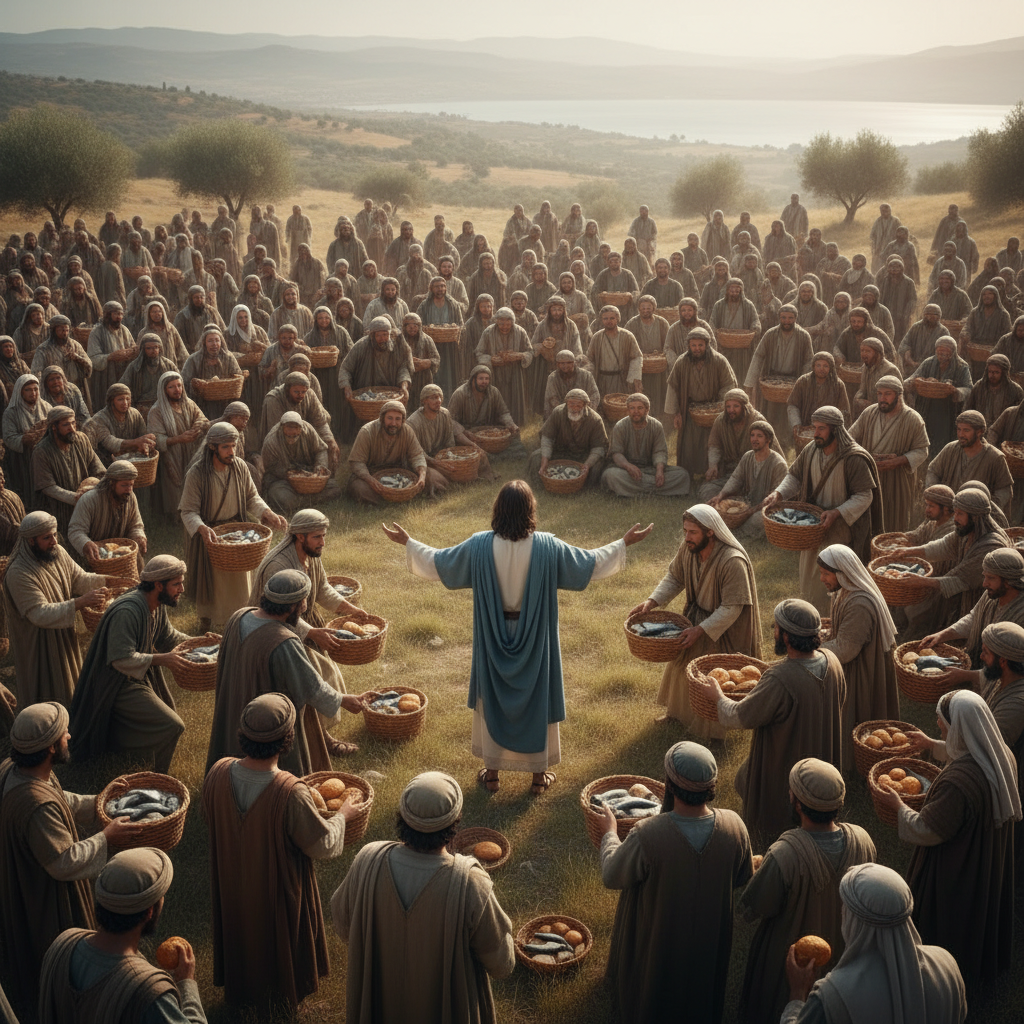

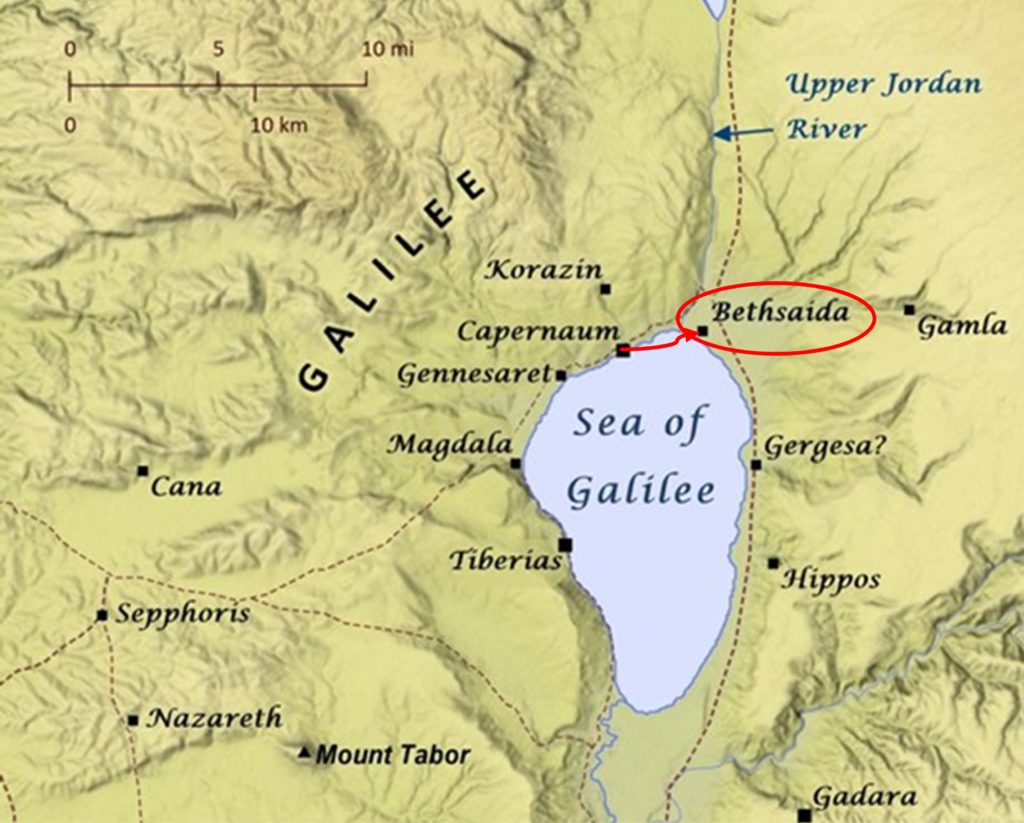
After a period of rest (PER167), the crowd begins to arrive and gather in great numbers. The Messiah Jesus then teaches the crowd, and time passes until the day begins to decline. The apostles suggest sending the crowd away so that everyone can go home to find food. It is stated that there are about 5,000 men, not counting women and children.
According to Mark, the disciples reckon that 200 silver coins would be needed to buy enough bread to feed the whole crowd. This situation highlights a major difficulty that exceeds their financial resources, thus illustrating the limitations inherent in the human condition.
However, the Messiah Jesus said to his apostles: “You give them something to eat.” Andrew then points out a detail to inform the Master that the solution is far from found: they have only five loaves and two fish.
The four texts are consistent and present no difficulty.
The Messiah Jesus knew that he was about to perform a great miracle. Let us now compare the four texts:
Matthew 14.13-21
Context:
- Jesus withdraws by boat to a desolate place after learning of the death of John the Baptist.
- A great crowd follows him on foot.
Action:
- Jesus heals the sick among the crowd.
- His disciples tell him that it is late and ask him to send the crowd away so that they can go and buy food.
- Jesus asks them to give the crowd something to eat themselves.
- They have five loaves and two fish.
- Jesus blesses and breaks the loaves and the fish.
- About 5,000 men, not counting women and children, are fed.
- Twelve baskets full of pieces are left over.
Mark 6.30-44
Context:
- The disciples tell Jesus everything they had done and taught.
- Jesus invites them to rest in a desolate place.
- A great crowd follows them.
Action:
- Jesus has compassion on the crowd because they were like sheep without a shepherd.
- He begins to teach them many things.
- It is late and the disciples suggest sending the crowd away so that they can buy food.
- Jesus asks them to give the crowd something to eat themselves.
- They have five loaves and two fish.
- Jesus blesses and breaks the loaves and the fish.
- About 5,000 men are fed.
- Twelve baskets full of pieces are left over.
Luke 9.10-17
Context:
- The disciples report to Jesus what they had done.
- Jesus takes them aside and withdraws to a desolate place near .
- The crowd follows him.
Action:
- Jesus welcomes the crowd, speaks to them about the kingdom of God and heals the sick.
- The day begins to wane and the disciples ask Jesus to send the crowd away so that they can find food and lodging.
- Jesus asks them to give the crowd something to eat themselves.
- They have five loaves and two fish.
- Jesus blesses and breaks the loaves and the fish.
- About 5,000 men are fed.
- Twelve baskets full of pieces are left over.
John 6.1-14
Context:
- Jesus withdraws to the other side of the (or Sea of Tiberias).
- A great crowd follows him because of the miracles he had performed on the sick.
Action:
- Jesus goes up on the mountain and sits down with his disciples.
- The Passover, the feast of the Jews, is near.
- Jesus tests Philip by asking him where to buy bread to feed the crowd.
- Philip answers that a great deal of money would be needed to buy enough bread.
- Andrew points out a boy with five barley loaves and two fish.
- Jesus blesses and breaks the loaves and the fish.
- About 5,000 men are fed.
- Twelve baskets full of pieces are left over.
- The crowd, impressed, wants to make Jesus their king.
Common Points:
Context of the Withdrawal :
The Messiah Jesus withdraws with his disciples to a desolate place after performing miracles or after being informed of the death of John the Baptist.
Great Crowd :
A great crowd follows Jesus and his disciples on foot.
Compassion of the Messiah Jesus:
The Messiah Jesus shows compassion by healing the sick and teaching the crowd.
Miraculous Meal :
The disciples suggest sending the crowd away to buy food.
The Messiah Jesus asks them to feed the crowd themselves.
There are five loaves and two fish available.
The Messiah Jesus blesses and breaks the loaves and the fish, and distributes them.
About 5,000 men are fed, and twelve baskets full of pieces are left over.
Differing Points:
Gospel of John :
-
- Testing of Philip: Jesus tests Philip by asking him where to buy bread.
- Identification of the Boy: Andrew points out a boy with the five loaves and the two fish.
- Going Up the Mountain: Jesus goes up on the mountain and sits down with his disciples.
- Reaction of the Crowd: The crowd wants to make Jesus their king after the miracle.
Gospel of Mark and of Luke:
-
- Teaching: Mark mentions that Jesus teaches the crowd before feeding them.
- Location: Luke specifies that the event takes place near .
These accounts, while presenting some variations in the details, all converge on the fundamental elements of the event and convey a message of abundance and divine compassion. They show the power of the Messiah Jesus to feed a great crowd with limited resources and reveal his deep compassion for the physical and spiritual needs of the crowd.
We can also consider another message, to the apostles, which would be the following: keep faith in every circumstance, for I have the power to meet all your needs. There is a second account of the by the Messiah Jesus, reported in Matthew 15.32-39 and Mark 8.1-10. These two events must not be confused, because Jesus explicitly refers to them in Matthew 16.9-10 and Mark 8.19-20.
We note that everyone remembered the number of baskets of food left over after the crowd had been fed. In other words, the Organizer abundantly met the needs, leaving surpluses of food that were not wasted. It is likely that these surpluses were distributed to needy families.