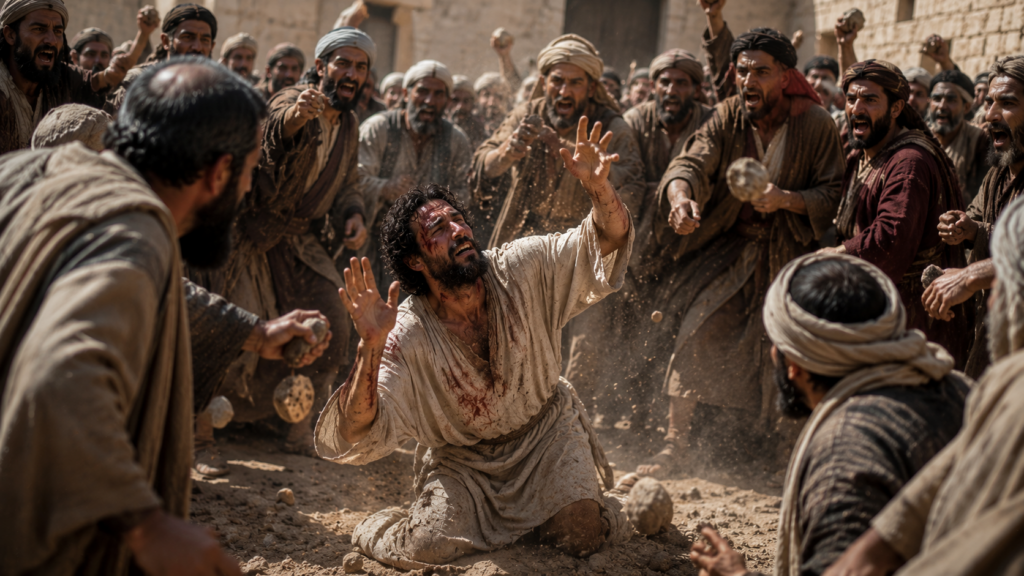
The account of Acts 7.54-60 marks the culmination of the confrontation between Stephen and his accusers. After hearing the reproaches the disciple addressed to the members of the (Acts 7.51-53), they are seized with violent anger. Luke describes their reaction by stating that they “ground their teeth at him” (Acts 7.54), an expression that evokes a deep hostility already known in the Old Testament (Psalms 35.16 ; Psalms 37.12).
The account gives the impression that events are gradually slipping out of control. Although the was made up of diverse sensibilities (Acts 23.6-10), one and the same fury now seems to unite Stephen's adversaries.
As at the trial of Jesus, the religious authorities seem to influence the crowd rather than follow a perfectly regular procedure (Matthew 27.20-24 ; Mark 15.11). Under Roman domination, the Jews normally no longer had the right to carry out a capital sentence without the agreement of the imperial power (John 18.31). The absence of a formal judgment or official sentence leads several commentators to regard Stephen's death more as an outburst of collective violence than as the normal outcome of a judicial procedure.
2- An execution with the appearance of legality
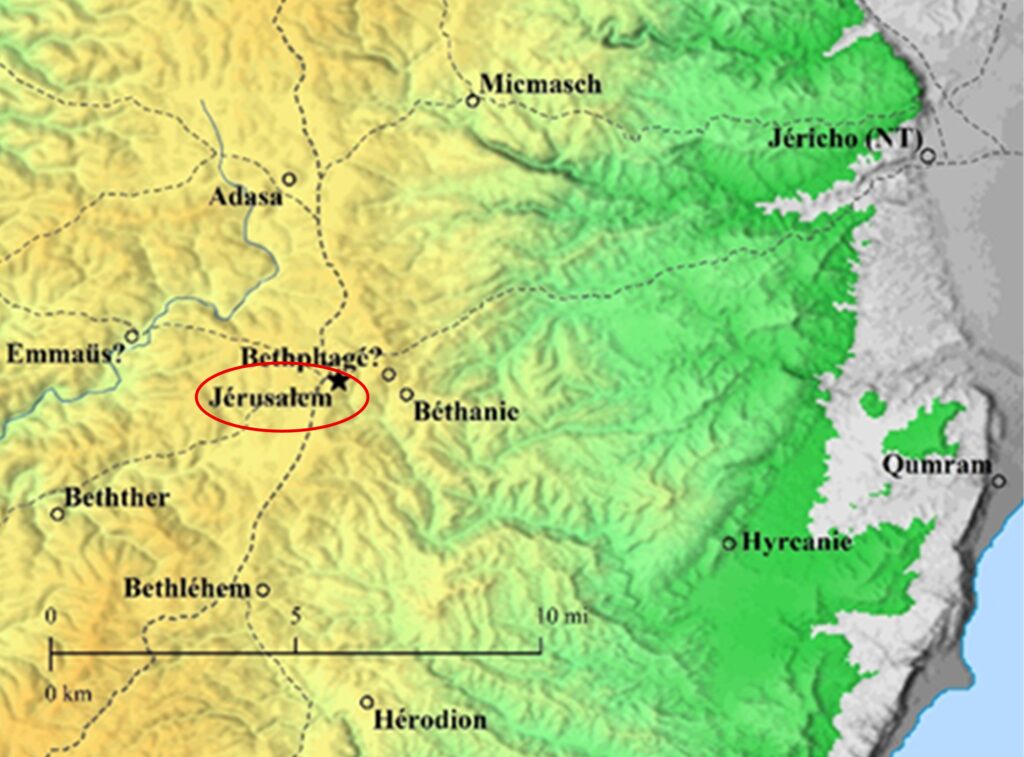
Stephen is taken outside the city, in accordance with the prescriptions of the Law (Deuteronomy 17.5). The witnesses lay down their garments (Acts 7.58), recalling the provision that the witnesses were to be the first to carry out the sentence (Deuteronomy 17.7).
However, although some elements recall the legal prescriptions, the account rather suggests a hasty and irregular action. The outward application of certain customs is not enough to conceal the violent and disorderly character of the events.
3- The vision of the glorified Son of Man
In the very midst of this violence, Stephen, full of the Holy Spirit (Acts 7.55), gazes at “the glory of God, and Jesus standing at the right hand of God.”
This vision confirms Jesus' declarations before the at his own trial (Mark 14.62) and recalls the royal promise of Psalms 110.1. From Luke's perspective, the one whom the religious authorities reject is precisely the one whom God has exalted.
The detail that Jesus is seen “standing” has sometimes been interpreted as an expression of his welcome or approval toward his faithful witness (Revelation 3.21). Such an interpretation nevertheless remains hypothetical, since the text itself does not specify the meaning of this posture.
4- Stephen in the image of his Master
In his passion, Stephen prays:
“Lord Jesus, receive my spirit” (Acts 7.59)
and:
“Lord, do not hold this sin against them” (Acts 7.60).
These words recall those of Jesus on the cross (Luke 23.34 ; Luke 23.46 ; Psalms 31.5). Luke thus establishes a particularly striking parallel between the Master and his disciple.
Like Jesus, Stephen shows complete trust in God and prays for his executioners. He thus appears as the first Christian martyr walking in the footsteps of the Lord and putting into practice the love of enemies taught by Jesus (Matthew 5.44).
5- “He fell asleep”
Luke does not say that Stephen died, but that “he fell asleep” (Acts 7.60).
This way of speaking is found frequently in the Scriptures to describe the death of believers (1 Kings 2.10 ; 1 Thessalonians 4.13-14). It underscores the hope of the resurrection and the certainty that death is not the ultimate end for those who belong to Christ (John 11.11 ; John 11.25-26).
6- The presence of Saul
Luke mentions that the witnesses laid down their garments at the feet of a young man named Saul (Acts 7.58) and specifies that he approved of this execution (Acts 8.1).
Later, Paul himself will acknowledge having persecuted the Church (Acts 22.20 ; Acts 26.9-11 ; 1 Corinthians 15.9 ; Galatians 1.13). It is possible that the memory of Stephen's witness helped to leave a deep mark on his conscience. However, nothing allows us to assert with certainty that this event played a direct role in his conversion on the road to Damascus (Acts 9.1-6).
7- The first Christian martyr
On the ecclesial level, Stephen inaugurates the history of Christian martyrdom. His witness already illustrates the paradoxical logic of the cross: what appears as a defeat becomes, in God's purpose, an instrument of progress for the Gospel.
The persecution that will follow his death will lead to the dispersion of the believers and promote the spread of the Christian message beyond Jerusalem (Acts 8.1-4), in keeping with the missionary program announced by Jesus (Acts 1.8).
Thus, from Luke's perspective, the death of the first martyr does not mark the failure of the nascent Church, but the opening of a new stage in the fulfillment of God's purpose.
(Acts 1.8) ; (Acts 8.1-4) – The dispersion of the believers and the expansion of the Gospel
(Acts 7.51-53) ; (Acts 7.54) – The anger of the against Stephen
(Acts 7.55) ; (Mark 14.62) ; (Psalms 110.1) ; (Revelation 3.21) – The vision of the glorified Son of Man
(Acts 7.58) ; (Acts 8.1) – The presence of Saul at the
(Acts 7.59) ; (Luke 23.46) ; (Psalms 31.5) – Committing one's spirit to the Lord
(Acts 7.60) ; (Luke 23.34) ; (Matthew 5.44) – Forgiving enemies
(Acts 22.20) ; (Acts 26.9-11) ; (1 Corinthians 15.9) ; (Galatians 1.13) ; (Acts 9.1-6) – Saul, persecutor and then apostle
(Acts 23.6-10) – The divisions within the
(Deuteronomy 17.5) ; (Deuteronomy 17.7) – The prescriptions concerning the
(John 11.11) ; (John 11.25-26) ; (1 Kings 2.10) ; (1 Thessalonians 4.13-14) – The sleep of believers and the hope of the resurrection
(John 18.31) ; (Matthew 27.20-24) ; (Mark 15.11) – The and the question of capital punishment
(Psalms 35.16) ; (Psalms 37.12) – The hatred of the wicked against the righteous
The
The