In a few verses, Luke reveals that the one chosen among the Seven (Acts 6.1-6) was by no means limited to a role of material assistance. Stephen also appears as a particularly active preacher and witness, carrying out a ministry that in several respects recalls that of the apostles.
Full of grace and power, he performs “great wonders and signs among the people” (Acts 6.8) and displays a wisdom inspired by the Holy Spirit that leaves his opponents unable to refute his arguments (Acts 6.10).
Luke thus shows that the proclamation of the Gospel and the exercise of spiritual gifts were not the exclusive preserve of the Twelve. Other disciples, also full of the Holy Spirit, took an active part in proclaiming the Christian message and building up the Church (Acts 8.5-8 ; Acts 11.19-21). The should therefore not be interpreted as a mere delegation of material tasks, but as the recognition of men called to carry out a genuine ministry within the Christian community.
2- The opposition of the Hellenistic Jews
Stephen's activity, however, provokes the opposition of several Hellenistic Jews belonging to the synagogues of the Freedmen, of the Cyrenians, of the Alexandrians, and of those from Cilicia and Asia (Acts 6.9).
The debates held with these men seem to turn quickly to their disadvantage, for they prove unable to withstand the wisdom and the Spirit by whom Stephen speaks (Acts 6.10). This situation recalls Jesus' promises to his disciples, to whom he had announced that he would give them a wisdom that their adversaries could not withstand (Luke 21.15).
Faced with their inability to refute his witness, the opponents abandon the field of discussion and resort to more questionable means.
3- The false witnesses
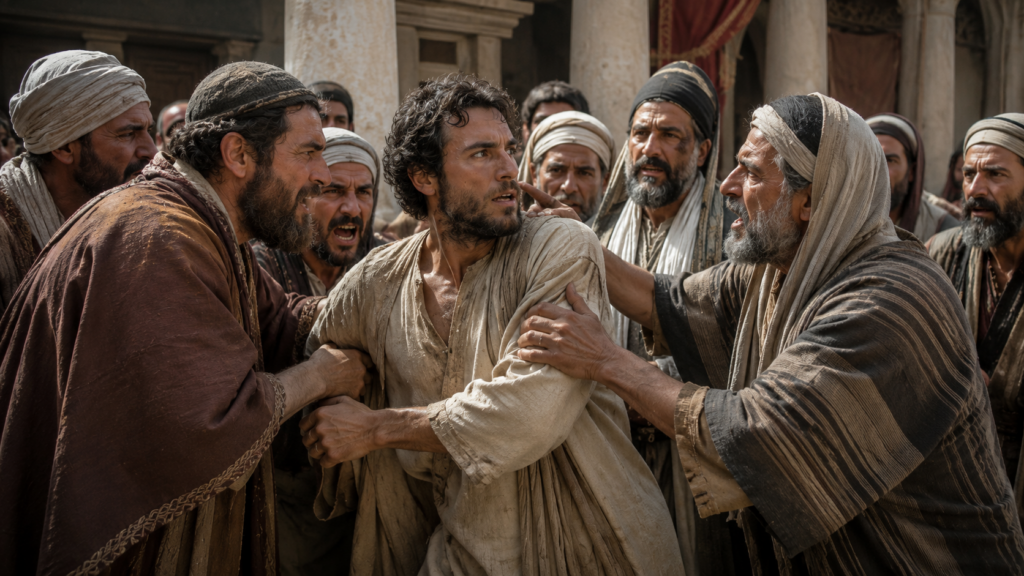
As at the trial of Jesus (Matthew 26.59-61), men are secretly bribed to give false testimony against Stephen (Acts 6.11-13). The accusations concern words allegedly blasphemous against Moses, the Law, and the Temple, that is, against the very foundations of Jewish religious identity.
Stephen's adversaries thus seek to turn a theological debate into a legal case capable of leading to an official condemnation. Once again, Luke underlines the resemblances between the fate of the disciple and that of his Master.
4- An opposition that spreads
Stephen thus becomes the first member of the Church, after the apostles, to appear before the . The same authorities who had already had Peter and John arrested (Acts 4.1-3), and then all the Twelve (Acts 5.17-18), are called upon once more.
Opposition to Christianity thus passes another stage. It no longer targets only the principal leaders of the Church but begins to extend to other disciples. The confrontation between the religious authorities and the Christian community now takes on a broader dimension.
It is remarkable that the initiative for this affair does not seem to come directly from the high priesthood or the , as in the earlier arrests, but from opponents from the Hellenistic milieu. It is they who stir up the people, the elders, and the scribes, organize the accusations, and present the false witnesses (Acts 6.12-13). The then appears as the judicial body responsible for examining these accusations.
5- An increasingly hostile climate
The religious climate then becomes more and more unfavorable to the Church. Despite the prudent advice of (Acts 5.34-39), nothing indicates that the opposition of the Sadducean authorities had truly eased. On the contrary, the events reported by Luke suggest that tensions continued to worsen.
Until then, the popularity of the apostles among the people had been a brake on harsher repression, as the authorities feared popular reactions (Acts 5.26). It is possible that the case of Stephen had different characteristics from the earlier arrests. Indeed, the initiative seems to come above all from opponents from the Hellenistic milieu, and not directly from the high priesthood or the .
It is not possible to determine with certainty the reasons that led the adversaries of Christianity to concentrate their attacks on Stephen. However, Luke's account hints at a gradual extension of the opposition. After targeting Peter, John, and the Twelve, the religious authorities now have to deal with another particularly influential representative of the Church in Jerusalem. Hostility toward the Christian movement is thus no longer limited to the apostles alone but tends to extend to the whole community.
6- A turning point in the book of Acts
The arrest of Stephen is a major turning point in the narrative of Acts. It foreshadows the dramatic events that will follow his condemnation and martyrdom, and prepares for the great persecution that will break out against the Church in Jerusalem (Acts 8.1-4).
Until now, the opposition of the religious authorities had been concentrated mainly on the apostles. With Stephen, it is now another leader of the Church who finds himself directly confronted with the . This development marks a new stage in the history of the first persecutions.
From Luke's perspective, however, these events have a deeper meaning. Persecutions are not an obstacle capable of compromising God's purpose. Paradoxically, they become one of the means by which the Gospel spreads beyond Jerusalem. The dispersion of the believers will indeed help carry the message of Christ into new regions, in keeping with the program announced by Jesus before his ascension (Acts 1.8).
Thus the growing opposition to Christianity, far from putting an end to its expansion, unwittingly takes part in the fulfillment of the divine plan. One of the great themes of the book of Acts is already discernible in the background: the Word of God continues to advance despite human resistance.
(Acts 1.8) ; (Acts 8.1-4) ; (Acts 11.19-21) – The dispersion of the disciples and the spread of the Gospel
(Acts 4.1-3) ; (Acts 5.17-18) – The first persecutions against the Church
(Acts 5.26) ; (Acts 5.34-39) – The caution of the authorities and the counsel of
(Acts 6.1-6) – The appointment of the Seven
(Acts 6.8) ; (Acts 6.10) – The ministry of Stephen
(Acts 6.9) – The synagogues of the Hellenistic Jews
(Acts 6.11-13) ; (Acts 6.12-13) – The false witnesses and the accusations against Stephen
(Acts 8.5-8) – The ministry of Philip
(Luke 21.15) – The wisdom promised to the disciples
(Matthew 26.59-61) – The false witnesses at the trial of Jesus
The
The