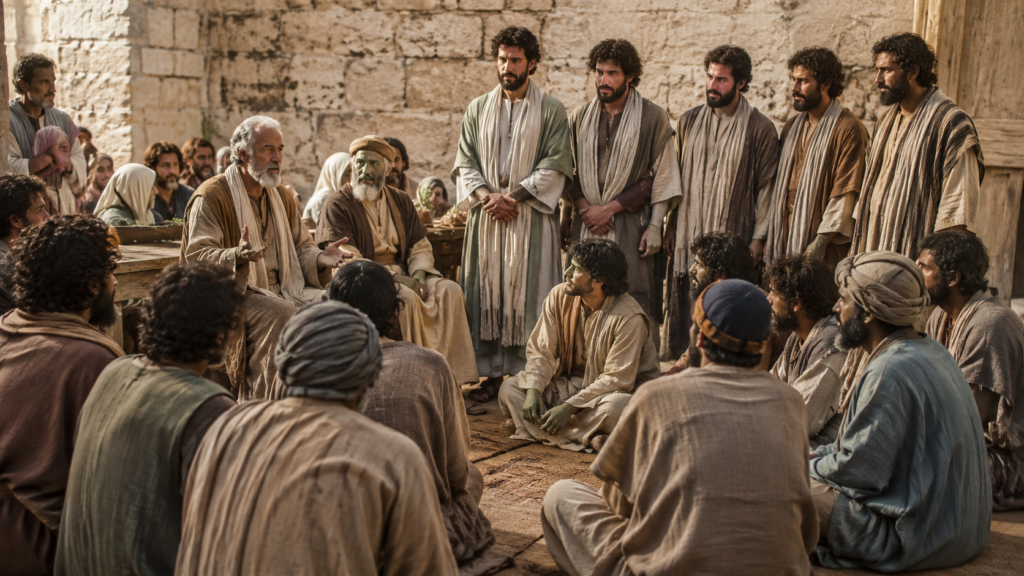


Luke reports here the first major internal crisis experienced by the Church in Jerusalem, as well as the measures the apostles adopted to remedy it. The appointment of the Seven marks an important stage in the organization of the nascent Christian community and in the preservation of its unity.
The rapid growth in the number of disciples inevitably brought new difficulties. After facing the opposition of the religious authorities (Acts 4.1-3 ; Acts 5.17-18), the Church now had to deal with tensions arising from within. These difficulties did not stem from doctrinal disagreements but from a practical question concerning the daily distribution intended for the widows (Acts 6.1).
From Luke's perspective, this crisis does not call the unity of the Church into question but reveals the challenges posed by its rapid development. Thus the spectacular growth of the community demanded an organization better suited to its needs.
2- The priority of the ministry of the Word
The Twelve understood that it was neither desirable nor fitting to neglect the ministry of the Word in order to devote themselves to the administration of this material assistance (Acts 6.2). This statement expresses no contempt for such tasks but underscores the need to share responsibilities within the Church.
The apostles intended to persevere in prayer and in the ministry of the Word (Acts 6.4). This twofold priority recalls the importance given from the very beginning of the Church to apostolic teaching (Acts 2.42). From Luke's perspective, the proclamation of the Word remains one of the essential missions entrusted to the apostles.
Far from setting spiritual service against material service, the account shows instead how they complement one another. The proper functioning of the community required that each person be able to carry out the ministry entrusted to him.
3- The qualities required of the Seven
The men chosen had to meet particularly demanding criteria. They had to be of good reputation, full of the Holy Spirit, and show wisdom (Acts 6.3).
It is remarkable that Luke places more emphasis on spiritual qualities than on administrative skills. In the eyes of the apostles, serving the neediest was also a genuine ministry requiring the action of the Holy Spirit.
The fact that these men are recognized as being full of the Spirit shows that this reality produced visible effects in their conduct, their wisdom, and their witness. Thus, in the early Church, practical responsibilities were by no means regarded as secondary or purely material.
4- The Seven and the Twelve
As he had already done for the Twelve (Acts 1.13), Luke takes care to preserve the names of the seven men appointed by the assembly (Acts 6.5). This precision probably testifies to the importance he attached to these men, who were called to play a major role in the first developments of the Church.
It is interesting to note that Joseph Barsabbas, proposed along with Matthias at the replacement of Judas Iscariot (Acts 1.23), does not appear in this list. This absence is probably explained by the fact that the selection criteria were not the same and that the responsibilities entrusted to the Seven differed from those of the apostolic ministry.
Moreover, the book of Acts will soon show that some of them, notably Stephen and Philip, would also carry out an important ministry of preaching and evangelism (Acts 6.8-10 ; Acts 8.5-6). The account thus suggests that their activity was not limited to the mere administration of assistance to the widows.
5- A new phase of growth
Luke concludes this section by mentioning a new phase of growth for the Church. The Word of God continued to spread and the number of disciples increased greatly in Jerusalem (Acts 6.7).
The author adds that a great was also obedient to the faith (Acts 6.7). This remark is particularly significant. Even as the chief priests and the were trying to silence the apostles (Acts 4.1-3 ; Acts 5.17-18), many priests, familiar with the Temple and the Scriptures, recognized in Jesus the Messiah announced by the prophets.
Luke does not explicitly establish a causal link between the resolution of the crisis described in the preceding verses and this new advance of Christianity. It is nevertheless remarkable that, in his account, the difficulties encountered by the Church never seem to compromise its development for long. On the contrary, external oppositions as well as internal tensions regularly appear to be followed by new progress of the Word of God (Acts 2.47 ; Acts 5.14 ; Acts 6.7 ; Acts 12.24 ; Acts 19.20).
From Luke's perspective, this constant progress manifests God's faithfulness toward his people and the fulfillment of the program announced by Christ before his ascension (Acts 1.8). Thus one of the major themes of the book of Acts appears once again: despite oppositions and obstacles, the Word of God continues to advance in keeping with the divine purpose.
(Acts 1.8) ; (Acts 2.47) ; (Acts 5.14) ; (Acts 6.7) ; (Acts 12.24) ; (Acts 19.20) – The progress of the Gospel
(Acts 1.13) ; (Acts 6.5) – The Twelve and the Seven
(Acts 1.23) – Joseph Barsabbas and Matthias
(Acts 2.42) ; (Acts 6.4) – Prayer and the ministry of the Word
(Acts 4.1-3) ; (Acts 5.17-18) – The opposition of the religious authorities
(Acts 6.1) – The complaint of the Hellenists
(Acts 6.2) – The sharing of responsibilities
(Acts 6.3) – The qualities required of the Seven
(Acts 6.5) – The appointment of the Seven
(Acts 6.7) – The growth of the Church and the conversion of the priests
(Acts 6.8-10) ; (Acts 8.5-6) – The ministry of Stephen and Philip
The
A