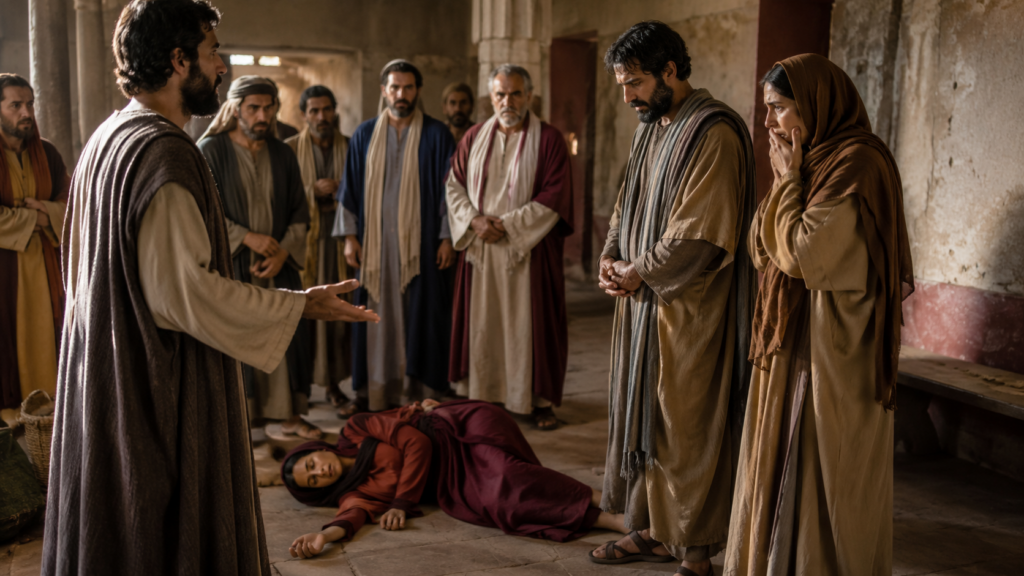
The article deals with the account of Ananias and Sapphira in Acts 5, showing the dramatic consequences of their deception toward the Christian community and the Holy Spirit. Their story contrasts with the sincere generosity of Barnabas, underscoring the ethical demands of the Christian faith and offering a warning against hypocrisy.
41 min
AnaniasSapphirahypocrisygenerosityHoly Spirit
60 verses
14 books
Note on the method: This information is found only in Luke
i
Luke now introduces a surprising and tragic event. He presents a couple belonging to the Christian community, but whose motives stand in deep contrast to those of the believers described earlier.
1- Presentation of Ananias and Sapphira
After presenting the positive example of Barnabas, who had sold a field and given the proceeds of the sale to the apostles to help the believers (Acts 4.36-37), Luke reports a particularly disturbing event that forms a striking contrast with this attitude of generosity and sincerity. This literary device, frequent in Luke, brings out the ethical demands of Christian community life. The very name of Barnabas, which Luke translates as “son of encouragement,” underscores the exemplary character of his act, while the account that follows illustrates the tragic consequences of hypocrisy.
It concerns a couple, Ananias and Sapphira, whose names are preserved by the historian. Both belong to the Christian community of Jerusalem, but their conduct reveals motives quite different from those that animated Barnabas and the other believers. The name Ananias, a Greek form of the Hebrew Hananyah, means “the is gracious,” while Sapphira derives from the Aramaic shappira, “beautiful.” This irony in the names does not escape the attentive reader: those whose names evoke grace and beauty are guilty of an act that is particularly ugly in the eyes of God.
Their desire seems to be to obtain the consideration and esteem enjoyed by those who showed great generosity, without fully sharing the same spirit of consecration. This attitude recalls Jesus’ warning against those who practice their righteousness before men to be seen by them (Matthew 6.1-2). The early Church lived an ideal of the sharing of possessions described in (Acts 2.44-45) and (Acts 4.32-35), but this ideal rested on freedom and sincerity of heart, not on outward compulsion.
2- The nature of their act
Like Barnabas, Ananias and Sapphira sell a property and decide to bring a sum of money to the apostles. However, by common agreement, they choose to secretly keep back part of the proceeds of the sale (Acts 5.2). The Greek verb used here, nosphizomai, means “to misappropriate” or “to set apart fraudulently.” The same term appears in the Septuagint to describe the sin of Achan, who had taken part of the devoted things at the capture of Jericho (Joshua 7.1, LXX). This lexical parallel is probably not accidental and suggests that Luke deliberately establishes a link between these two episodes.
Peter clearly stresses that this decision was not blameworthy in itself. The property belonged to them, and nothing obliged them either to sell it or to hand over the whole sum to the community (Acts 5.4). The sin therefore did not lie in keeping back part of the money, but in the deliberate intention of making people believe they had given everything. As the apostle Paul writes, “Each one must give as he has decided in his heart, not reluctantly or under compulsion, for God loves a cheerful giver” (2 Corinthians 9.7). Authentic Christian generosity flows from a renewed heart, not from a calculation of appearances.
3- Lying to the Holy Spirit and the deity of the Spirit
Peter then declares that Ananias let Satan fill his heart to lie to the Holy Spirit (Acts 5.3). This statement underscores the particular gravity of their fault. It was not simply a deception of the apostles or of the Church, but a lie directed against God himself, since lying to the Holy Spirit amounts to lying to God (Acts 5.3-4). This passage is, moreover, one of the most explicit testimonies of the New Testament concerning the deity of the Holy Spirit. By establishing a direct equivalence between “lying to the Holy Spirit” (v. 3) and “lying to God” (v. 4), Peter implicitly affirms the full deity of the third person of the Trinity.
The intervention of Satan in this account also deserves to be emphasized. Just as Satan had entered into Judas before his betrayal (Luke 22.3; John 13.27), here he fills the heart of Ananias. This mention is a reminder that behind human sin there often lies an evil spiritual influence, without in any way diminishing the personal responsibility of the sinner. Ananias remains fully guilty of his choice. James teaches that “each person is tempted when he is lured and enticed by his own desire” (James 1.14), and Peter himself will later exhort believers to resist the devil (1 Peter 5.8-9).
4- The judgment of Ananias
At the announcement of these words, Ananias falls dead, arousing deep fear among all who hear what has happened (Acts 5.5). This immediate and visible judgment manifests the holiness of God in a way reminiscent of the Old Testament theophanies. It should be noted that Peter did not pronounce a sentence of death; he merely revealed the truth about Ananias’s sin. The judgment comes directly from God, underscoring that the Church belongs to the Lord and not to men.
The text states that “the young men rose, wrapped him up, and carried him out and buried him” (Acts 5.6). The speed of the burial, in keeping with Jewish customs of the time, contributes to the solemn atmosphere of the account and prepares the next scene, in which Sapphira arrives without knowing the fate of her husband.
5- The judgment of Sapphira
About three hours later, Sapphira comes in, unaware of the preceding events. Peter then gives her the opportunity to tell the truth by asking her whether the field had been sold for such a price (Acts 5.7-8). This question reveals the mercy of God who, even in judgment, leaves a door open to repentance. Sapphira could have confessed the truth and distanced herself from her husband’s lie. However, she deliberately confirms the lie, and her personal responsibility thus appears fully engaged.
Peter reproaches her for having taken part in this testing of the Spirit of the Lord (Acts 5.9). The Greek verb peirazō, translated “to tempt” or “to put to the test,” is the same one that describes the temptation of Jesus in the wilderness (Matthew 4.1) and the warning not to put the Lord to the test (Matthew 4.7, quoting Deuteronomy 6.16). Ananias and Sapphira in a way tested the limits of divine omniscience, as if they could deceive the Holy Spirit. This presumption is a particularly serious form of unbelief. Sapphira in her turn dies, and she is buried beside her husband.
6- The fear of the Church and the holiness of God
These two sudden deaths deeply marked the young Church. Luke stresses twice that great fear came upon all (Acts 5.5; Acts 5.11). This fear should not be understood as superstitious terror, but as a renewed awareness of the holiness of God. The Greek term phobos, used here, denotes in the biblical context the reverent fear that is “the beginning of wisdom” (Proverbs 9.10; Psalms 111.10).
At the very moment when the Church was experiencing rapid growth and remarkable unity, God was reminding it that his grace must not be confused with a form of complacency toward sin. The author of the epistle to the Hebrews would later write: “Our God is a consuming fire” (Hebrews 12.29, quoting Deuteronomy 4.24). Far from abolishing the demands of holiness, divine grace makes them all the more imperative.
7- Old Testament parallels
This episode recalls certain exemplary judgments of the Old Testament, such as those of Nadab and Abihu (Leviticus 10.1-3) or of Achan (Joshua 7.1-26). In the case of Nadab and Abihu, the sons of Aaron, their death occurred at the inauguration of the tabernacle worship, when they offered before the strange fire that he had not commanded them. God then declared: “Among those who are near me I will be sanctified, and before all the people I will be glorified” (Leviticus 10.3).
The case of Achan presents even more striking similarities with that of Ananias and Sapphira. After the miraculous victory at Jericho, Achan took part of the devoted things, bringing about Israel’s defeat before Ai and his own death. In each of these cases, God intervenes in an exceptional way at the beginning of a new stage in the history of salvation in order to underscore the holiness of his work. The inauguration of the Levitical worship, the conquest of and the birth of the Church are so many founding moments in which God clearly establishes his requirements.
8- The theological significance of the episode
Thus, this account shows that the power of the Holy Spirit, which was manifested in the early Church through miracles, unity and generosity, also implied the requirement of truth and sincerity. The Lord Jesus himself had taught that “whoever hides will be found out, and what is covered will be known” (Luke 12.2). Luke thus reminds us that the Church belongs to God and that there can be no question of seeking the appearance of godliness without genuine integrity of heart. Paul would later warn that some would have “the appearance of godliness, but denying its power” (2 Timothy 3.5).
This tragic episode is a reminder that the power of the Holy Spirit was manifested not only through miracles, healings and the growth of the Church, but also through the holiness that was to characterize the people of God. The prophet Ezekiel had announced that God would give his people a new heart and put his Spirit within them (Ezekiel 36.26-27). This promise, fulfilled at Pentecost, implied a genuine inner transformation, not mere outward conformity to the expectations of the community.
Conclusion: the fruits of divine judgment
The great fear that came upon the believers and upon all who heard of these events (Acts 5.11) helped to strengthen the reverence due to God and to preserve the purity of the nascent Church. It is significant that Luke here mentions for the first time the term ekklesia (Church) in Acts. It is precisely in the context of divine judgment that the identity of the community as the holy people of God is affirmed.
Far from interrupting the divine work, this exceptional judgment preceded a new period of growth and manifestations of God’s power (Acts 5.12-16). The text stresses that “many signs and wonders were regularly done among the people by the hands of the apostles” and that “multitudes of both men and women were added to the Lord.” Thus holiness and power, far from being opposed, go together in the divine economy. As Peter writes in his first epistle: “You are a chosen race, a royal priesthood, a holy nation, a people for his own possession, that you may proclaim the excellencies of him who called you out of darkness into his marvelous light” (1 Peter 2.9).
(Acts 2.44-45) – The sharing of possessions in the early Church
(Acts 4.32-35) – The unity of heart and soul among the believers
(Acts 4.36-37) – The example of Barnabas
(Acts 5.1-11) – The account of Ananias and Sapphira
(Acts 5.12-16) – The growth of the Church after the judgment
(Joshua 7.1-26) – The sin of Achan
(Leviticus 10.1-3) – The judgment of Nadab and Abihu
(Deuteronomy 4.24); (Deuteronomy 6.16) – The holiness of God
(Psalms 111.10); (Proverbs 9.10) – The fear of the
(Ezekiel 36.26-27) – The promise of the new heart
(Matthew 4.1), (Matthew 4.7) – The temptation of Jesus
(Matthew 6.1-2) – The warning against hypocrisy
(Luke 12.2); (Luke 22.3) – Words of Jesus
(John 13.27) – Satan and Judas
(2 Corinthians 9.7) – Cheerful giving
(2 Timothy 3.5) – The appearance of godliness
(Hebrews 12.29) – God, a consuming fire
(James 1.14) – The origin of temptation
(1 Peter 2.9); (1 Peter 5.8-9) – The identity and vigilance of the people of God
The
The
A title, a person, a place, a reference (“Luke 15”)…
opens in a new window
Bible reference
INF346
Information note
INF346 - The sentence pronounced against Ananias and Sapphira
The sentence pronounced against Ananias and Sapphira
The severity of the judgment that strikes Ananias and Sapphira has often surprised readers of the New Testament. After Peter's words, Ananias falls dead on the spot (Acts 5.5). About three hours later, Sapphira, unaware of what has just happened, knowingly confirms her husband's lie and suffers the same fate (Acts 5.7-10).
It should be noted, however, that Peter does not pronounce the condemnation himself. He does not curse the couple and does not ask for their death. He merely exposes their sin under the inspiration of the Holy Spirit. The sentence evidently comes from God himself.
This exceptional judgment recalls several episodes of the Old Testament. Nadab and Abihu were struck down after offering strange fire before the Eternal (Leviticus 10.1-3). Likewise, Achan was severely punished after concealing part of the forbidden spoil (Joshua 7.1-26). In each of these cases, God intervenes at the beginning of a new stage in the history of salvation in order to underline the holiness of his work.
The death of Ananias and Sapphira must therefore not be interpreted as the usual rule of divine government. On the contrary, the New Testament shows that God generally displays patience and mercy toward sinners (2 Peter 3.9). The exceptional character of this sentence precisely underlines its importance.
Twice, Luke notes that great fear came upon the believers and upon all who heard of these events (Acts 5.5; Acts 5.11). This is not a superstitious fear, but a renewed awareness of God's holiness and of the sacred character of the Church.
Thus, this solemn sentence recalls that God's grace removes neither truth nor the demands of holiness. The early Church, though animated by the power of the Holy Spirit, could not become a place where hypocrisy and lying would be tolerated. At the beginning of this new covenant, God reminded his people in an exceptional way that they were to be characterized by sincerity and faithfulness (1 Peter 1.15-16).
INF345
Information note
INF345 - The crime of Ananias and Sapphira
The crime of Ananias and Sapphira
The account of Ananias and Sapphira has often provoked incomprehension. At first sight, one might think that their fault consisted in not having given the entire proceeds of the sale of their property. Yet Peter clearly points out that nothing obliged them to sell this property or to hand over the whole sum to the apostles (Acts 5.4). The property belonged to them, and they were free to dispose of it as they wished.
The couple's real crime lay elsewhere. Ananias and Sapphira had decided, by common agreement, to secretly keep back part of the proceeds of the sale while letting it be believed that they had given everything (Acts 5.2). They were thus seeking the regard and esteem aroused by the acts of generosity performed by certain believers, notably Barnabas (Acts 4.36-37), without being willing to make the same sacrifice.
Their sin was therefore above all a sin of hypocrisy. They wanted to appear more generous than they really were. This attitude recalls Jesus' warnings against those who performed their pious works in order to be seen by men (Matthew 6.1-2), as well as his rebukes addressed to the Pharisees who valued outward appearances at the expense of inner sincerity (Matthew 23.27-28).
Peter, however, goes further. He declares that Ananias let Satan fill his heart so as to lie to the Holy Spirit (Acts 5.3). This lie was therefore aimed not only at the apostles or the Christian community, but at God himself. Peter states precisely:
“You have not lied to men but to God” (Acts 5.4).
This declaration is one of the most explicit statements in the New Testament about the deity of the Holy Spirit. To lie to the Holy Spirit is to lie to God.
The sin of Ananias and Sapphira thus appears as a combination of hypocrisy, lying and the pursuit of appearances. They wished to enjoy the prestige attached to generosity without possessing the sincerity that was to accompany it. Their attitude reveals that the Christian life cannot be reduced to outward behavior; it demands above all truth of the heart before God (Psalms 51.6).
INF011
Information note
INF011 - The land of Canaan
The land of Canaan
The land of Canaan mentioned in our Bibles corresponds approximately to the present-day territories of Israel, Palestine, Lebanon and parts of Jordan and Syria.
This region is called ‘the most beautiful of all lands’ four times in the Bible. Ezekiel 20.6 (S21)
On that day, I pledged to bring them out of Egypt into a land I had sought out for them, a land flowing with milk and honey, the most beautiful of all lands.
(Louis Segond translation S21) In antiquity, several ethnic groups inhabited Canaan, including the Canaanites, Amorites, Hittites and Philistines. The Bible mentions this region as the land promised to the people of Israel.
We observe two stages, separated by approximately 470 years, that led the Hebrews to take possession of this territory.
The first begins with Abraham's arrival, and the second continues with Joshua's conquest, after the period of captivity in Egypt and the forty years of wandering in the wilderness.
INF038
Information note
INF038 - YHWH
YHWH
The tetragrammaton YHWH is the proper name of God used in the Hebrew Bible. Here is some key information:
Meaning and origin
Name of God:YHWH is regarded as the most sacred name of God in Judaism. It is often rendered "the LORD" or "Jehovah" in English.
Origin: The term "tetragrammaton" means "four letters" in Greek, referring to the four Hebrew letters יהוה (yod, heh, waw, heh).
Pronunciation
Unknown: The exact pronunciation of the tetragrammaton is unknown because, in Jewish tradition, it was forbidden to pronounce this name in order to avoid profaning it.
Substitutes: In its place, substitutes such as "Adonai" (Lord) or "HaShem" (The Name) are used.
Usage
Sacred text:The tetragrammaton appears frequently in the Torah and other writings of the Hebrew Bible. Ritual and prayers: In prayers and rituals, Jews generally use "Adonai" to replace YHWH when they read the sacred texts aloud.
Theological importance
Monotheism:YHWH underscores the uniqueness and exclusivity of God in the Jewish faith. Divine relationship:It expresses the personal relationship between God and the people of Israel, marking a divine revelation and a covenant.
The tetragrammaton is therefore a central and sacred element in Jewish theology and religious practice.