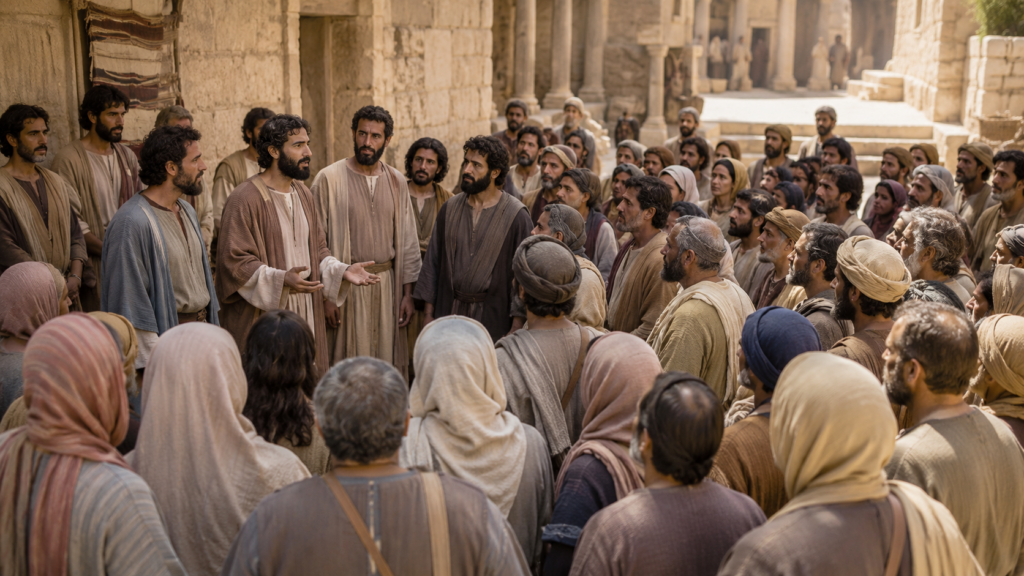

Luke describes here a quite remarkable situation that bears witness to the rapid growth of the early Church. Miracles multiply, and the author specifies that they are performed by “the hands of the apostles” (Acts 5.12). This wording shows that miraculous activity is no longer limited to Peter and John, but now involves the whole apostolic college. The expression “by the hands” (dia tōn cheirōn) underscores that the apostles are the instruments through which God acts, in accordance with Jesus’ promise that his disciples would do works like his own (John 14.12).
The apostles gather publicly in Solomon’s Portico, on the Temple esplanade, a place already mentioned at the time of Peter’s speech after the (Acts 3.11). This portico, a covered colonnade running along the eastern side of the Court of the Gentiles, was a suitable space for teaching and gatherings. Jesus himself had taught there (John 10.23). Far from hiding, the apostles now carry out their ministry at the very heart of the religious life of Jerusalem, thus fulfilling the mission the risen Lord had entrusted to them: to be his witnesses “in Jerusalem” before reaching “the end of the earth” (Acts 1.8).
2- The distinction of the apostolic group
Luke also stresses that the apostles now form a distinct, recognized and respected group. The text states that “none of the rest dared join them” (Acts 5.13). This remark has given rise to various interpretations among commentators. The fear inspired by the recent events concerning Ananias and Sapphira (Acts 5.1-11) probably explains this reserve: anyone considering associating with the apostles had to weigh the seriousness of such a commitment. The holiness of God manifested in the judgment of the lying couple was a reminder that belonging to the Christian community was not a light matter.
However, this reserve in no way diminished the esteem in which the apostles were held by the people (Acts 5.13). This apparent paradox — fear coexisting with admiration — recalls the attitude of the crowds before Jesus after certain miracles (Luke 5.26; Luke 7.16). The manifest presence of God arouses both reverence and attraction. The early Church thus enjoyed a favorable reputation among the people, a situation that Luke had already noted earlier (Acts 2.47).
3- The continued growth of the Church
The Church kept on growing, and men and women alike were coming to faith in great numbers (Acts 5.14). This explicit mention of women deserves to be noted. Luke, in his Gospel as in Acts, pays particular attention to the place of women in the history of salvation (Luke 8.1-3; Acts 1.14; Acts 9.36-42). Their significant presence among the converts testifies to the universality of the gospel message, which transcends the social and cultural barriers of the time.
Although Luke no longer explicitly mentions baptisms in this passage, nothing suggests that this practice, instituted at Pentecost, had ceased (Acts 2.38-41). Baptism was the rite of entry into the community of believers, in accordance with the Lord’s command (Matthew 28.19). It is therefore likely that new believers continued to be incorporated into the Church by this sacrament, thereby receiving the forgiveness of sins and the gift of the Holy Spirit (Acts 2.38).
4- The healing scenes and the parallel with the ministry of Jesus
The scenes described recall those of Jesus’ earthly ministry. As formerly around the Master, the sick flock to the apostles, and the crowds hope to obtain healing (Matthew 4.23-25; Mark 6.56). This continuity is not accidental: the apostles carry on the work of the one who sent them. Jesus himself had announced that his disciples would do “greater works” than his, not in quality but in extent, thanks to the outpouring of the Spirit (John 14.12).
Luke even reports that some laid the sick in the streets, on beds and mats, so that Peter’s shadow might fall on them as he passed by (Acts 5.15). This detail recalls the Gospel accounts in which the sick sought to in order to be healed (Mark 5.27-28; Mark 6.56; Luke 8.44). The text does not state that the shadow itself possessed any particular power; rather, it highlights the extraordinary faith and hope of the people. Just as the woman with the issue of blood was healed by her faith when she touched the Lord’s garment (Luke 8.47-48), the faith of the inhabitants of Jerusalem disposed them to receive divine healing.
5- The effectiveness of the healings and the influx of crowds
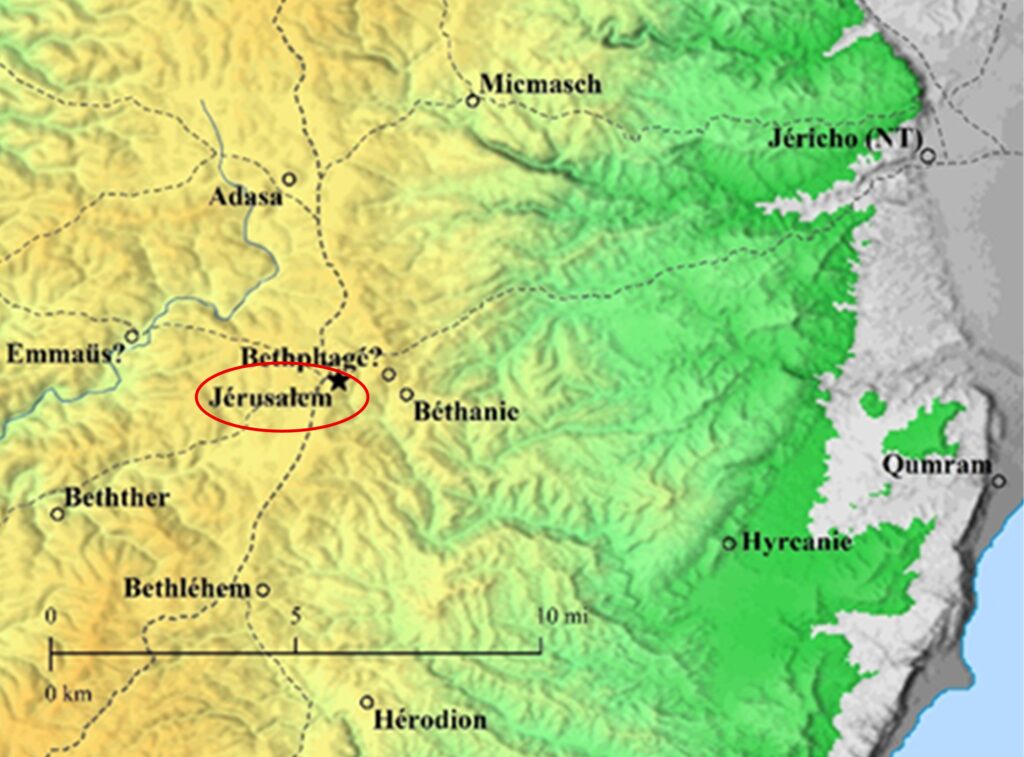
However that may be, the result is unequivocal: “they were all healed” (Acts 5.16). This remarkable statement underscores the extraordinary power that accompanied the apostolic ministry. Luke adds that the crowds also came running “from the towns around Jerusalem,” bringing the sick and those tormented by unclean spirits (Acts 5.16). The renown of the apostles thus spreads beyond the walls of the holy city, recalling how the reputation of Jesus had spread throughout the surrounding region (Luke 4.14; Luke 4.37).
The mention of unclean spirits indicates that the apostolic ministry included the deliverance of the possessed, as Jesus had given both the example and the commission (Mark 16.17; Luke 9.1). Such a succession of miracles — physical healings and spiritual liberations — must have aroused immense joy among the population and contributed to the constant increase in the number of disciples. These signs attested that the Kingdom of God was truly present and at work among the people (Luke 11.20).
6- The challenges of administering a growing community
The Church thus experiences spectacular expansion, while the apostles must learn to administer a community that has become particularly large. This rapid growth will soon pose organizational challenges, as the episode of the murmuring between the Hebrews and the Hellenists will show, leading to the appointment of the seven deacons (Acts 6.1-6). The wisdom of the apostles will then consist in delegating certain responsibilities so as to devote themselves fully “to prayer and to the ministry of the word” (Acts 6.4).
All discretion now seems impossible for the apostles. Their public ministry, the crowds that surround them and the miracles they perform inevitably attract the attention of the authorities. The early Church could not remain a marginal movement; it was becoming a phenomenon impossible to ignore in the religious landscape of Jerusalem.
7- The anxiety and jealousy of the religious authorities
The religious authorities observe this ferment with anxiety and jealousy (Acts 5.17). The Greek term zēlos, translated here as “jealousy,” can also mean “zeal.” In this context, however, it is clearly a hostile jealousy provoked by the success of the apostles. The , who at that time controlled the and the priesthood, were particularly irritated by the preaching of the resurrection, a doctrine they rejected (Acts 4.1-2; Matthew 22.23).
and are forced to acknowledge that they are confronted with events for which no natural explanation can easily account. The extraordinary healings and the numerous conversions are, in the eyes of the population, manifest signs of divine intervention. This situation recalls the dilemma the had faced after the : “What shall we do with these men? For that a notable sign has been performed through them is evident to all who dwell in Jerusalem, and we cannot deny it” (Acts 4.16).
8- The failure of human opposition to the divine work
The Jewish leaders had thought to put an end to the movement begun by Jesus by condemning him to death. They had believed that by eliminating the shepherd, the sheep would be scattered (Zechariah 13.7; Matthew 26.31). Yet, far from disappearing, the movement experiences an even greater development. The resurrection of Jesus had turned apparent defeat into resounding victory, and the outpouring of the Spirit at Pentecost had given the disciples new power (Acts 1.8).
A few verses later, , a respected teacher of the Law and teacher of the apostle Paul (Acts 22.3), will formulate a principle that has remained famous: “If this plan or this undertaking is of man, it will fail; but if it is of God, you will not be able to overthrow it. You might even be found opposing God” (Acts 5.38-39). This prudent counsel reveals a wisdom that the other members of the would have done well to ponder.
9- Fighting against God: an undertaking doomed to failure
Thus, in continuing their opposition against the apostles, the religious authorities now find themselves engaged in a struggle that goes beyond the framework of a mere human conflict. In Luke’s eyes, they no longer oppose only the disciples, but the very action of God. The term used by , theomachoi (“fighters against God”), expresses this reality forcefully (Acts 5.39). Biblical history offers many examples of human attempts to oppose the divine purposes, all doomed to failure (Psalms 2.1-4; Proverbs 21.30).
The work of God continues to advance with irresistible power. The prophet Isaiah had declared: “My word that goes out from my mouth shall not return to me empty, but it shall accomplish that which I purpose” (Isaiah 55.11). Likewise, Jesus had promised: “I will build my church, and the gates of Hades shall not prevail against it” (Matthew 16.18). The persecutions to come, far from destroying the Church, will paradoxically contribute to its spread, according to the principle later stated by Tertullian: “The blood of the martyrs is the seed of Christians.”
Conclusion: the sovereignty of God in the expansion of the Church
This passage masterfully illustrates the sovereignty of God in the expansion of his Church. Despite the opposition of the religious authorities, despite human obstacles, the divine work advances irresistibly. The miracles authenticate the apostolic message, conversions multiply, and the Christian community asserts itself as an unavoidable reality in the religious landscape of Jerusalem.
Luke thus invites his readers to recognize the hand of God in the history of the early Church. What unfolds is not the fruit of chance or human skill, but the fulfillment of God’s redemptive plan announced by the prophets and inaugurated by Jesus the Messiah. As Peter will declare before the : “We must obey God rather than men” (Acts 5.29). This conviction will animate the apostles throughout their ministry and remains a model for the Church of all ages.
- (Acts 1.8) – The promise of power and the missionary mandate
- (Acts 1.14) – Women in the early community
- (Acts 2.38); (Acts 2.38-41); (Acts 2.47) – Pentecost and its aftermath
- (Acts 3.11) – Solomon’s Portico
- (Acts 4.1-2); (Acts 4.16) – The opposition of the
- (Acts 5.1-11) – Ananias and Sapphira
- (Acts 5.12-16) – The miracles of the apostles
- (Acts 5.17); (Acts 5.29); (Acts 5.38-39) – The opposition and the counsel of
- (Acts 6.1-6); (Acts 6.4) – The appointment of the deacons
- (Acts 9.36-42) – Tabitha
- (Acts 22.3) – , teacher of Paul
- (Isaiah 55.11) – The effectiveness of the Word of God
- (Zechariah 13.7) – The stricken shepherd
- (Psalms 2.1-4) – The vain opposition of the nations
- (Proverbs 21.30) – No wisdom against the
- (Matthew 4.23-25) – The healing ministry of Jesus
- (Matthew 16.18) – The promise concerning the Church
- (Matthew 22.23) – The and the resurrection
- (Matthew 26.31) – The stricken shepherd
- (Matthew 28.19) – The command to baptize
- (Mark 5.27-28); (Mark 6.56); (Mark 16.17) – Healings and signs
- (Luke 4.14); (Luke 4.37) – The renown of Jesus
- (Luke 5.26); (Luke 7.16) – Reverent fear
- (Luke 8.1-3); (Luke 8.44); (Luke 8.47-48) – Women and faith
- (Luke 9.1); (Luke 11.20) – The authority given to the disciples
- (John 10.23) – Jesus in Solomon’s Portico
- (John 14.12) – The greater works
Where did the first Christians meet?