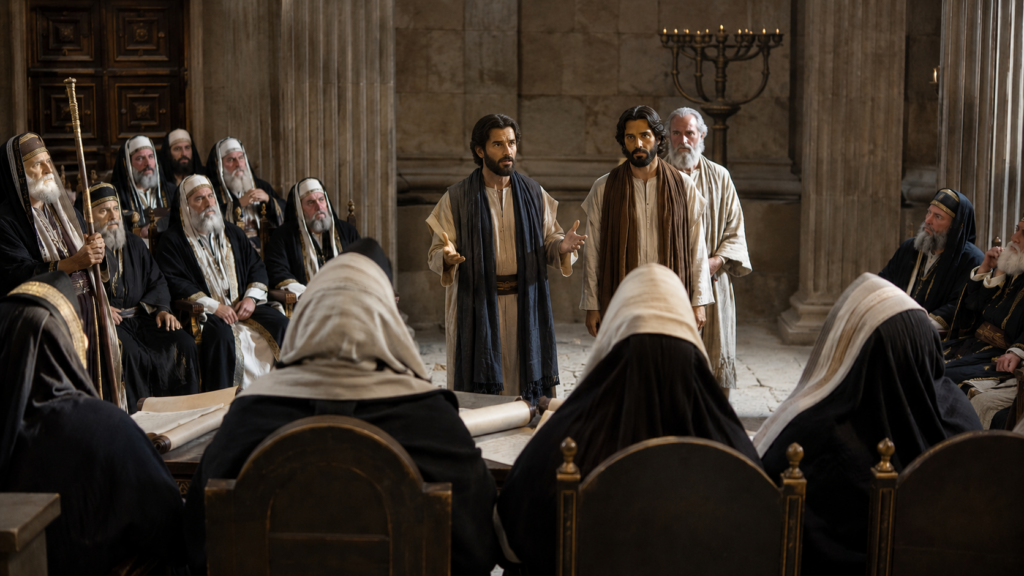

The surprise of the members of the must have been considerable. Instead of finding two men intimidated and overawed by the solemnity of this assembly, they hear Peter speak with remarkable assurance. Luke moreover stresses that the apostle is then “filled with the Holy Spirit” (Acts 4.8), thus showing that this boldness does not rest solely on his personal qualities.
What is more, certain aspects of his argument recall that of the Lord Jesus Himself. In the way Peter answers his accusers and bases his reasoning on the Scriptures, the reader finds certain traits of the Master's ministry. The action of the Holy Spirit is certainly not foreign to this assurance and to this remarkable mastery of the situation.
2- The astonishment of the members of the Sanhedrin
No one seemed to expect such an attitude. Luke takes care to stress the astonishment of the members of the , who recognize in Peter and John common men, without recognized rabbinic training (Acts 4.13). Yet these same authorities discover with surprise that these simple men possess an assurance and a wisdom that they are unable to silence.
This scene recalls the promises Jesus made to His disciples. He had told them that, when they were brought before the courts, the Holy Spirit would give them the words they needed (Matthew 10.19-20; Luke 12.11-12). The events reported by Luke thus appear as the concrete fulfillment of these words.
3- The miracle puts the judges in an awkward position
The irony of the situation is particularly striking. Those who had come to judge Peter and John find themselves in an awkward position. The presence of the former lame man, miraculously healed, makes any contradiction particularly difficult. The evidence of the miracle disturbs the reasoning of the members of the and deprives them of any decisive argument.
Unable to deny the facts, they are compelled to have the accused leave the room in order to confer among themselves (Acts 4.14-15). The court charged with condemning the apostles thus finds itself confronted with a reality that it can neither explain nor refute.
4- Peter, main spokesman of the apostles
Luke places the main emphasis on Peter, who appears as the main spokesman of the apostolic group during the first years of the Church. This role is already noticeable in the Gospels (Matthew 16.16; John 6.68-69) and is confirmed in the first chapters of Acts.
However, Luke also stresses John's assurance (Acts 4.13). We do not know whether he spoke during this appearance, since the narrative focuses essentially on Peter. This silence does not mean that John remained passive; it rather reflects Luke's literary choice, which favors the figure of Peter in this first part of his work.
5- A new illustration of the Lord's promise
A few weeks earlier, these same disciples had abandoned their Master at the time of His arrest (Matthew 26.56). Now they appear before the same religious authorities with an assurance that surprises even their adversaries.
The contrast is striking. The leaders of the people probably thought they would intimidate two simple Galileans, but they discover resolute witnesses whose boldness recalls that of the Lord Jesus Himself. Once again, the opposition of the religious authorities becomes an opportunity for the apostles to bear witness to the risen Christ.
6- The Sanhedrin facing an insoluble problem
The embarrassment of the members of the foreshadows the rest of the narrative. Unable to deny the miracle and to refute Peter's arguments, the religious authorities will look for another way to put an end to the apostolic preaching.
In the next study we will examine the reaction of the and the measures it will try to take in order to silence the two apostles.
?
The