

_21 The crowd, gathered in front of Pontius Pilate’s palace, demands the crucifixion. Matthew 27.22 ; Mark 14.11-15 ; Luke 23.23 ; John 19.15.
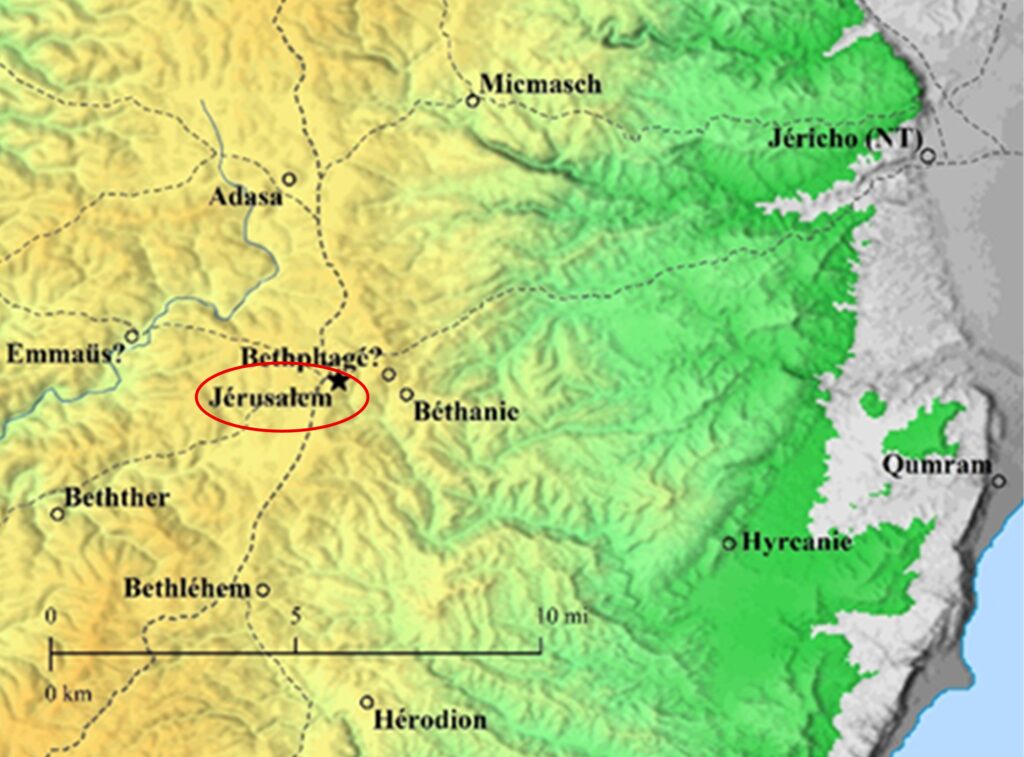
_22 The departure for Mount Golgotha begins before 9 a.m. Matthew 27.32 ; Mark 15.21-22 ; Luke 23.26-33 ; John 19.17.
_23 The placing on the cross therefore takes place around 9 a.m. according to Mark's text. The imprecision of the measurement allows for the time needed to travel to Mount Golgotha. Mark 15.20-41 ; Matthew 27.31-56 ; Luke 23.26-49 ; John 18.17-30.
You can consult the complete chronology in the study ANN026 : The hour of the crucifixion.
Commentary:
The Gospels report that Jesus is not crucified alone, but surrounded by two condemned men, called “robbers” or “criminals” (cf. Matthew 27.38 ; Mark 15.27 ; Luke 23.32). This detail is not insignificant: it fulfills the prophecy that the Servant of God would be “numbered with the transgressors” (cf. Isaiah 53.12). Jesus is thus willingly counted among sinners.
Mark gives an important detail of time: the crucifixion takes place at the third hour, that is, around 9 a.m. (cf. Mark 15.25). This detail underlines that the events unfold quickly after the trial.
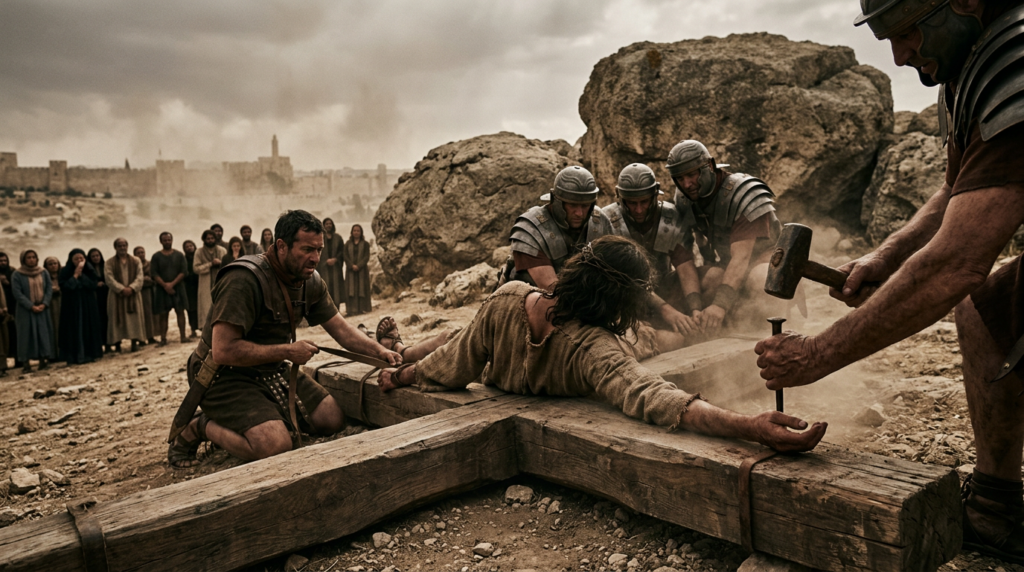
The texts say little about the technical aspects of crucifixion, which was nevertheless a well-known practice at the time. However, some passages make it clear that Jesus was indeed nailed. After the resurrection, Thomas is invited to see “the print of the nails” (cf. John 20.25) and Jesus shows his hands and his feet (cf. Luke 24.39). This confirms the use of nails, even though the Gospels do not explicitly describe how they were placed.
Concerning the hands, the text does indeed speak of “hands”, but it should be noted that in ancient language this term can include the wrist area. From a historical point of view, the sometimes used nails and sometimes ropes, or both. It is therefore possible that Jesus was both nailed and tied, in order to hold the body on the cross.
John gives a significant detail about the clothes of Jesus: the soldiers divide them among themselves, but cast lots for his seamless tunic (cf. John 19.23-24). This act fulfills the psalm: “They divide my garments among them, and cast lots for my clothing” (cf. Psalms 22.18). Even in this humiliation, the Scriptures are fulfilled.
The inscription placed on the cross, “the King of the Jews” (cf. John 19.19), underlines a tragic irony: what the authorities reject becomes a public proclamation. Jesus is acknowledged as king, but in a context of derision.
The scene is marked by mockery. Passersby, the religious leaders and even the soldiers ridicule Jesus (cf. Matthew 27.39-43 ; Luke 23.35-36). They take up his words about the temple and challenge his ability to save himself. This misunderstanding is central: Jesus has not come to save himself, but to save others.
Even the two crucified men react, at first joining in the insults (cf. Mark 15.32), although Luke specifies that one of them ends up repenting (cf. Luke 23.40-43). This shows that, even in the midst of condemnation, an opening toward grace remains possible.
Historically, crucifixion was a Roman punishment intended to humiliate and deter. It was public, slow and extremely painful. Bodies could remain on display for a long time, serving as a warning. In this context, the death of Jesus might appear as an ordinary event among other executions.
And yet, the Gospels show that this death is unique. Jesus is crucified outside the city (cf. John 19.17), like the sin offerings (cf. Hebrews 13.12). This detail gives a deep theological meaning to the event: he dies for sin, outside the camp.
Finally, the expression “they crucified him” (cf. Matthew 27.35 ; Mark 15.24 ; Luke 23.33) is strikingly restrained. The Gospels do not dwell on physical suffering, but emphasize the meaning of this act: rejection, fulfillment of the Scriptures, and voluntary offering.
One main line emerges: the crucifixion, a common event in the Roman Empire, becomes here a central moment in biblical history, where human violence, the fulfillment of prophecies and the work of salvation meet.