

_15 The Messiah Jesus is questioned for two hours, from 4:30 to 6:30 a.m. Matthew 26.59-68, Mark 14.55-65, Luke 22.67-71, John 18.19-24.
_16 The rooster crows around 6:15 a.m., a little before sunrise. Matthew 26.74, Mark 14.72, Luke 22.61-62, John 18.27.
_17 The appearance before the should have taken place after sunrise at 6:38 a.m. But this was not the case, because at the moment the rooster crows the Master is, according to our interpretation of Luke’s text, taken to Pilate right after the sentence of the , which therefore waited for daybreak to pronounce it. Luke 22.66-71, Mark 15.1, Matthew 27.1-2.
_18 The first appearance before Pontius Pilate begins around 6:45 a.m. Mark 15.1-5, Matthew 27.2-14, Luke 23.1-5, John 18.28-38.
You can consult the complete chronology in the study ANN026 : The hour of the crucifixion.
Commentary:
After the nighttime appearance before the , which probably took place in a room of Caiaphas’ spacious residence, the procession sets out at the first light of day. At that very moment, the eyes of the Master and of Simon Peter meet, as Luke relates, just before the Messiah Jesus is led to the procurator (Luke 22.61). This poignant scene marks the end of the religious trial and the beginning of the civil trial.
We are struck to see that all these people are already up at such an early hour. The members of the had been waiting for several hours for the “guilty man” to be presented to them so as to make the sentence official at sunrise, in accordance with the requirements of Jewish law. Caiaphas had organized everything: the nighttime meeting to obtain the verdict, then the dawn session to give it an appearance of legality (Matthew 27.1).
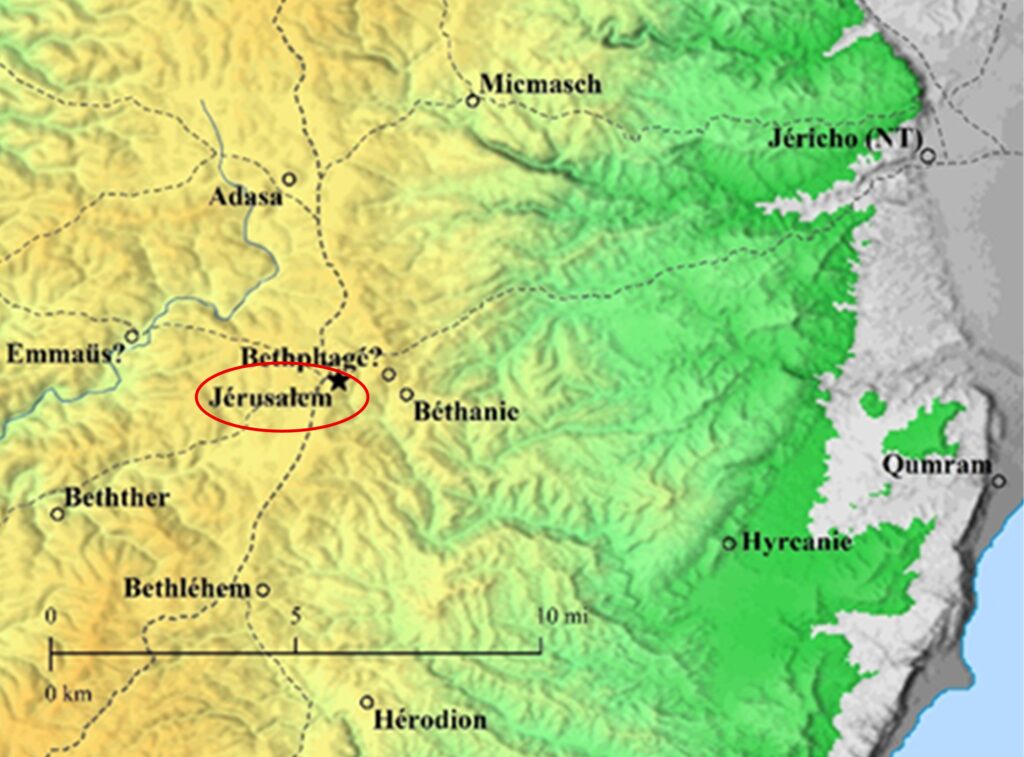
For his part, Pontius Pilate is not caught off guard. He knew that a Roman squad had been mobilized in the garden of Gethsemane, about one kilometer from Jerusalem. Such a military movement in the middle of the night could not escape him. Governor for seven years, he knows the political fragility of the region: the slightest incident can get out of hand. He must therefore be present to oversee the situation.
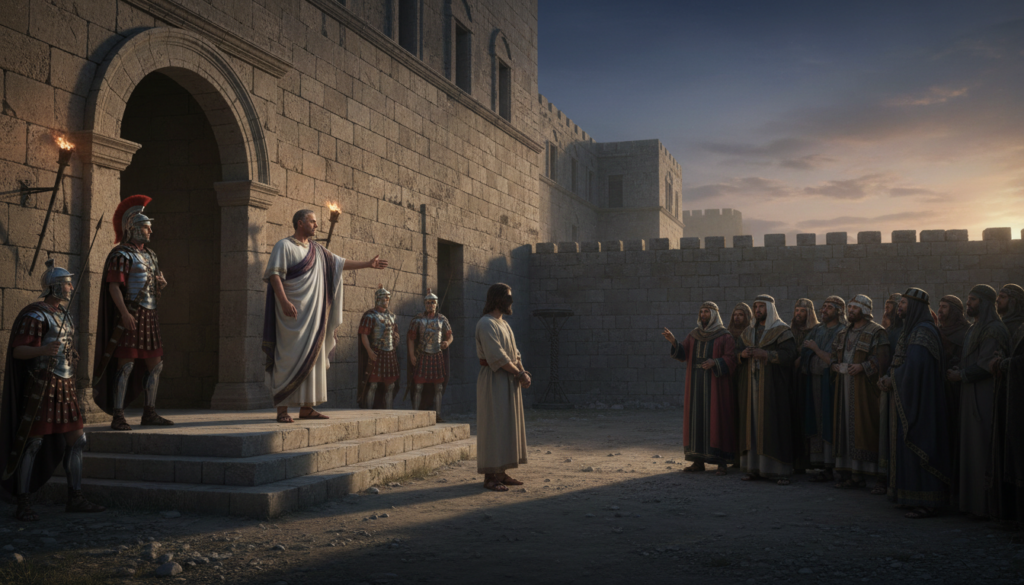
The Messiah Jesus, now bound, is led to the Praetorium, the official residence of the procurator. The discussion between Pilate and the Messiah Jesus takes place on the outer esplanade, because the religious leaders refuse to enter the home of a Gentile for fear of ritual defilement (John 18.28). Striking irony: those who are plotting a murder scrupulously avoid a ritual impurity. Pilate, who is well acquainted with Jewish customs, can only be irritated by this attitude, which he perceives as contemptuous and hypocritical.
Only the Messiah Jesus, accompanied by a few guards, enters the Praetorium. The dialogue between Pilate and the Messiah appears to take place in Greek, the administrative language of the Empire. No interpreter is mentioned, which suggests that Jesus had sufficient command of that language to converse with the governor. Pilate is intrigued by the words of the Messiah Jesus concerning his kingdom (John 18.36). A surprisingly calm and almost respectful exchange develops between them.
Pilate is not naive. He quickly understands that the Jewish leaders are trying to manipulate him. When they present the Messiah Jesus to him, he first tells them to judge him themselves (John 18.31). He has not yet grasped that they are demanding the death penalty, which they cannot obtain without his authorization. When he realizes that they want an execution, he does not hide his surprise. Nothing in this affair seems to him to deserve such a sentence.
Pilate questions the Messiah Jesus, then turns back to the accusers: he finds no fault in him (Luke 23.4). Glad to send away these men whom he considers arrogant and quarrelsome, he thinks he can quickly close the case. But he is about to discover that the religious leaders will not let go. Their determination to obtain the death of the accused will drag him into a political spiral from which he will not emerge unscathed.
In the midst of these human maneuvers, the Messiah Jesus remains sovereign. He goes willingly toward the cross, fulfilling the divine plan by which God shows his love for the world (John 3.16-17). The religious authorities plot, Pilate hesitates, the crowd stirs, but the Messiah walks calmly toward the fulfillment of his mission.