

After the transfiguration, Jesus the Messiah and his disciples, Peter, James and John, according to the account in Matthew 17.9, come back down from the mountain and find a large crowd. The sick come in numbers, as always. But the healing of this epileptic child highlights the disciples’ failure.
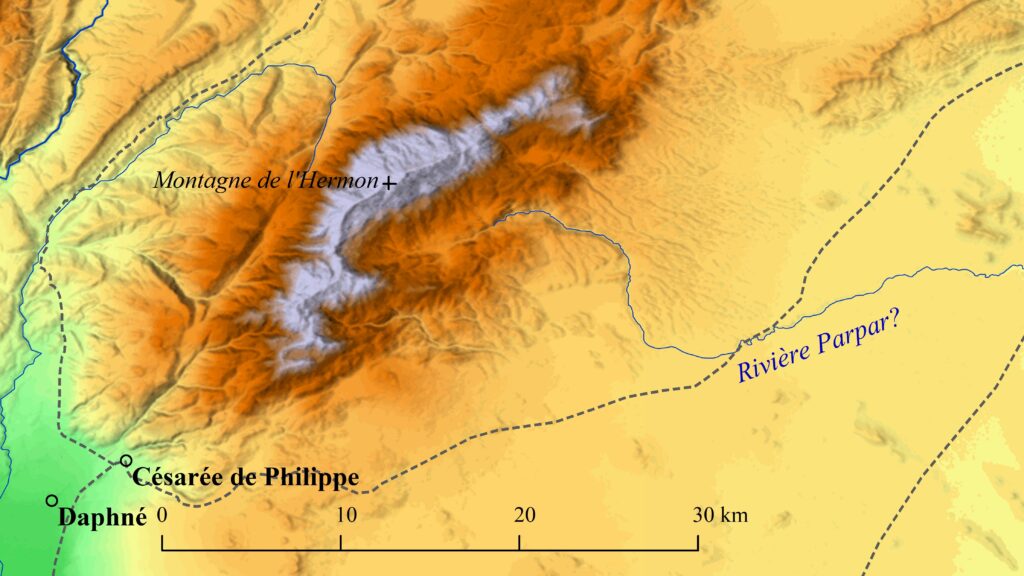
Despite their prayers for this child’s deliverance, no improvement was seen. Faced with this unexpected situation, the father decides to seek the help of Jesus the Messiah and begs him to intervene. These events take place the day after the transfiguration, still at Caesarea Philippi, at the foot of Mount Hermon.
The expression “the next day” in Luke 9.37 may indicate that the transfiguration took place at night and that Jesus and his apostles came down in the morning. Alternatively, they may have stayed there for several days.
The texts show that the apostles were not merely passive observers under the Master’s guidance; they also played an active role in bringing healing to the sick. Jesus had given his disciples the power to cast out demons and to heal the sick (Matthew 10.1, Luke 9.1-2, Mark 16.18 and Matthew 10.8). In this particular situation, however, their intervention proves insufficient and the intervention of Jesus the Messiah is essential.
The crowd recognized their authority and also appealed to the disciples (Matthew 17.16, Mark 9.18, Luke 9.40).
These three passages of the Synoptic Gospels recount the disciples’ failure to heal a child possessed by an evil spirit, which compels Jesus the Messiah to act. Here is a comparative analysis:
Summary of the texts
- Matthew 17.14-18: A man begs Jesus to heal his epileptic son, because the disciples failed to do so. Jesus the Messiah expresses his exasperation at the prevailing unbelief, then casts out the demon, healing the child immediately.
- Mark 9.14-27: This account is more detailed. Jesus returns to his disciples and finds a crowd debating with them. The child’s father describes the symptoms of possession: convulsions, muteness, foaming at the mouth. Jesus the Messiah stresses the importance of faith and, after an exchange with the father, drives out the spirit after a violent fit.
- Luke 9.37-45: The account is more concise. The day after the Transfiguration, a man implores Jesus the Messiah on behalf of his son, who suffers convulsions caused by a demon. Jesus the Messiah expresses his irritation at the unbelief, drives out the spirit and heals the child.
Comparison of the accounts
Contexte narratif :
Matthew and Mark place the event after the Transfiguration, whereas Luke specifies that it happens the next day.
Mark adds an interaction between Jesus the Messiah and the crowd, which is absent from Matthew and Luke.
Description of the symptoms:
Matthew speaks of epilepsy.
Mark gives more detail about the physical manifestations and stresses the muteness.
Luke mentions the convulsions but remains more concise.
Réaction de Jésus :
In all three accounts, Jesus expresses his exasperation at the unbelief.
Mark highlights the dialogue between Jesus the Messiah and the father, who expresses a wavering faith (“I believe; help my unbelief!”).
Healing:
In Matthew and Luke, the healing is immediate.
Mark describes one last convulsion before the child is raised up by Jesus the Messiah.
Mark stands out for his attention to detail and his emphasis on the father’s faith, whereas Matthew and Luke offer more condensed accounts. This diversity reflects the theological sensitivities of each evangelist.