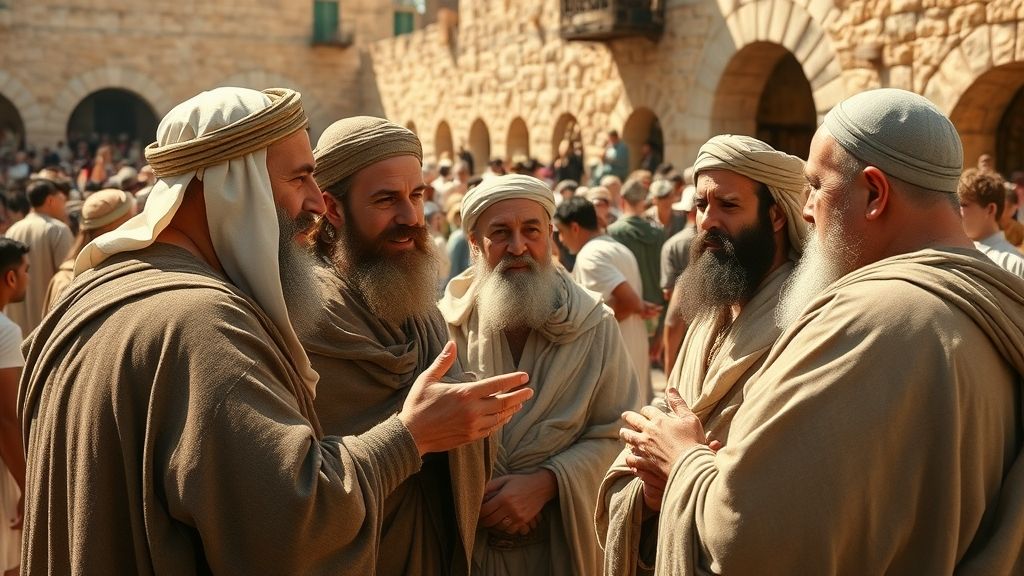

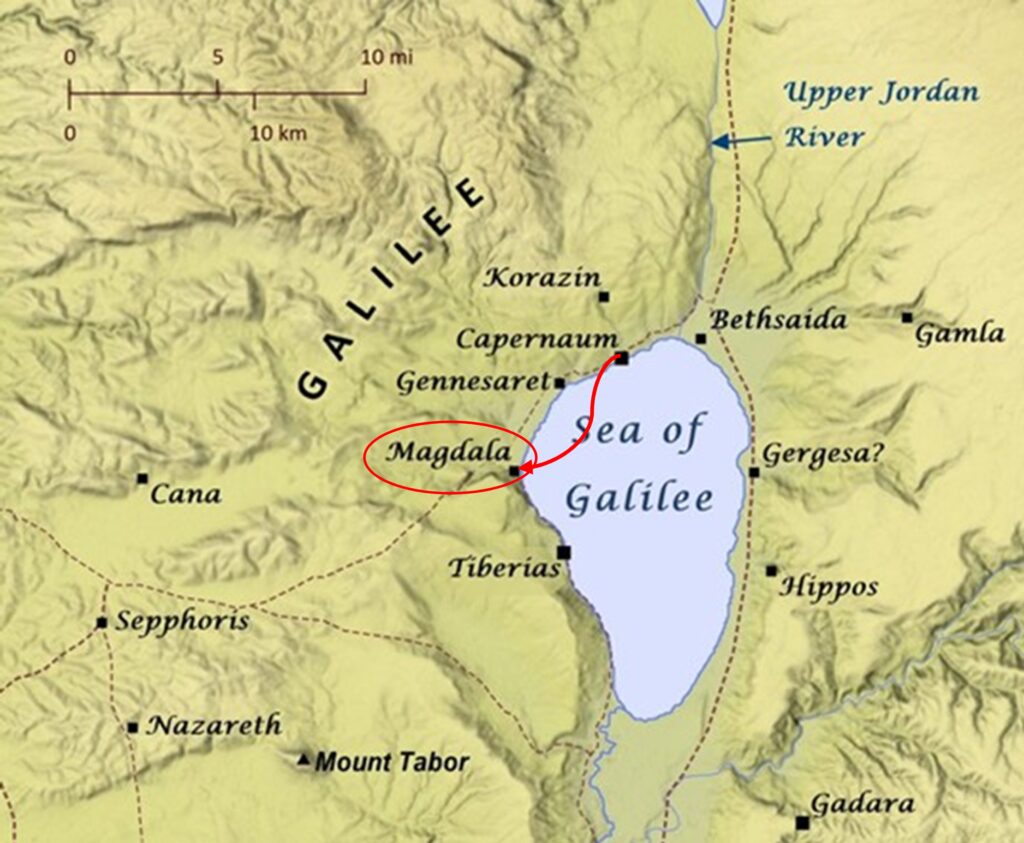
The Messiah Jesus and his apostles are currently in the city of Magdala (also known as ), where they are surrounded by a large crowd. But in the midst of this crowd are and (Matthew 16.1), who are looking for the slightest opportunity to discredit the Messiah Jesus in the eyes of the people.
The dialogue promises to be difficult. The and the ask the Messiah Jesus to perform a miraculous sign in their presence, in order to test him, as Matthew and Mark report. The many testimonies of healing already witnessed do not seem to convince them.
Summary of the texts
The passages of Matthew 16.1-4 and Mark 8.11-12 report a confrontation between Jesus and the (accompanied by the according to Matthew), who ask him for a miraculous sign to prove his divine authority.
In Matthew 16.1-4, the and the put the Messiah Jesus to the test by demanding a . Jesus answers them by denouncing their hypocrisy, explaining that they know how to interpret weather signs but are unable to discern spiritual signs. He refuses to give a sign, except that of Jonah, before leaving them.
In Mark 8.11-12, only the are mentioned. They seek to test Jesus by demanding a sign from heaven. Jesus, deeply grieved by their lack of faith, declares that no sign will be given to them and leaves their presence.
Comparison of the texts
The interlocutors: Matthew mentions the and the , whereas Mark names only the . This distinction may reflect the theological emphasis of each evangelist.
Jesus' reply :
- In Matthew, Jesus explicitly reproaches them for their inability to read the signs of the times and refers to the sign of Jonah, a symbol of his death and resurrection.
- In Mark, his reply is more concise and stresses the categorical refusal to grant a sign.
- The tone of the account: Mark emphasizes the emotion of the Messiah Jesus, who sighs deeply at the unbelief of the . Matthew, for his part, puts more weight on the argument and the reference to prophetic signs.
These passages underline the resistance of the religious leaders to recognizing the divine authority of Jesus and illustrate the growing tension between him and the religious authorities of his day. The sign of Jonah mentioned in Matthew foreshadows the crucifixion and the resurrection, which will be the true proofs of his mission.