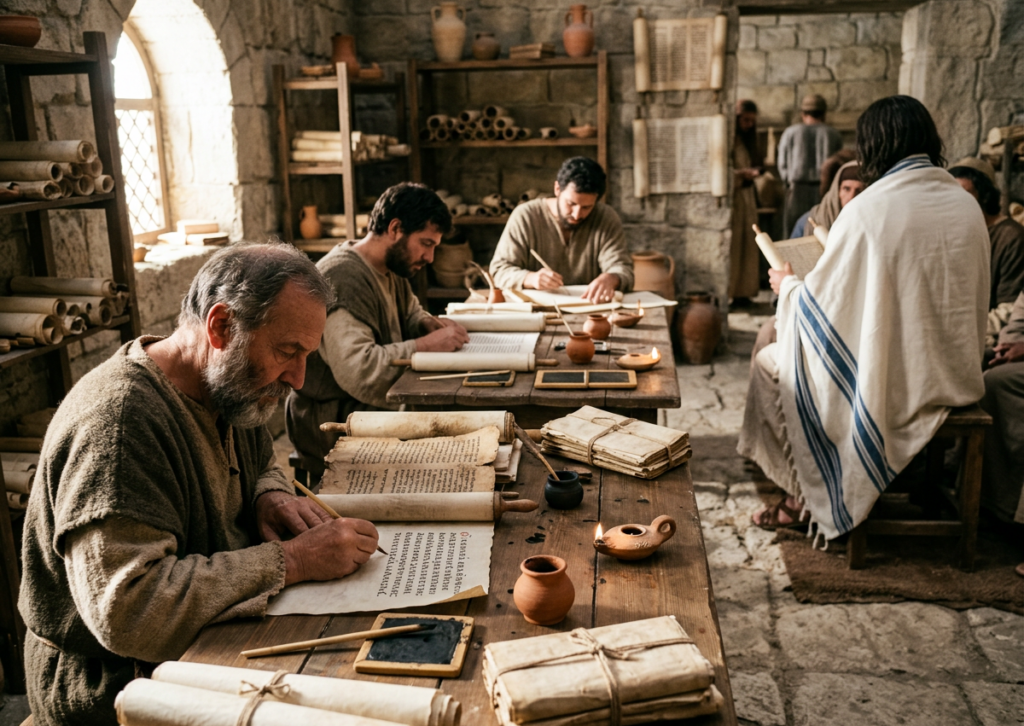
The article deals with the writing of the first five books of the Bible. It highlights oral transmission, writing, and the integration of various literary sources. The importance of textual preservation through the centuries is also addressed, as are the historical motivations of the writers.
8 min
Pentateuchoral traditionJahwist sourceBabylonian exile
4 verses
3 books
In this first section, we will examine the formation of the Pentateuch, which comprises the first five books of the and of our present-day Bibles. The transmission of their history was essential for the Jewish people. Indeed, it was imperative that future generations, especially their children, know how (God) had protected and preserved his people.
It was therefore necessary for future generations to take their place in this continuity, as the people of God, and to know their history. Moreover, these texts governed their lives on both the judicial and the religious level, thus giving these writings capital importance for Jewish society.
I. The Writing and Compilation of the First Texts of the Bible, the Pentateuch
1. Oral Tradition
The biblical accounts were first handed down orally. Before the stories were put in writing, they were memorized and told from generation to generation. These oral traditions included accounts of the patriarchs (Abraham, Isaac, Jacob), the Exodus from Egypt, and many other significant events in the history of the people of Israel. Oral transmission played a crucial role in preserving history and religious teachings (Exodus 13.8, Deuteronomy 4.9, Deuteronomy 6.7, Psalms 78.4).
2. The First Writings
The first books of the Bible, called the Torah or the Pentateuch, comprise Genesis, Exodus, Leviticus, Numbers and Deuteronomy. These texts began to be written at a time when the Israelites felt the need to record their oral traditions in order to preserve them and pass them on more faithfully.
Writing of the Torah: The writing of these books probably began in the time of Moses (13th century BC) and continued until the period of the Babylonian exile (6th century BC). The texts reflect different traditions and theological perspectives that were integrated over time.
3. The Documentary Sources
The documentary hypothesis proposes that the Pentateuch results from the combination of several distinct literary sources, each bringing its own theological and stylistic characteristics. The main sources are:
Jahwist Source (J): Uses the divine name Yahweh. Anthropomorphic and vivid accounts, probably originating in the kingdom of Judah (9th century BC).
Elohist Source (E): Uses the divine name Elohim. More formal style, divine revelations through dreams and angels. Originating in the kingdom of Israel (8th century BC).
Deuteronomist Source (D):The book of Deuteronomy, emphasizing the covenant and the law. Linked to the reforms of King Josiah (7th century BC).
Priestly Source (P):Focused on rituals, genealogy and religious laws. Compiled during and after the Babylonian exile (6th century BC).
4. Compilation of the Texts
Over time, these different sources were compiled by later editors to form a coherent text. This compilation process involved the selection, revision and integration of the texts, while preserving the diversity of the traditions.
5. Manuscripts and Transmission
The earliest biblical manuscripts were written in Hebrew, with a few portions in Aramaic. The oldest manuscripts of the , such as the Dead Sea Scrolls, date from the 2nd century BC and show a remarkable fidelity of transmission. They provide valuable clues about the scribal practices of the time and the way the texts were carefully preserved.
II. The Motivations of the Writers
The writing and compilation of the first texts of the Bible were long and complex processes, involving oral transmission, writing from various sources, and compilation by later editors. These efforts made it possible to preserve the history of this Jewish people.
The relationship between this people and God illustrates a unique political system, namely a theocracy. This model shows that God is regarded as capable of leading his people. Although he used intermediaries such as Moses, Joshua, Samuel and others, he remained the initiator, and it was his decisions that were carried out.
This testimony was to be handed down from generation to generation in order to encourage these men always to rely on God ().
This preliminary analysis lays the foundations of the complex and rich history of the Bible, highlighting the origin and writing of the first books making up the Jewish Torah. The next study will look at the other books making up the , which are found in today's Bibles.
Conclusion
The writing and compilation of the first texts of the Bible were long and complex processes, involving oral transmission, writing from various sources, and compilation by later editors. These efforts made it possible to preserve the history of this Jewish people.
The relationship between this people and God illustrates a unique political system, namely a theocracy. This model shows that God is regarded as capable of leading his people. Although he used intermediaries such as Moses, Joshua, Samuel and others, he remained the initiator, and it was his decisions that were carried out.
This testimony was to be handed down from generation to generation in order to encourage these men always to rely on God ().
This preliminary analysis lays the foundations of the complex and rich history of the Bible, highlighting the origin and writing of the first books making up the Jewish Torah. The next study will look at the other books making up the , which are found in today's Bibles.
A title, a person, a place, a reference (“Luke 15”)…
opens in a new window
Bible reference
INF038
Information note
INF038 - YHWH
YHWH
The tetragrammaton YHWH is the proper name of God used in the Hebrew Bible. Here is some key information:
Meaning and origin
Name of God:YHWH is regarded as the most sacred name of God in Judaism. It is often rendered "the LORD" or "Jehovah" in English.
Origin: The term "tetragrammaton" means "four letters" in Greek, referring to the four Hebrew letters יהוה (yod, heh, waw, heh).
Pronunciation
Unknown: The exact pronunciation of the tetragrammaton is unknown because, in Jewish tradition, it was forbidden to pronounce this name in order to avoid profaning it.
Substitutes: In its place, substitutes such as "Adonai" (Lord) or "HaShem" (The Name) are used.
Usage
Sacred text:The tetragrammaton appears frequently in the Torah and other writings of the Hebrew Bible. Ritual and prayers: In prayers and rituals, Jews generally use "Adonai" to replace YHWH when they read the sacred texts aloud.
Theological importance
Monotheism:YHWH underscores the uniqueness and exclusivity of God in the Jewish faith. Divine relationship:It expresses the personal relationship between God and the people of Israel, marking a divine revelation and a covenant.
The tetragrammaton is therefore a central and sacred element in Jewish theology and religious practice.
INF031
Information note
INF031 - The Torah
The Torah
The Torah is the central and most sacred text of Judaism. It is made up of the first five books of the Hebrew Bible, also known as the Pentateuch. These books are:
Law and teaching: The word "Torah" means "instruction" or "law" in Hebrew. It contains the laws, teachings and narratives that are fundamental to Jewish faith and practice. Liturgy:The Torah is read and studied regularly in the synagogues. Portions of the Torah are read aloud during religious services, especially on the Shabbat and on festival days.
Holy Scripture: The Torah is regarded as the divine word revealed to Moses on Mount Sinai.
Influence and interpretation
Exegesis: The Torah has been interpreted and commented on by generations of rabbis and scholars, giving rise to a rich tradition of rabbinic literature, including the Talmud and the Midrash. Ethics and morality: The teachings of the Torah form the basis of Jewish ethics and morality, guiding believers in their daily lives.
The Torah is therefore far more than a mere religious text; it is at the heart of the spiritual and cultural life of the Jewish people.
INF032
Information note
INF032 - The Pentateuch
The Pentateuch
The Pentateuch is a term that designates the first five books of the Jewish and Christian Hebrew Bible. Here is a brief description of each book:
Genesis: This book tells of the creation of the world, the story of Adam and Eve, Noah's flood, and the stories of the patriarchs Abraham, Isaac, Jacob and Joseph.
Exodus:It describes the departure of the Hebrews from Egypt under the leadership of Moses, and includes the Ten Commandments given at Mount Sinai.
Leviticus:This book contains laws and ritual regulations for the priests and the people of Israel.
Numbers: It narrates the journey of the Israelites in the wilderness for forty years and the various censuses that were taken.
Deuteronomy: This last book is a series of speeches by Moses reiterating and summarizing the laws for the people of Israel before they enter the Promised Land.
The Pentateuch is therefore fundamental to the Jewish and Christian traditions, laying the legal, moral and narrative foundations of these religions.
INF033
Information note
INF033 - Difference between the Pentateuch and the Torah
Difference between the Pentateuch and the Torah
The Pentateuch and the Torah are two closely related but not entirely synonymous terms. Here are the key differences:
Pentateuch
Origin of the term: It comes from the Greek "Pentateuchos," meaning "five books". Content: It specifically designates the first five books of the Jewish and Christian Hebrew Bible: Genesis, Exodus, Leviticus, Numbers, and Deuteronomy. Usage: Often used in an academic or Christian context to refer to this section of the Bible.
Torah
Origin of the term: It comes from the Hebrew "Torah," meaning "instruction" or "law". Content:In Judaism, the Torah refers to the same five books as the Pentateuch but also carries a broader connotation of divine instruction and law. Usage: Used mainly in a Jewish context to designate not only these five books, but also all the teachings and laws they contain.
Common points
Identical books: The five basic books are the same in both terms. Religious importance: Both are fundamental to Judaism and Christianity, providing the narrative and legal foundations of these religions.
In summary, the Pentateuch and the Torah designate the same set of books, but the Torah has a broader connotation in Judaism, encompassing divine instruction and law.
INF041
Information note
INF041 - The Jahwist source
The Jahwist source
The Jahwist source (or Jahwist), often abbreviated as J, is a hypothetical source of the Torah (the first five books of the Hebrew Bible) according to the documentary hypothesis. Here are some key points:
Origin and Definition
Documentary hypothesis: This hypothesis, developed in the 19th century by scholars such as Julius Wellhausen, proposes that the Torah is a compilation of four distinct sources: Jahwist, Elohist, Deuteronomist and Priestly. Divine name: The Jahwist source is so named because it frequently uses the divine name YHWH (or Yahweh) for God.
Characteristics
Style and theology: The Jahwist source is characterized by an anthropomorphic style, describing God with human traits. It emphasizes the relationship between God and human beings, as well as the land and human corruption1. Attributed passages: Passages such as the creation of man and woman (Genesis 2:4b-25), the fall of man (Genesis 3), and the call of Moses at the burning bush (Exodus 3:1-15) are attributed to this source.
Dating and validity
Dating: Scholars have proposed different periods for the writing of the Jahwist source, ranging from the monarchic period (10th century BCE) to the exilic/post-exilic period (6th-5th century BCE). Validity: The documentary hypothesis, including the Jahwist source, is no longer widely accepted by contemporary scholars, who prefer other models to explain the composition of the Torah.
The Jahwist source is therefore an important concept in the study of the Hebrew Bible, although its existence and importance are debated among scholars.
INF034
Information note
INF034 - Examples of the Jahwist source
Examples of the Jahwist source
Here are some examples of passages attributed to the Jahwist source (J) in the Bible. These examples are taken from the Pentateuch, the first five books of the Bible, where the Jahwist source is assumed to be prevalent:
Genesis 2.4-25: the creation of man and woman. This passage uses the divine name Yahweh God and describes God's actions in an anthropomorphic way, such as forming man from the dust and planting the garden of Eden. Genesis 3: the account of the fall of man. This passage also uses the name Yahweh God and presents God anthropomorphically, speaking directly with Adam and Eve. Genesis 4.1-16: the story of Cain and Abel. It uses the divine name Yahweh and describes a direct interaction between God and Cain. Genesis 6.1-8: the "sons of God" and the "daughters of men", as well as God's decision to shorten human lifespan and send the flood. This passage uses the name Yahweh. Genesis 7.1-5: part of the flood account in which God (Yahweh) gives specific instructions to Noah. Exodus 3.1-15: the call of Moses at the burning bush. This passage is famous for the revelation of the divine name Yahweh.
These examples are based on the analysis of the stylistic and theological differences between the texts. The precise attribution may vary depending on scholars' interpretations.
INF042
Information note
INF042 - The Elohist source
The Elohist source
The Elohist source (or Elohist), often abbreviated as E, is a hypothetical source of the Torah according to the documentary hypothesis. Here are some key points about it:
Origin and Definition
Documentary hypothesis: This hypothesis, developed in the 19th century, proposes that the Torah is made up of several distinct sources: Jahwist (J), Elohist (E), Deuteronomist (D) and Priestly (P).
Divine name: The Elohist source is so named because it frequently uses the divine name Elohim for God, rather than YHWH.
Characteristics
Style and theology: The Elohist source is characterized by a more transcendent view of God, avoiding anthropomorphisms. It often emphasizes prophecy and divine revelation through dreams and visions. Attributed passages: Certain accounts, such as the call of Abraham (Genesis 20), Jacob's dream at Bethel (Genesis 28.10-22), and parts of the story of Joseph are attributed to this source.
Dating and validity
Dating: Scholars estimate that the Elohist source was written during the time of the northern kingdom of Israel, between the 9th and 8th centuries BCE. Validity: Like the Jahwist source, the validity of the Elohist source and of the documentary hypothesis in general is debated among contemporary scholars, some of whom prefer other models to explain the composition of the Torah.
In summary, the Elohist source is a theoretical component of the critical study of biblical texts, offering a particular perspective on the relationship between God and human beings.
INF035
Information note
INF035 - Examples of the Elohist source
Examples of the Elohist source
Here are some biblical passages often attributed to the Elohist source (E). This source mainly uses the divine name Elohim and is distinguished by a more formal style and by accounts in which God reveals himself through dreams and angels.
Genesis 20.1-18: the story of Abraham and Abimelech. God (Elohim) appears to Abimelech in a dream to warn him against taking Sarah, Abraham's wife. Genesis 21.8-21:the expulsion of Hagar and Ishmael. God (Elohim) hears the child's cries and sends an angel to comfort Hagar and show her a well of water. Genesis 22.1-19: the sacrifice of Isaac. God (Elohim) tests Abraham by asking him to sacrifice his son Isaac, but an angel of God stops him at the last moment. Genesis 28.10-22: Jacob's dream at Bethel. God (Elohim) appears to Jacob in a dream and promises him the land on which he is sleeping, as well as many descendants. Genesis 31.1-55: Jacob's flight from Laban's house. God (Elohim) appears to Laban in a dream and orders him not to harm Jacob. Jacob then recounts how God (Elohim) guided him throughout his stay with Laban. Exodus 1.1-2.25: the oppression of the Israelites in Egypt. This passage describes the rise of Moses and the call of God (Elohim) to free his people. Exodus 3.1-15 (in part): the call of Moses. God (Elohim) speaks to Moses through the burning bush, although this passage also contains elements of the Jahwist source.
These examples are based on the analysis of the linguistic and theological characteristics attributed to the Elohist source. The precise attribution may vary depending on scholars' interpretations.
INF043
Information note
INF043 - The Deuteronomist Source
The Deuteronomist Source
The Deuteronomist (or Deuteronomic) source, often abbreviated as D, is one of the four hypothetical sources of the Torah according to the documentary hypothesis. Here are some essential points:
Origin and Definition
Documentary Hypothesis: This hypothesis proposes that the Torah is composed of four distinct sources: Yahwist (J), Elohist (E), Deuteronomist (D) and Priestly (P).
Name: The Deuteronomist source is so named because of its close association with the Book of Deuteronomy.
Characteristics
Style and Theme: It is characterized by a homiletic style and a theological perspective centered on faithfulness to the covenant between God and Israel, with an emphasis on laws and religious reforms. Attributed Passages: Besides Deuteronomy, Deuteronomistic influences are often attributed to the historical books such as Joshua, Judges, 1 Samuel, 2 Samuel, 1 Kings and 2 Kings.
Dating and Origin
Dating: The Deuteronomist source is generally dated to the 7th century BCE, in the time of King Josiah of Judah. Composition: It may have been written by priests and scribes close to the Temple in Jerusalem, as part of Josiah's religious reforms aimed at centralizing worship in the Temple in Jerusalem.
Validity and Acceptance
Validity: Although widely accepted by many scholars, the existence of the Deuteronomist source remains a hypothesis, and other models have also been proposed to explain the formation of the Torah.
The Deuteronomist source is thus an important theoretical component for understanding the structure and development of the biblical texts, particularly with regard to the laws and the covenant.
INF036
Information note
INF036 - Examples of the Deuteronomist source
Examples of the Deuteronomist source
The Deuteronomist source (D) is mainly characterized by specific theological and legislative themes, as well as by a distinct style. It is mainly associated with the book of Deuteronomy, but its influence is also found in the historical books of Joshua, Judges, 1 and 2 Samuel, and 1 and 2 Kings. Here are some examples of passages attributed to the Deuteronomist source:
Deuteronomy 5.1-22:the Ten Commandments: This passage reiterates the Ten Commandments given to the people of Israel, stressing the importance of following the divine laws. Deuteronomy 6.4-9: Shema Israel: "Hear, O Israel: the the Eternal our God, the the Eternal is one." This passage underscores the uniqueness of God and the importance of love and obedience to his commandments. Deuteronomy 12.1-14: centralized place of worship: The passage insists that worship must be centralized in a single place that God will choose, probably Jerusalem. Deuteronomy 28.1-68: blessings and curses: This passage describes the blessings for obeying God's commandments and the curses for disobedience. Joshua 1.1-9: call of Joshua: After the death of Moses, God speaks to Joshua, reminding him to be strong and courageous and to follow the law given by Moses. 1 Samuel 12:Samuel's speech: Samuel reminds the people of God's deeds, urges them to follow the commandments and warns of the consequences of disobedience. 2 Kings 22.1-20: Josiah's reform: This passage describes the religious reform of King Josiah after the discovery of the book of the law in the temple, which is often associated with the rediscovery of Deuteronomy. Judges 2.11-23: cycle of judgment: This passage describes the cycle of disobedience, oppression, repentance and deliverance that characterizes the book of Judges, reflecting a Deuteronomistic theology of reward and punishment based on faithfulness to the covenant.
These examples show how the Deuteronomist source emphasizes the law, the covenant, the centralization of worship, and the consequences of obedience or disobedience to God.
INF044
Information note
INF044 - The Priestly Source
The Priestly Source
The Priestly source (or P, for "Priestly") is one of the four hypothetical sources of the Torah according to the documentary hypothesis. Here are the key points to know:
Origin and Definition
Documentary Hypothesis: This hypothesis proposes that the Torah is composed of four distinct sources: Yahwist (J), Elohist (E), Deuteronomist (D) and Priestly (P). Name: The Priestly source is so named because of its close connection with the interests and perspectives of the priests (sacrificers) of Israel.
Characteristics Style and Content: The Priestly source is characterized by a formal, structured and repetitive style. It emphasizes laws, rituals, genealogies, and cultic concerns. Theology: It presents God as transcendent and majestic, often distant, with a particular concern for ritual purity and the rules of worship.
Attributed Passages: Sections such as the creation account in Genesis 1, the Levitical laws and the detailed descriptions of ceremonies in the book of Leviticus are attributed to this source.
Dating and Origin
Dating: The Priestly source is generally dated to the period of the Babylonian exile or the post-exilic period (6th-5th century BCE). Authors: It is thought to have been written by priests and scribes of the Temple community in Jerusalem, with the intention of codifying cultic practices and priestly traditions.
Validity and Acceptance
Validity: As with the other sources of the documentary hypothesis, the validity of the Priestly source is debated among contemporary scholars. Some prefer alternative models to explain the composition of the Torah.
In summary, the Priestly source is an important theoretical component for understanding the emphasis on rituals and laws in the biblical texts.
INF037
Information note
INF037 - Examples of the Priestly source
Examples of the Priestly source
The Priestly source (P) is distinguished by its concern for ritual, religious laws, genealogies, and a formal, structured style. It frequently uses the divine name Elohim in the early chapters, then Yahweh after Exodus 6. Here are some examples of passages attributed to the Priestly source in the Bible:
Genesis 1.1-2: the Creation account: This passage describes the creation of the world in seven days. It is characterized by a formal, repetitive structure, with phrases such as "And God said" and "There was evening, and there was morning". Genesis 5: genealogy from Adam to Noah: A genealogical list detailing the descendants of Adam down to Noah. This type of genealogy is typical of the Priestly source. Genesis 17: covenant of circumcision: This passage describes God's covenant with Abraham, marked by the practice of circumcision. The formal style and ritual details are characteristic of the Priestly source. Exodus 25-31: instructions for building the Tabernacle: These chapters provide detailed instructions for building the Tabernacle, the priestly garments, and the rituals. The attention to detail and the emphasis on ritual are typical of the Priestly source. Leviticus, the whole book:Leviticus is mainly attributed to the Priestly source. It contains laws about sacrifices, ritual purity, holy days, and various regulations for the priests and worship. Numbers 1-10: censuses and organization of the camp: These chapters describe the censuses of the tribes of Israel, the organization of the camp around the Tabernacle, and the responsibilities of the Levites. Numbers 16-17:Korah's rebellion: This story underscores the importance of priestly authority and rituals. It shows how God confirms the priesthood of Aaron and his descendants.
These examples illustrate the concerns of the Priestly source for religious structures, rituals and genealogies, as well as its distinctive style.
INF010
Information note
INF010 - The unpronounceable name of God
YHWH, the unpronounceable name of God
The name of God, transcribed in French as YHWH, is considered unpronounceable because it consists of four Hebrew consonants: Yod (י), He (ה), Waw (ו) and He (ה).
Vowels are not written in Hebrew, which makes the exact pronunciation uncertain. This name appears about 6,800 times in the Hebrew Bible and is considered holy.
In accordance with the third commandment, which forbids taking the divine name in vain (Exodus 20.7), Jews avoid pronouncing it. Instead, they use other terms such as Adonai (my Lord) or Ha Elohim (the God). Some Bible translations also use the names Yahvé, Yahweh or Jehovah to represent the Tetragrammaton.
The Tetragrammaton would eventually be translated by the Greek word Kyrios, meaning Lord, which would in turn be replaced by ‘the Eternal’ in our Protestant Bibles.
The One God of the Jews, who is also the God of Christians, therefore has an unpronounceable name.
INF012
Information note
INF012 - The different Bible versions
The different Bible versions
There are not several Bibles, whether Protestant, Catholic or otherwise. There are different translations, all of which have the same origins: Greek texts for the New Testament and Hebrew texts for the Old Testament.
The Hebrew Bible contains only the Old Testament.
It is important to note that the so-called New World Translation is subject to criticism, particularly because certain translation choices were made to bring it into line with Jehovah's Witnesses' theology. Some scholars regard these choices as dishonest and indefensible.
The meanings of our words change over time, and some words disappear. It therefore becomes necessary to use terms that readers can understand, hence the successive adaptations.
These are often merely revisions, as we see with the different versions of Louis Segond's or Augustin Crampon's translations. Catholic Christians have added seven further books to their translations, exclusively in the Old Testament. These books are called deuterocanonical or apocryphal.