ANN020

The regulation of fishing

The article describes fishing in the time of Jesus, especially on Lake Tiberias in Galilee, examining its economic and spiritual importance. It describes the tax burdens weighing on fishermen and the tensions with the Romans. The lake is crucial for local resources, but faces environmental challenges.

13 min Galilee fishing Lake Tiberias taxes 7 verses 4 books

Further information

Introduction

The Synoptic Gospels focus mainly on the ministry of the Messiah Jesus in Galilee, especially in the region of Capernaum. To discover his work in Judea, specifically in the region of Bethany and Aenon, one must turn to the Gospel of the apostle John.

Galilee enjoys a climate very favorable to agriculture, as well as an abundance of fish in the , also called Lake Tiberias or Gennesaret.

That is why the majority of the apostles carried out occupations connected with fishing in this sea.

All commercial transactions, including fishing, were subject to taxes. Even salt, used to preserve fish, was taxed.

This study aims to emphasize how heavily the tax burden weighed on the people, thus breeding an aversion toward the authorities, and especially toward the .

I. Lake Tiberias

The lake lies in the northeast of Israel, in Lower Galilee, about 200 meters below sea level. This makes it one of the lowest points on earth that is not covered by the ocean.

Lake Tiberias measures about 21 km in length and 13 km in width, with a maximum depth of about 43 meters. It is the largest freshwater lake in Israel.

The lake is famous for its importance in the New Testament. Several major events in the life of Jesus Christ, such as the walking on water, the calming of the storm, and the miraculous catch of fish, are believed to have taken place on or near its waters.

Lake Tiberias is fed mainly by the Jordan River and is a vital water for Israel. It plays a crucial role in the country’s water supply.

The lake is known for its biodiversity, especially the species of fish that live in it, some of which are mentioned in the Bible, such as the barbel and “St. Peter’s fish.” Fishing has long been an important economic activity for the communities living around the lake.

Like many bodies of water around the world, Lake Tiberias faces environmental problems today, notably a drop in the water level due to overuse and drought, as well as pollution.

In short, Lake Tiberias is not only a site of great natural beauty but also a place of immense historical and spiritual significance, while being vital to Israel’s water resources.

II. The abundance of fish

The , rich in fish, is the main of economic activity in the region, supporting many families and facilitating export. Near Capernaum, fish-processing facilities have been established, where the fish is generally dried or salted for better preservation.

Israeli studies have identified up to 27 different species of fish in the sea. In the time of the apostles, three species dominated: the sardine, the barbel, and St. Peter’s fish. Sardines, often caught in this sea, were the staple food of the poor and were probably the two fish that the young boy had brought along with the five loaves Mark 6.39.

The barbel, which lives at the bottom of the water and can reach up to 25 cm, is harder to catch and represents an important share of professional net fishing, just like St. Peter’s fish.

The latter, which can measure up to 45 cm and weigh 1.5 kg, plays a crucial role in the balance of the marine ecosystem thanks to its diet of algae.

The 153 large fish mentioned by John 21.11, were probably St. Peter’s fish, representing an exceptional catch of nearly 200 kg.

The fishermen used different types of nets. Cast nets were thrown by hand into shallow water, while dragnets were used to fish in deeper water.

Fishing was often done at night, the fishermen spending long hours on the lake, as the story of the miraculous catch tells, where Jesus asks Peter to cast his nets after a fruitless night.

Boats make it possible to reach more distant areas for a more abundant catch. However, buying a boat was often beyond financial reach, forcing some to resort to renting.

Fishing from the shore yielded smaller results, and many worked for fleet owners. Despite the abundance of fish at the time, the financial stability of these fishing businesses was fragile.

The two miraculous catches described in the Gospels show that sometimes, even after long hours of work, the fishermen came back empty-handed Luke 5.5.

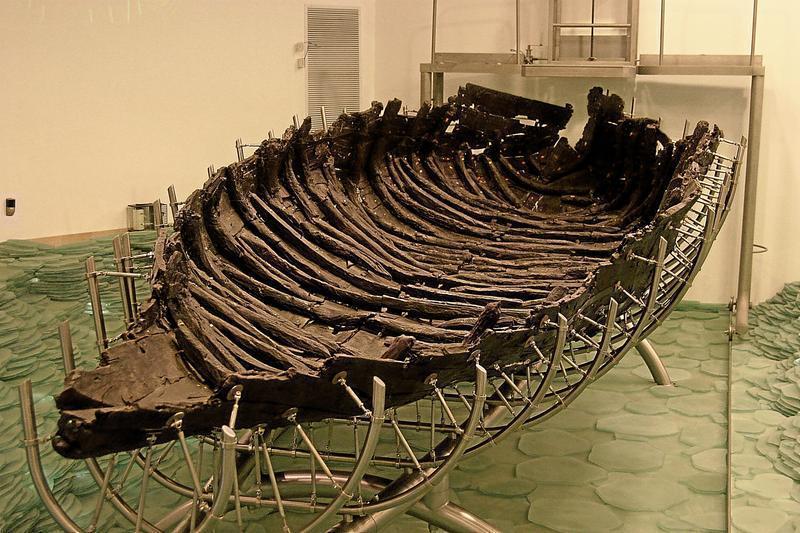
The fishermen used relatively small boats to sail on the lake and spread their nets. An example of this type of boat was discovered in 1986 near the and is often called the “Jesus Boat.”

Although there is no proof that it belonged to Jesus or his disciples, it gives a good idea of the size and style of the fishing boats of the time.

The growing poverty of the population, crushed by taxes, caused in the time of the Messiah Jesus exoduses of population toward Galilee, where natural abundance helped the people to survive.

Despite everything, overfishing in the led to a rapid decline in fish resources.

III. The apostles as fishermen

Several of Jesus’ apostles were professional fishermen before following him. Among them, the most notable are Simon Peter and his brother Andrew, as well as James and John, sons of Zebedee.

These men lived and worked on the shores of the , a region known for its flourishing fishing.

These fishermen of the grouped together in guilds, which depended heavily on fishing. These communities were often tight networks of families and friends who worked together.

In the Gospels, notably in that of Matthew 4.18-22, we find the account of their calling. Jesus meets Simon (who would later be called Peter) and Andrew casting a net into the sea, for they were fishermen.

He said to them:

Matthew 4.19 (King James Version) :
And he saith unto them, Follow me, and I will make you fishers of men.

Mark 1.17 (King James Version) :
And Jesus said unto them, Come ye after me, and I will make you to become fishers of men.

Shortly afterward, he sees two other brothers, James son of Zebedee and his brother John, in a boat with their father Zebedee, mending their nets. He calls them as well, and they follow him, leaving behind their boat and their father.

This experience of fishing probably shaped their character, their endurance, and their capacity for hard work. Moreover, the and the lessons drawn from fishing are often used by Jesus in his teaching, speaking to them in a language they understand well.

For example, the idea of “fishing for men” suggests the act of gathering people into the kingdom of God, a concept they could easily grasp given their daily trade.

IV. Fishing and taxes

We can imagine Zebedee, the husband of Salome and the father of James and John, as a wealthy business owner. He has workers and several boats, but that does not mean he had fabulous income.

Indeed, at that time, the king imposed very high taxes directly on fishing. Matthew, the tax collector, probably knew the business of Zebedee and sons, working in Capernaum.

This scene from Mark 1.19-20, takes place in Capernaum. Levi, who is also called Matthew, the author of the Gospel, knows the legislation well because he is also responsible for collecting the tax on fishing.

All these sums were intended for the one who passes himself off as a king, Herod Antipas. The Roman authority had granted him this favor of keeping the fishing taxes for himself in order to support his lavish lifestyle.

The population of the time was subjected to unbearable tax pressure. Under these conditions, we better understand the permanent insurrectionary climate and the leaders’ fear of triggering a revolt of the Jews.

The Messiah Jesus, passing by the toll office of Capernaum, will call Matthew, also named Levi, to follow him. We deduce from this call that the Messiah Jesus had already had one or several conversations with Matthew, although no written record of it remains.

We observe that some Jews did not hesitate to work for the Roman occupier, which led to their rejection by the people. These collaborators were, in general, hated by their fellow citizens.

Conclusion

The main concern of the Roman authority regarding conquered countries was the collection of the various taxes. They therefore maintained a certain political and social peace, since any revolt or sedition could only hinder these sources of revenue.

The population, in the time of the Messiah Jesus, was crushed by all sorts of taxes and levies for the benefit of the , the king, or the religious authorities. Fishing was therefore monitored, and the Roman army took it upon itself, when necessary, to remind the reluctant of the obligation to pay these taxes.

This situation led to a general impoverishment of the population and to exoduses toward the lush province of Galilee. From all this information we can deduce that the Apostles and the Messiah Jesus did not live in opulence, like the vast majority of people of that time.