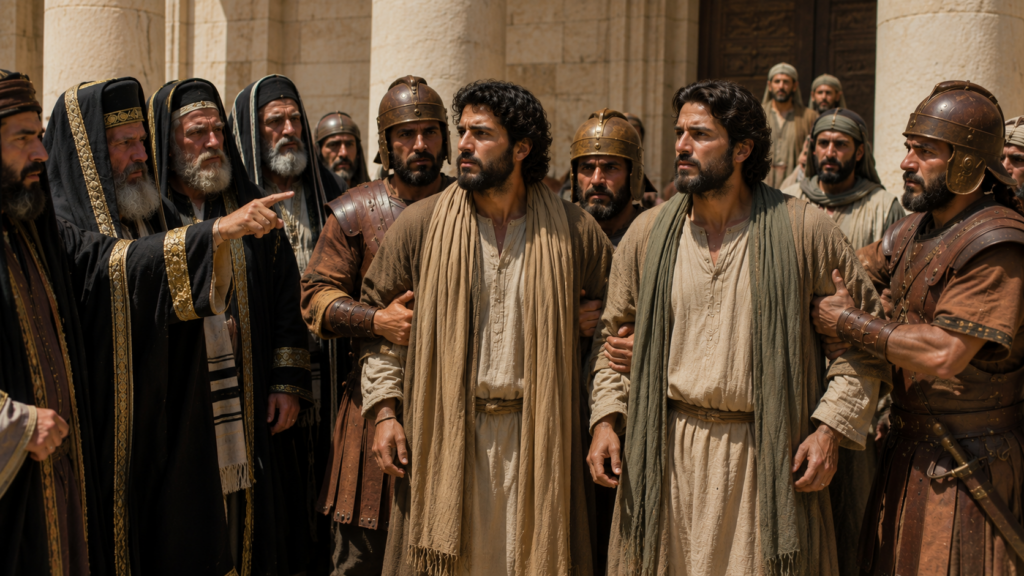

The healing of the man lame from birth and the speech that follows quickly attract the attention of the Jewish religious authorities. While Peter is still addressing the crowd, the priests, the captain of the Temple and the intervene and have Peter and John arrested (Acts 4.1-3).
Luke specifies that they were deeply irritated to see the disciples continuing the work of Jesus and above all proclaiming, through His resurrection, that of the dead (Acts 4.2). This last claim particularly offended the , who believed neither in the resurrection nor in the existence of angels (Matthew 22.23; Acts 23.8).
2- An unexpected situation for the leaders of the people
The surprise of the religious leaders must have been considerable. A few weeks earlier, they had obtained the condemnation and execution of Jesus (John 19.15-16) and could reasonably think they had thereby put an end to the movement He had started. Yet they now discover that His disciples have taken up the torch and are publicly continuing His work.
What is more, they note that a man lame from birth, well known to the inhabitants of Jerusalem, has been miraculously healed (Acts 3.2; Acts 4.16). Such a miracle makes any attempt at contradiction particularly difficult.
3- An arrest carried out with caution
The authorities therefore decide to have arrested those whom they regard as the main persons responsible for this religious agitation. However, they seem to avoid any use of violence, for fear of provoking a reaction from the people. The crowd remains favorable to the apostles, and many glorify God for this miracle (Acts 4.21).
This caution recalls the attitude that the members of the had already adopted during the ministry of Jesus, when they repeatedly feared the reactions of the people (Matthew 21.26; Mark 12.12).
4- A remarkable growth of the Church
Since Pentecost, the Christian community of Jerusalem has been experiencing remarkable growth. The group of about one hundred and twenty disciples, mentioned earlier (Acts 1.15), had already grown considerably following Peter's first speech, about three thousand people having joined the Church (Acts 2.41).
Luke now specifies that the number of believers reaches about five thousand men (Acts 4.4). This indication shows that the first Christians were aware of the importance this nascent community had taken on, even if this figure should probably be understood as an estimate.
5- Why had the authorities not intervened earlier?
The absence of intervention by the authorities at Pentecost can be explained by several factors. Jerusalem was then welcoming a considerable crowd of pilgrims who had come to celebrate Shavuot (Acts 2.5), which made any repressive action particularly delicate. Moreover, the religious leaders were doubtless far from imagining the scale this movement would take.
A few weeks later, the situation looks different. The authorities realize that the movement begun by Jesus did not die out with His death, but that it continues to grow in the very heart of Jerusalem.
6- The first apostles imprisoned
In these circumstances, the arrest of the two main spokesmen of the movement appears, in the eyes of the authorities, as the most effective means of trying to curb this expansion. Peter and John thus become the first apostles to experience imprisonment because of their testimony, fulfilling the warnings that Jesus had given them during His ministry (Matthew 10.17-18; John 15.20).
Paradoxically, this first persecution marks the beginning of an opposition which, far from making the Church disappear, will contribute to its progress and spread, in keeping with the program announced by the Lord (Acts 1.8).
7- The beginnings of opposition against the Church
It is possible that the Christian community, quickly informed of the arrest of Peter and John, gathered in prayer to seek God's help. This hypothesis seems all the more likely since Luke will report a little further on a prayer meeting following their release (Acts 4.23-31).
The reality of persecution now tempers the enthusiasm aroused by the first successes of the apostolic preaching. The newborn Church discovers that it will have to learn to live in the midst of opposition and to rely constantly on the assistance of the Holy Spirit. A new stage of its history begins, marked both by growth and by the first manifestations of the hostility of the religious world.
The
The