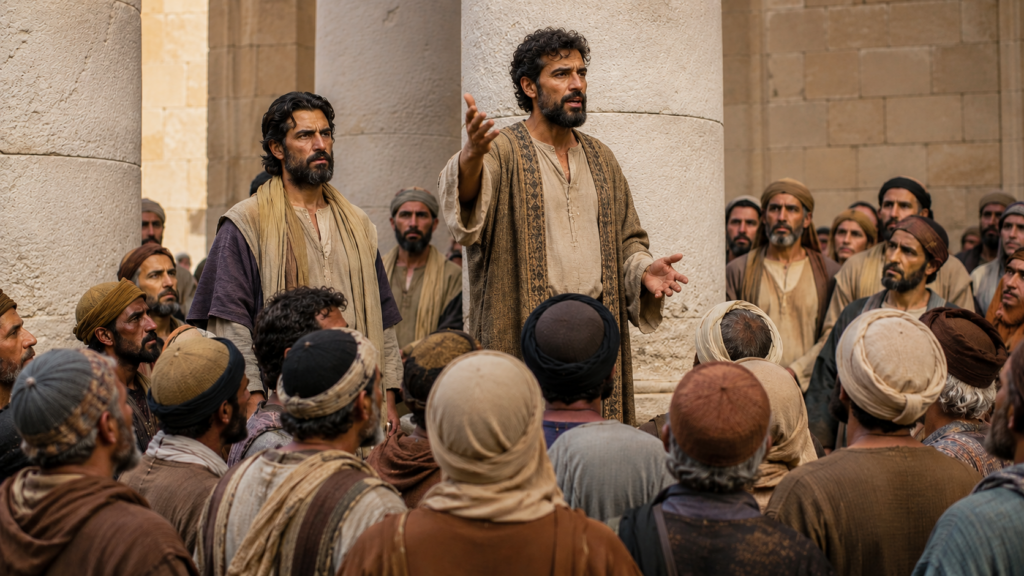


Only a few days after the great speech delivered at Pentecost on Sunday, May 22, 33 (Acts 2.14-40), Peter and John find themselves once again at the Temple, this time before a considerable crowd that has come to see the spectacular healing of a man lame from birth, well known to the inhabitants of Jerusalem (Acts 3.1-10).
As at Pentecost, Peter sees in this miracle a new opportunity to proclaim the Gospel and naturally speaks up in order to explain to the crowd the meaning of this extraordinary event.
2- A message centered on the person of Christ
Peter's speech, particularly forceful, recalls in certain respects that of John the Baptist. Like the forerunner, he calls his hearers to repentance and conversion (Matthew 3.1-2; Acts 3.19). However, his message is distinguished by its deeply Christ-centered character.
All his argument converges on the person of Jesus the Messiah, His death, His resurrection and His glorification with the Father (Acts 3.13-15). Without using the theological vocabulary that will be developed later in the epistles, Peter already presents the foundations of the redemption accomplished by the sacrifice of Christ. The One who had been rejected and delivered to death by men was raised and exalted by God (Acts 3.15).
It is henceforth in His name that miracles are performed and that the forgiveness of sins is offered to men (Acts 3.16; Acts 3.19).
3- Repentance and the times of refreshing
Unlike the speech at Pentecost, Peter here makes no explicit mention of water baptism or of the gift of the Holy Spirit. His immediate aim is above all to interpret the and to show that Jesus is indeed the Messiah announced by Moses and the prophets (Deuteronomy 18.15; Acts 3.22-24).
He also insists on the necessity of repentance so that sins may be wiped out and the times of refreshing announced by God may come (Acts 3.19-21).
4- The impact of the speech
Luke does not report the immediate results of this second preaching with the same precision as he did for the speech at Pentecost. It is moreover possible that a significant part of the audience had already heard Peter a few days earlier and had already joined the young Christian community (Acts 2.41).
Nevertheless, the swift reaction of the religious authorities, who have Peter and John arrested (Acts 4.1-3), shows that this new speech had a considerable impact. Luke indeed specifies that “many of those who had heard the word believed” and that the total number of believers then reached about five thousand men (Acts 4.4).
It is therefore likely that this second preaching contributed significantly to the growth of the Church in Jerusalem, although it is impossible to determine precisely how many new believers were added on this occasion.
5- Peter and John, two inseparable coworkers
John accompanies Peter throughout these events, but Luke reports no word from him. This silence does not mean that he remains inactive. The clearly regard Peter and John as inseparable actors in this missionary work and will have them appear together before the (Acts 4.13).
Since the Gospels, these two disciples appear frequently associated (Luke 22.8; John 20.2-8), and the book of Acts confirms this close collaboration.
Luke does not say more about where the other apostles are, nor the one hundred and twenty disciples mentioned earlier (Acts 1.15). The narrative focuses essentially on Peter and John, without however excluding the presence of other believers nearby. This literary focus allows Luke to highlight the particular role played by these two men in the early days of the Church.
6- Miracles at the service of preaching
Luke's accounts show that miracles regularly become opportunities to proclaim the Gospel. They are never an end in themselves, but draw the attention of the crowds in order to lead them to the Messiah Jesus.
Peter naturally appears as the main spokesman of the apostolic group, a role he already exercised during the earthly ministry of the Lord (Matthew 16.16; John 6.68-69).
7- Continuity with the preaching of the prophets
The call to repentance was nothing new for the Jewish hearers. This notion had long belonged to the spirituality of Israel and held an important place in the teaching of the prophets (Isaiah 55.7; Joel 2.12-13). John the Baptist himself had taken up this theme at the beginning of his ministry (Matthew 3.1-2).
Peter's hearers were therefore not at all surprised to hear this call to return to God. The real novelty lay elsewhere: the foundation of salvation was no longer sought in the sacrifices of the Temple, but in the very person of Jesus Christ.
Peter now presents the crucified and risen Messiah as the fulfillment of the promises made to the patriarchs and the prophets (Acts 3.25-26). Thus, the apostolic preaching stands in continuity with biblical Judaism while inaugurating a new stage in the history of salvation, centered on the person and redemptive work of the Lord Jesus Christ.
8- An essentially Jewish audience
Peter's second speech is manifestly addressed to an essentially Jewish audience. Delivered within the Temple precincts, it rests entirely on the Scriptures of Israel and appeals to references familiar to the Jews of the first century.
Peter addresses his compatriots as the heirs of the promises made to Abraham and to the prophets. His aim is not to make them discover the God of Israel, whom they already know, but to show them that Jesus of Nazareth is the Messiah announced long ago and that it is in Him that the promises of the covenant now find their fulfillment (Acts 3.25-26).
The