
We are now at the day of Pentecost, called Shavuot by the Jews. This feast, instituted by the Law of Moses, was celebrated fifty days after the feast of firstfruits (Leviticus 23.15-16). If we adopt Sunday, April 3, 33, as the date of the resurrection of Jesus the Messiah, the fiftieth day brings us to Sunday, May 22, 33. It was on this occasion that the promise announced by Jesus a few days before his ascension was fulfilled: “you will be baptized with the Holy Spirit not many days from now” (Acts 1.5).
2- The disciples gathered in one place
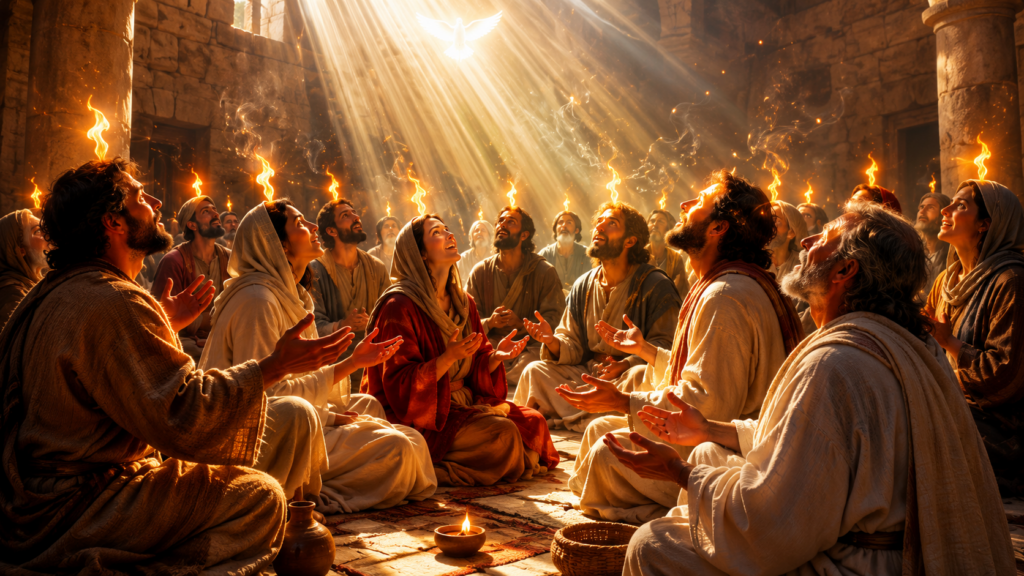
When Luke specifies that the disciples “were all together in one place” (Acts 2.1), he seems to refer to the one hundred and twenty believers mentioned earlier (Acts 1.15). This detail implies that they did not live continually gathered together, but had formed the habit of meeting regularly for prayer and fellowship.
The information Luke provides later also shows that they devoted themselves together to fellowship and shared their possessions according to each person's need (Acts 2.42-47; Acts 4.32-35). The spiritual unity of this group is also evident in the perseverance in prayer that had characterized the days before Pentecost (Acts 1.14).
3- The extraordinary manifestations of the Spirit
Luke then reports the outpouring of the Holy Spirit, which concerned all the disciples, men and women without distinction. This universality is already the fulfillment of Joel's prophecy announcing that God would pour out his Spirit “on all flesh” (Joel 2.28-29), a prophecy that Peter would quote a few moments later (Acts 2.16-18).
This divine manifestation is accompanied by extraordinary phenomena: a sound like that of a mighty rushing wind fills the whole house, and then there appear tongues that Luke compares to tongues of fire, which divide and rest on each of the disciples (Acts 2.2-3). The vocabulary used underlines the analogical character of the description. Luke does not speak of a real wind or a material fire, but of a supernatural phenomenon that he tries to convey in human language.
In the Scriptures, wind and fire are frequently associated with manifestations of the divine presence (Exodus 19.18; 1 Kings 19.11-12; Ezekiel 37.9-10).
4- The gift of tongues
The result of this outpouring is clearly set out: all the disciples were filled with the Holy Spirit and began to speak in as the Spirit gave them utterance (Acts 2.4).
Nothing in the account suggests that this was unintelligible speech. On the contrary, the disciples proclaim “the mighty works of God,” and the hearers understand this message in their own native language (Acts 2.11). This phenomenon is a sign intended to authenticate the work of God and to announce the future universality of the Gospel, in keeping with the mission Jesus entrusted to his disciples (Acts 1.8; Matthew 28.19-20).
5- A crowd from the whole Mediterranean world
The noise caused by these events quickly drew a large crowd. Among the witnesses were devout Jews and proselytes who had come from many regions of the Mediterranean world to celebrate the feast of Shavuot (Acts 2.5).
Luke gives an impressive list of the peoples represented: Parthians, Medes, Elamites, residents of Mesopotamia, Cappadocia, Pontus, Asia, Phrygia, Pamphylia, Egypt, Libya, , Crete and Arabia (Acts 2.8-11). This geographical diversity already illustrates the universal scope of the Christian message.
The miracle causes all the more astonishment because the disciples are all Galileans (Acts 2.7), a region whose inhabitants did not enjoy a great cultural or intellectual reputation (John 1.46; John 7.52).
6- Toward the Temple esplanade
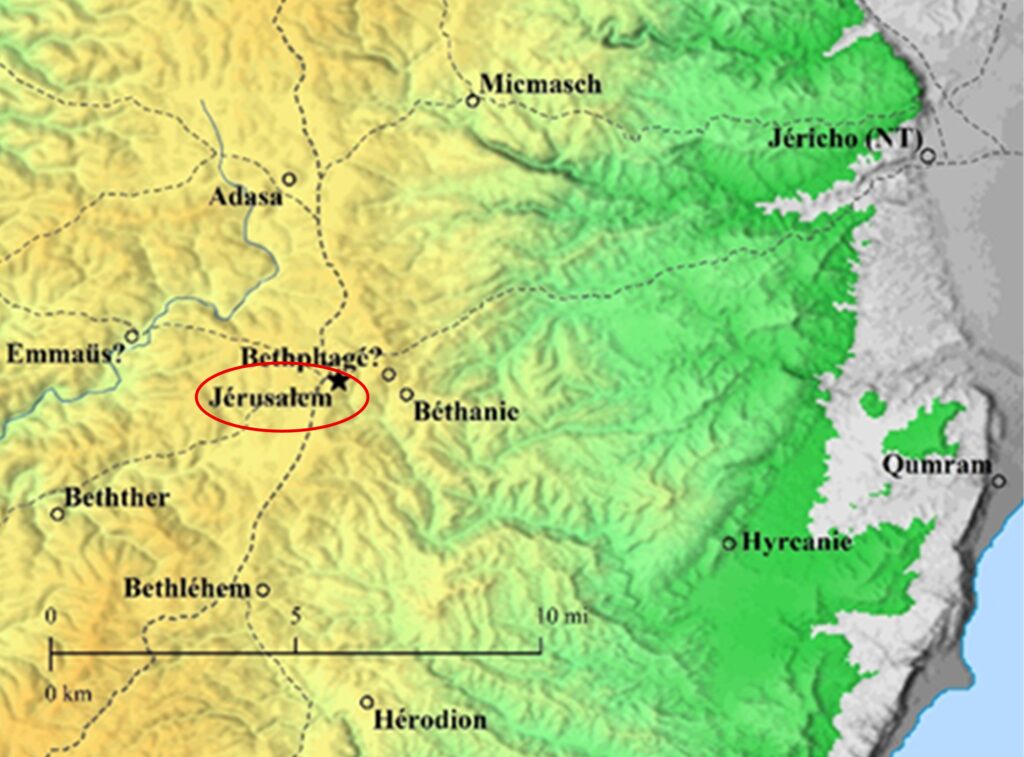
In view of the influx of the crowd, it seems likely that the disciples then moved to the surroundings or the esplanade of the Temple, the only place capable of accommodating several thousand people. A few hours later, about three thousand people would be baptized following Peter's speech (Acts 2.41), which indeed presupposes a much larger setting than a mere house.
This reconstruction nevertheless remains hypothetical, since Luke does not state explicitly where Peter delivered his speech.
7- Amazement and mockery
Not everyone reacts in the same way, however. Luke reports that some of the witnesses, far from seeking a spiritual explanation, mock the disciples and accuse them of being under the influence of wine (Acts 2.13). This opposition does not seem marginal, since Peter judges it necessary to begin his speech by refuting this accusation: “These people are not drunk, as you suppose, since it is only nine o'clock in the morning” (Acts 2.15).
From the birth of the Church, faith thus provokes contrasting reactions: some are struck with amazement and seek to understand (Acts 2.12), while others choose mockery. This division in the face of God's action will be found throughout the book of Acts (Acts 17.32; Acts 28.24).
The
The