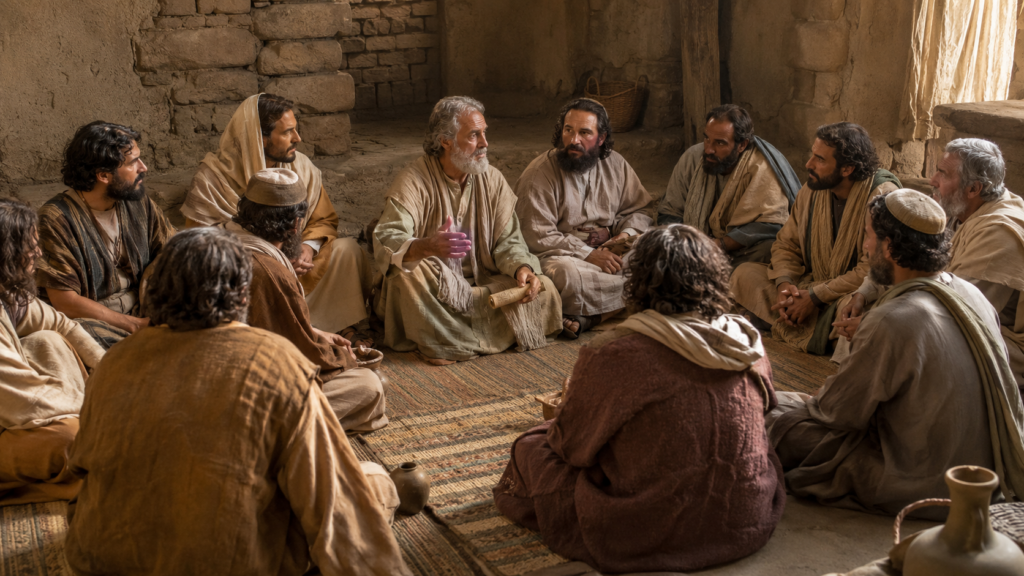

The first element that stands out in this passage is the special position Peter occupies within the group of disciples. Without seeking to set himself above his brothers, he naturally appears as their spokesman. His speaking up is accepted without objection, and no one seems to question his authority. His denial now belongs to the past, and the restoration brought about by Jesus the Messiah allowed him to take his place again among the apostles (John 21.15-19).
Throughout the earthly ministry of Jesus, Peter had already played this role as representative of the group (Matthew 16.16; John 6.68-69). In the four lists of the apostles, his name always appears first (Matthew 10.2-4; Mark 3.16-19; Luke 6.14-16; Acts 1.13), while John is generally mentioned immediately after him. The particular authority that Jesus had entrusted to him thus seems to be naturally recognized within the assembly (Matthew 16.18-19; Luke 22.31-32).
2- The one hundred and twenty disciples gathered in Jerusalem
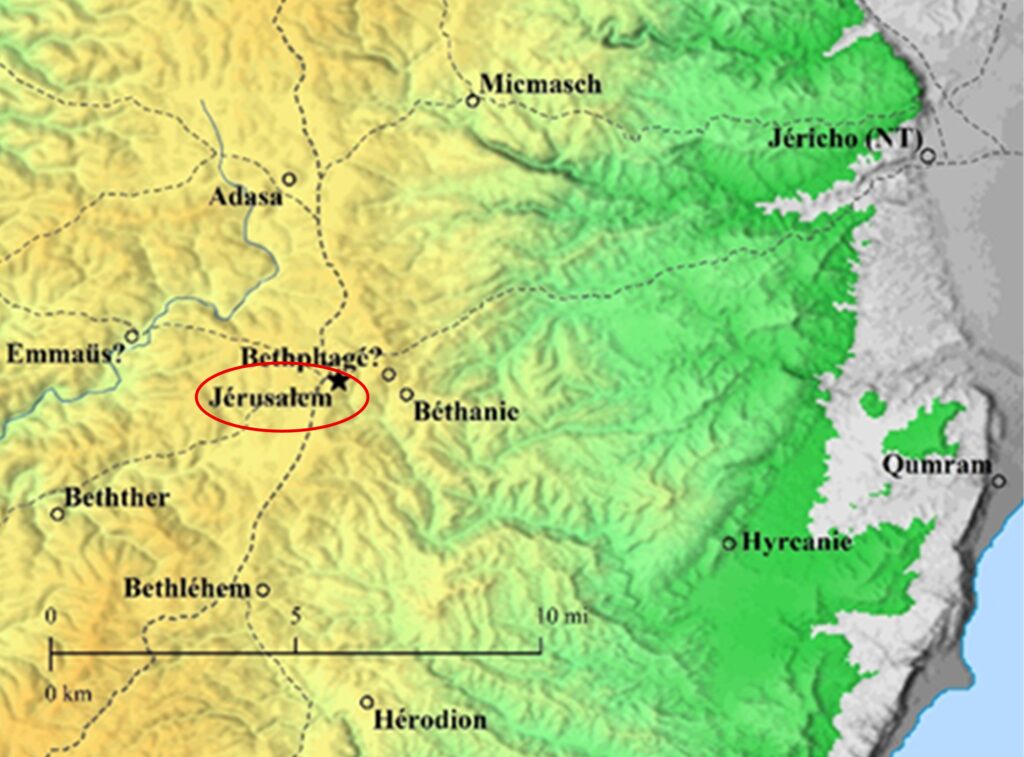
Luke specifies that about one hundred and twenty people are gathered in Jerusalem (Acts 1.15). This figure does not necessarily mean that the total number of disciples was limited to this group. Other believers may have been absent or scattered. Neither Joseph of Arimathea (Matthew 27.57) nor Nicodemus (John 19.39) is mentioned.
In the climate of hostility that prevailed after the crucifixion, it is possible that certain precautionary measures led the disciples to exercise a degree of discretion concerning the meeting places and the identity of several believers (John 20.19).
3- The need to replace Judas
Peter's proposal to replace Judas Iscariot does not rest on an arbitrary or authoritarian decision. It rests above all on the Scriptures. By relating the events to the words of the Psalms (Psalms 69.25; Psalms 109.8), Peter judges that it is necessary for another to take the office left vacant by the traitor (Acts 1.20).
This interpretation seems to be agreed upon by the disciples. It appears self-evident that the apostolic college must regain its fullness and again have twelve members, in keeping with the Lord's original choice (Matthew 10.1-4). This number carries strong symbolic weight, since it recalls the twelve tribes of Israel and the promise of Jesus that the Twelve will sit on twelve thrones judging the twelve tribes of Israel (Matthew 19.28; Luke 22.29-30).
4- The criteria for the choice
This requirement naturally excludes the brothers of Jesus, whose conversion seems to have taken place after the resurrection (John 7.5; Acts 1.14). Peter specifies, in fact, that the future apostle must have accompanied Jesus from the baptism of John until the ascension and have become a witness of his resurrection (Acts 1.21-22). The length and continuity of the witness are therefore essential criteria.
We also discover that around the Twelve there was a wider circle of faithful disciples. The apostles have no difficulty proposing two candidates: Joseph called Barsabbas, who was surnamed Justus, and Matthias (Acts 1.23). These men had followed Jesus from the beginning of his ministry and had witnessed the main events of his life. Their presence reveals that a significant number of disciples, who remained in the background, had accompanied the Lord throughout his ministry.
5- The death of Judas Iscariot
Peter then recalls the tragic end of Judas Iscariot (Acts 1.18-19). The details reported by Luke may seem to be in tension with Matthew's account, which says that Judas went and hanged himself (Matthew 27.5). However, these two accounts are not necessarily contradictory. Matthew reports the cause of death, whereas Luke seems to describe the later consequences of that hanging. The two descriptions thus appear more complementary than opposed.
6- A designation placed under God's sovereignty
The procedure for designating the new apostle may surprise the modern reader. The use of the might seem unspiritual. Yet Luke stresses that this step was taken after a solemn prayer addressed to the Lord who knows the hearts of all (Acts 1.24-25). The disciples do not rely on chance but on divine sovereignty.
This practice belongs to an ancient tradition well attested in the Scriptures (Leviticus 16.8; Joshua 18.10; 1 Chronicles 24.5). The book of Proverbs also reminds us that “every decision is from the ” (Proverbs 16.33). It is remarkable that this method no longer appears after Pentecost, important decisions henceforth being made under the direction of the Holy Spirit (Acts 13.2-3; Acts 15.28).
7- Matthias and the restoration of the Twelve
The choice finally falls on Matthias, who is added to the eleven apostles (Acts 1.26). This appointment underlines the importance the disciples attach to the apostolic college in the future development of the Church. The Twelve are the official witnesses of the life, the death and above all the resurrection of Jesus the Messiah (Acts 1.8; Acts 1.22). They represent, in a sense, the guarantors of the authenticity of the Christian witness.
Later, Paul would recall that the Church is built on the foundation of the apostles and prophets, Christ Jesus himself being the (Ephesians 2.20).
8- The preservation of the apostolic witness
It is also possible to see in this election a first measure intended to preserve the integrity of the apostolic witness. The disciples know that their essential mission is to transmit faithfully what they have seen and heard (Acts 4.20; 1 John 1.1-3). The replacement of Judas thus shows their determination to keep the college of witnesses intact even before the coming of the Holy Spirit.
However, the persecutions that would soon fall on the Church (Acts 4.1-3; Acts 5.17-18), the death of Stephen (Acts 7.54-60) and then that of James, the son of Zebedee (Acts 12.1-2), would show the fragility of these eyewitnesses. This situation would gradually lead the Church to preserve their witness in written form.
Luke himself recalls that many had already undertaken to compile in writing the events handed down by those who had been eyewitnesses from the beginning (Luke 1.1-2). It is therefore likely that an early composition of the Gospel according to Matthew contributed to this desire to safeguard the apostolic memory in the face of the risk of prematurely losing those who had accompanied the Lord.
Thus the Gospels of Matthew, Mark and later Luke can be regarded as the natural extension of the apostolic witness. Men were mortal and exposed to persecution, but their witness had to be preserved and passed on to future generations (John 20.30-31; 2 Peter 1.15; 2 Timothy 3.16-17). The restoration of the Twelve and the writing down of the apostolic witness then appear as two complementary aspects of one and the same concern: to preserve faithfully the memory of the founding events on which the Church rests.
On substance, this is probably one of the passages closest to an academic biblical commentary among those you have written. The only part that would call for greater caution in its wording is the hypothesis of a very early composition of Matthew in Aramaic: it is defensible, but it belongs to the realm of hypotheses and would benefit from being presented with expressions such as “it is possible,” “some authors have proposed,” or “this hypothesis could explain…”.
The
The
An