

PER324

Jesus the Messiah speaks of his coming death

The article deals with the passage in which Jesus announces his coming death, giving his disciples words of comfort and assurance of victory over evil through the resurrection.

13 min Jesus disciples death resurrection Joy 19 verses 8 books

Resources

Biblical texts

Matthew
Matthew (King James Version) not cited in the book
Mark
Mark (King James Version) not cited in the book
Luke
Luke (King James Version) not cited in the book
John
John 16.16-33 (King James Version)

A little while, and ye shall not see me: and again, a little while, and ye shall see me, because I go to the Father.

Then said some of his disciples among themselves, What is this that he saith unto us, A little while, and ye shall not see me: and again, a little while, and ye shall see me: and, Because I go to the Father?

They said therefore, What is this that he saith, A little while? we cannot tell what he saith.

Now Jesus knew that they were desirous to ask him, and said unto them, Do ye enquire among yourselves of that I said, A little while, and ye shall not see me: and again, a little while, and ye shall see me?

Verily, verily, I say unto you, That ye shall weep and lament, but the world shall rejoice: and ye shall be sorrowful, but your sorrow shall be turned into joy.

A woman when she is in travail hath sorrow, because her hour is come: but as soon as she is delivered of the child, she remembereth no more the anguish, for joy that a man is born into the world.

And ye now therefore have sorrow: but I will see you again, and your heart shall rejoice, and your joy no man taketh from you.

And in that day ye shall ask me nothing. Verily, verily, I say unto you, Whatsoever ye shall ask the Father in my name, he will give it you.

Hitherto have ye asked nothing in my name: ask, and ye shall receive, that your joy may be full.

These things have I spoken unto you in proverbs: but the time cometh, when I shall no more speak unto you in proverbs, but I shall shew you plainly of the Father.

At that day ye shall ask in my name: and I say not unto you, that I will pray the Father for you:

For the Father himself loveth you, because ye have loved me, and have believed that I came out from God.

I came forth from the Father, and am come into the world: again, I leave the world, and go to the Father.

His disciples said unto him, Lo, now speakest thou plainly, and speakest no proverb.

Now are we sure that thou knowest all things, and needest not that any man should ask thee: by this we believe that thou camest forth from God.

Jesus answered them, Do ye now believe?

Behold, the hour cometh, yea, is now come, that ye shall be scattered, every man to his own, and shall leave me alone: and yet I am not alone, because the Father is with me.

These things I have spoken unto you, that in me ye might have peace. In the world ye shall have tribulation: but be of good cheer; I have overcome the world.

Technical details

AD 33

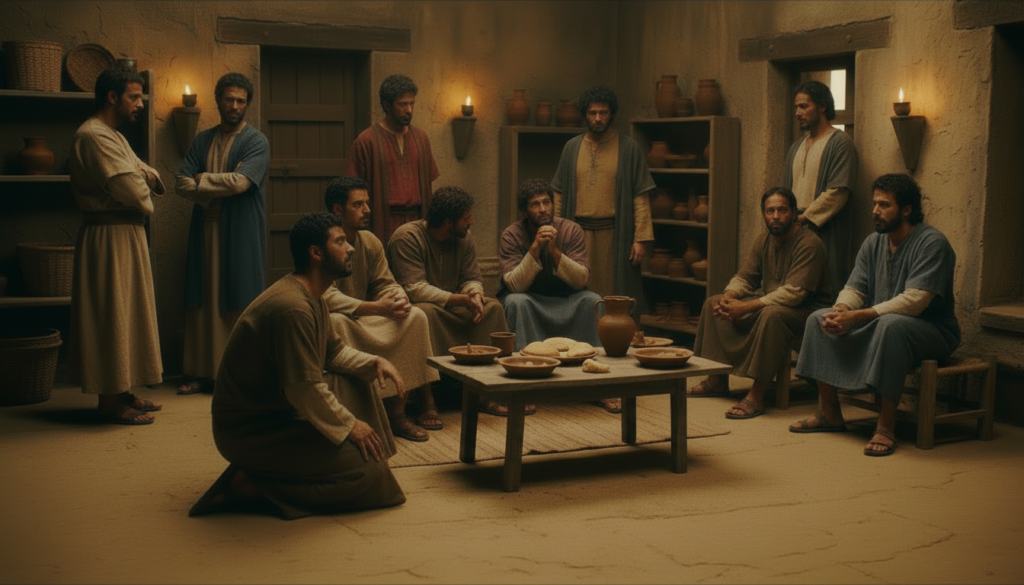
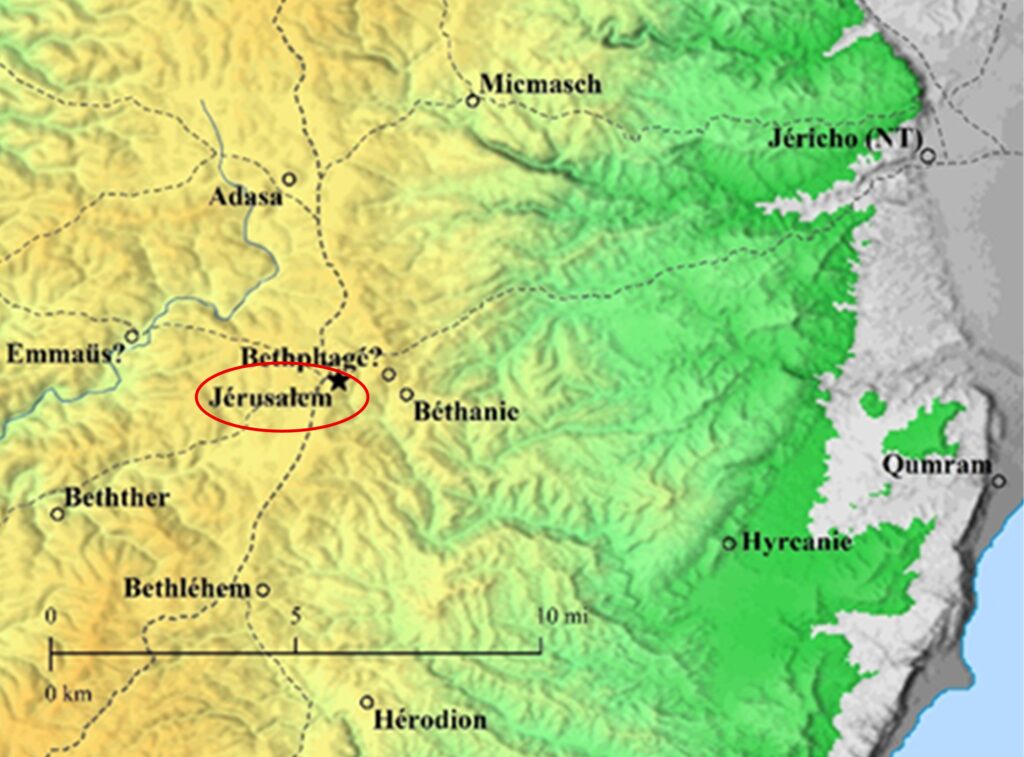
Place: The city of Jerusalem, the house of Mary, mother of John Mark

Date: Friday, April 1, very early in the morning

Procedure: We now follow John

Note on the method: John is the only one to record these last teachings of the Master

Map of Jerusalem and Its Surroundings
Friday bar graph

Jesus the Messiah now speaks openly of his coming death.

Chronological details, according to our conclusions:

_3 The house is, in our view, that of Mary, the mother of John, surnamed Mark. Acts 12.12.

_4 The Passover meal begins on Thursday evening, after 6 p.m. It is already Friday for the Jews (Mark 14.17, Matthew 26.20, Luke 22.14-18). It is therefore not the official Seder, which will take place on Friday evening John 18.28.

_5 The meal ends on Friday morning before dawn, between midnight and 2:30 a.m.

_6 Judas Iscariot left before the end of this meal. John 13.30.

You can consult the complete chronology in the study ANN026 : The hour of the crucifixion.

Commentary:

In this passage, Jesus the Messiah announces to his disciples an imminent separation, declaring:

(

John 16.16 (King James Version) :
A little while, and ye shall not see me: and again, a little while, and ye shall see me, because I go to the Father.

This saying bewilders them, for they do not understand what it means, their vision remaining limited to what they are living in the moment (John 16.17-18). Jesus the Messiah then explains to them that their sadness will turn into joy, like a woman who goes through the pain of childbirth but then rejoices in the birth of her child, an image already present among the prophets to announce a coming deliverance (Isaiah 66.7-9, John 16.20-22).

He tells them that after his departure they will have direct access to the Father through prayer, in the name of the Son, which marks a new stage in the relationship between God and believers, made possible by the work of the Messiah (Hebrews 4.16, John 16.23-24).

Jesus the Messiah affirms that the Father himself loves them because they have believed that he came from God, stressing that faith opens a personal and genuine relationship with the Father (John 16.27). The disciples then express their conviction that they have finally understood, but Jesus the Messiah reveals to them that they will soon be scattered, each returning to his own home and leaving him alone, which will be fulfilled at his arrest (Mark 14.50, John 16.31-32).

Yet he affirms that he is never alone, for the Father is with him, recalling that even in trial the divine presence remains. He concludes by giving them a word of peace and victory: they will have tribulation in the world, but they can take courage, for the world, a victory already won that guarantees that evil will not have the last word (John 16.33, Romans 8.37).

Thus, this discourse prepares the disciples to go through the crisis of the crucifixion by giving them the certainty that suffering is only temporary and that the joy of the resurrection will transform their understanding and their mission (John 20.20).