

PER297

The Messiahship of Jesus

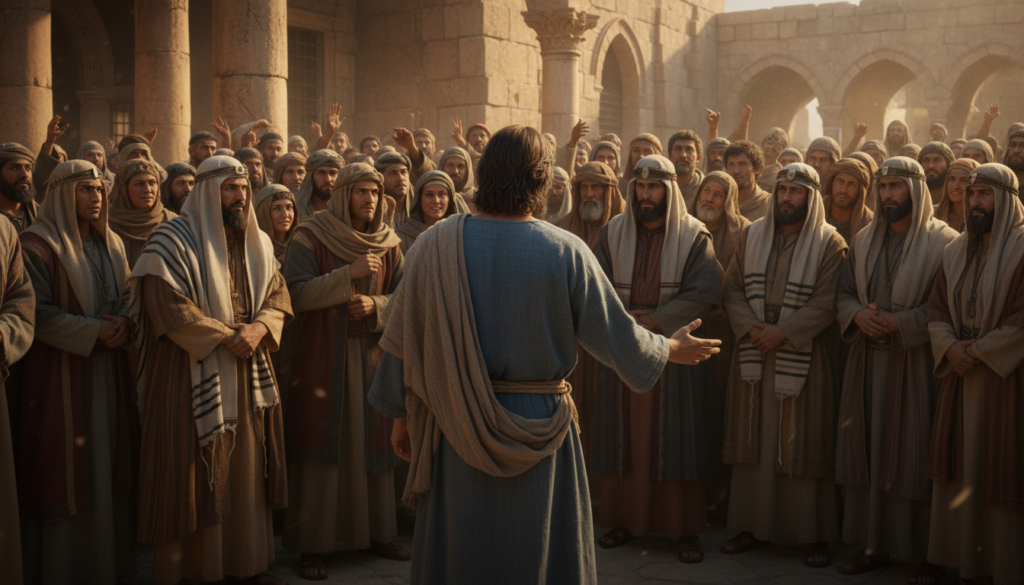
At the Temple court in Jerusalem, on the Tuesday before his Passion, Jesus questions the Pharisees about the identity of the Messiah. Citing Psalm 110, he reveals that the Messiah is both Son of David according to the flesh and eternal Lord according to his divinity, confounding his opponents, who are left without an answer. A fundamental Christological statement about the dual nature of Jesus.

11 min Messiahship Jesus the Messiah Son of David Psalm 110 dual nature of Christ 14 verses 14 books

Resources

Biblical texts

Matthew
Matthew 23.1-39 (King James Version)

Then spake Jesus to the multitude, and to his disciples,

Saying, The scribes and the Pharisees sit in Moses’ seat:

All therefore whatsoever they bid you observe, that observe and do; but do not ye after their works: for they say, and do not.

For they bind heavy burdens and grievous to be borne, and lay them on men’s shoulders; but they themselves will not move them with one of their fingers.

But all their works they do for to be seen of men: they make broad their phylacteries, and enlarge the borders of their garments,

And love the uppermost rooms at feasts, and the chief seats in the ,

And greetings in the markets, and to be called of men, Rabbi, Rabbi.

But be not ye called Rabbi: for one is your Master, even Christ; and all ye are brethren.

And call no man your father upon the earth: for one is your Father, which is in heaven.

Neither be ye called masters: for one is your Master, even Christ.

But he that is greatest among you shall be your servant.

And whosoever shall exalt himself shall be abased; and he that shall humble himself shall be exalted.

But woe unto you, scribes and Pharisees, hypocrites! for ye shut up the kingdom of heaven against men: for ye neither go in yourselves, neither suffer ye them that are entering to go in.

Woe unto you, scribes and Pharisees, hypocrites! for ye devour widows’ houses, and for a pretence make long prayer: therefore ye shall receive the greater damnation.

Woe unto you, scribes and Pharisees, hypocrites! for ye compass sea and land to make one proselyte, and when he is made, ye make him twofold more the child of hell than yourselves.

Woe unto you, ye blind guides, which say, Whosoever shall swear by the temple, it is nothing; but whosoever shall swear by the gold of the temple, he is a debtor!

Ye fools and blind: for whether is greater, the gold, or the temple that sanctifieth the gold?

And, Whosoever shall swear by the altar, it is nothing; but whosoever sweareth by the gift that is upon it, he is guilty.

Ye fools and blind: for whether is greater, the gift, or the altar that sanctifieth the gift?

Whoso therefore shall swear by the altar, sweareth by it, and by all things thereon.

And whoso shall swear by the temple, sweareth by it, and by him that dwelleth therein.

And he that shall swear by heaven, sweareth by the throne of God, and by him that sitteth thereon.

Woe unto you, scribes and Pharisees, hypocrites! for ye pay tithe of mint and anise and cummin, and have omitted the weightier matters of the law, judgment, mercy, and faith: these ought ye to have done, and not to leave the other undone.

Ye blind guides, which strain at a gnat, and swallow a camel.

Woe unto you, scribes and Pharisees, hypocrites! for ye make clean the outside of the cup and of the platter, but within they are full of extortion and excess.

Thou blind Pharisee, cleanse first that which is within the cup and platter, that the outside of them may be clean also.

Woe unto you, scribes and Pharisees, hypocrites! for ye are like unto whited sepulchres, which indeed appear beautiful outward, but are within full of dead men’s bones, and of all uncleanness.

Even so ye also outwardly appear righteous unto men, but within ye are full of hypocrisy and iniquity.

Woe unto you, scribes and Pharisees, hypocrites! because ye build the tombs of the prophets, and garnish the sepulchres of the righteous,

And say, If we had been in the days of our fathers, we would not have been partakers with them in the blood of the prophets.

Wherefore ye be witnesses unto yourselves, that ye are the children of them which killed the prophets.

Fill ye up then the measure of your fathers.

Ye serpents, ye generation of vipers, how can ye escape the damnation of hell?

Wherefore, behold, I send unto you prophets, and wise men, and scribes: and some of them ye shall kill and crucify; and some of them shall ye scourge in your , and persecute them from city to city:

That upon you may come all the righteous blood shed upon the earth, from the blood of righteous Abel unto the blood of Zacharias son of Barachias, whom ye slew between the temple and the altar.

Verily I say unto you, All these things shall come upon this generation.

O Jerusalem, Jerusalem, thou that killest the prophets, and stonest them which are sent unto thee, how often would I have gathered thy children together, even as a hen gathereth her chickens under her wings, and ye would not!

Behold, your house is left unto you desolate.

For I say unto you, Ye shall not see me henceforth, till ye shall say, Blessed is he that cometh in the name of the Lord.

Mark
Mark 12.38-40 (King James Version)

And he said unto them in his doctrine, Beware of the scribes, which love to go in long clothing, and love salutations in the marketplaces,

And the chief seats in the , and the uppermost rooms at feasts:

Which devour widows’ houses, and for a pretence make long prayers: these shall receive greater damnation.

Luke
Luke 20.45-47 (King James Version)

Then in the audience of all the people he said unto his disciples,

Beware of the scribes, which desire to walk in long robes, and love greetings in the markets, and the highest seats in the , and the chief rooms at feasts;

Which devour widows’ houses, and for a shew make long prayers: the same shall receive greater damnation.

John
John (King James Version) not cited in the book

Technical details

AD 33

Location: The courtyard of the Temple of Jerusalem

Date: Tuesday, March 29, AD 33

Method: We continue with Mark

Note on the method: Matthew and Luke also report this discourse

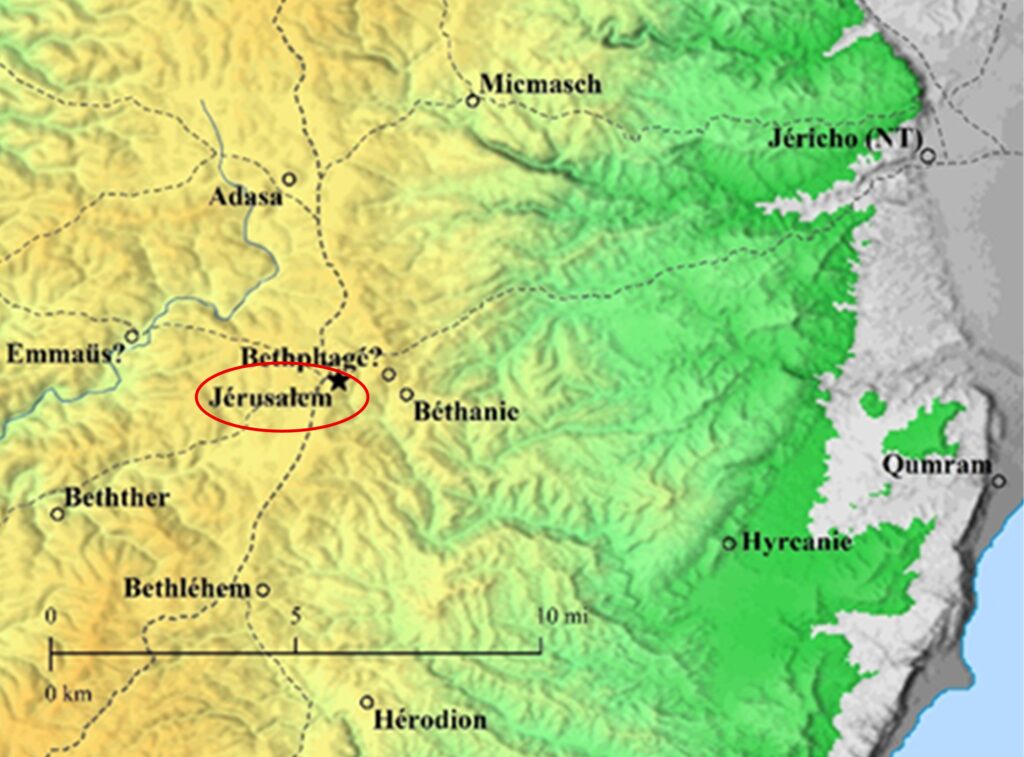
Map of Jerusalem and Its Surroundings
Bar graph Tuesday, March 29

The Messiah Jesus now turns to the theme of his Messiahship.

Comments

Throughout the various public appearances of the Messiah Jesus, we discover how his days unfolded at the Temple in Jerusalem. He taught there every day and was frequently approached by religious leaders who, driven by jealousy or hostility, tried to trap him with their questions in the hope of discrediting him before the people. Yet, despite their malicious intentions, the people listened to him with admiration. They had indeed witnessed his miracles, his healings, and the deliverances that only God could accomplish. They also saw how, in the face of the religious authorities, Jesus, a man of the people, stood up to the scholars of the Law without ever being caught at fault. For many, it was a deeply moving scene: seeing a teacher full of authority, yet without arrogance, put in their place those who had dominated them for so long by their knowledge and their position.

But now the scene changes: the Master becomes the questioner. After being questioned at length, he takes the initiative to ask, in his turn, an essential question about the identity of the Messiah. Only Matthew 22.41 stresses that it is Jesus who now takes the floor to question the , while all the people listen with deep attention.

Dans Matthew 22.41-46, Mark 12.35-37 et Luke 20.41-44, Jésus demande : « Que pensez‑vous du Christ ? De qui est‑il fils ? » Les répondent : « De David. » Alors Jésus cite le Psaume de David :

Psalms 110.1 (King James Version) :
The LORD said unto my Lord, Sit thou at my right hand, until I make thine enemies thy footstool.

(Or Psalms 109.1 according to the other numbering.) By this quotation, the Messiah Jesus reveals a mystery that the teachers of the Law had not grasped: if David calls the Messiah “my Lord,” how can he at the same time be his descendant?

Jésus montre ainsi que le Messie n’est pas un simple héritier royal, mais qu’il possède une nature supérieure : il est à la fois Fils de David selon la chair et Seigneur de David par sa divinité (Romans 1.3-4). Il met ainsi en lumière la limite de leur compréhension purement terrestre du Royaume et du rôle du Messie. Les et scribes attendaient un roi humain, un libérateur politique qui les délivrerait du joug . Mais Jésus leur révèle un Messie spirituel, venu instaurer le règne de Dieu dans les cœurs (John 18.36).

Devant cette révélation, les adversaires du Seigneur restent sans voix : « Nul ne put lui répondre un mot, et depuis ce jour, personne n’osa plus lui proposer de question » (Matthew 22.46). Le silence des docteurs de la Loi devient un témoignage de la sagesse divine qui surpasse toute intelligence humaine. Ces passages affirment avec puissance la double nature du Messie Jésus : pleinement homme, héritier de David, et pleinement Dieu, Seigneur et Roi glorifié, assis à la droite du Père (Hebrews 1.3-4).

Thus, with this last question, Jesus no longer seeks to debate: he reveals who he truly is — the Son of God, before Abraham, before David, existing from all eternity (John 8.58).