

PER292

The parable of the wedding feast

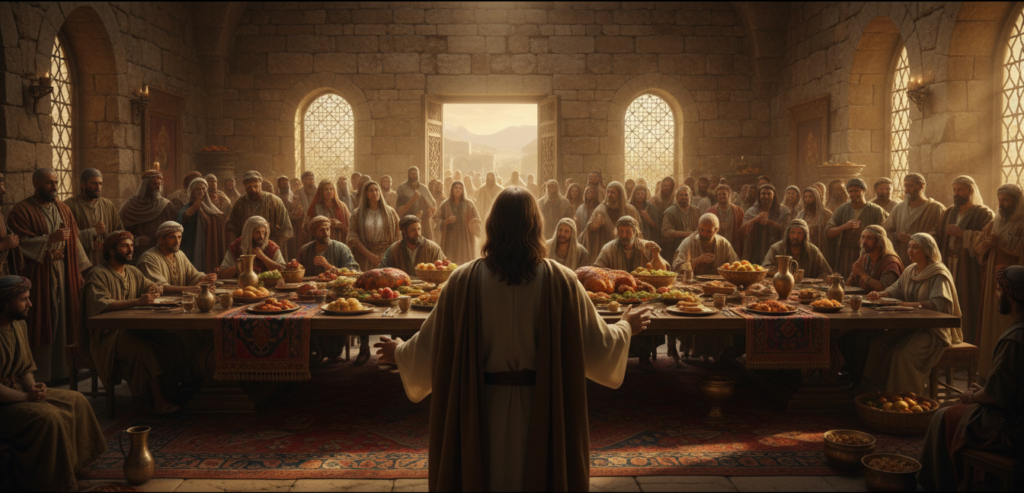
The parable of the wedding feast (Mt 22,1-14; Lk 14,15-24) teaches that God invites all people into His Kingdom, but that rejecting this invitation brings a grave judgment. Spoken in the Temple of Jerusalem on the Tuesday of Passion Week, it prophetically announces the destruction of Jerusalem in AD 70. The man without a wedding garment reminds us that entering the Kingdom requires a genuine spiritual transformation, received by faith in Christ.

7 min parable wedding feast Matthew 22 Luke 14 Kingdom of God 9 verses 5 books

Resources

Biblical texts

Matthew
Matthew 22.1-14 (King James Version)

And Jesus answered and spake unto them again by parables, and said,

The kingdom of heaven is like unto a certain king, which made a marriage for his son,

And sent forth his servants to call them that were bidden to the wedding: and they would not come.

Again, he sent forth other servants, saying, Tell them which are bidden, Behold, I have prepared my dinner: my oxen and my fatlings are killed, and all things are ready: come unto the marriage.

But they made light of it, and went their ways, one to his farm, another to his merchandise:

And the remnant took his servants, and entreated them spitefully, and slew them.

But when the king heard thereof, he was wroth: and he sent forth his armies, and destroyed those murderers, and burned up their city.

Then saith he to his servants, The wedding is ready, but they which were bidden were not worthy.

Go ye therefore into the highways, and as many as ye shall find, bid to the marriage.

So those servants went out into the highways, and gathered together all as many as they found, both bad and good: and the wedding was furnished with guests.

And when the king came in to see the guests, he saw there a man which had not on a wedding garment:

And he saith unto him, Friend, how camest thou in hither not having a wedding garment? And he was speechless.

Then said the king to the servants, Bind him hand and foot, and take him away, and cast him into outer darkness; there shall be weeping and gnashing of teeth.

For many are called, but few are chosen.

Mark
Mark (King James Version) not cited in the book
Luke
Luke 14.15-24 (King James Version)

And when one of them that sat at meat with him heard these things, he said unto him, Blessed is he that shall eat bread in the kingdom of God.

Then said he unto him, A certain man made a great supper, and bade many:

And sent his servant at supper time to say to them that were bidden, Come; for all things are now ready.

And they all with one consent began to make excuse. The first said unto him, I have bought a piece of ground, and I must needs go and see it: I pray thee have me excused.

And another said, I have bought five yoke of oxen, and I go to prove them: I pray thee have me excused.

And another said, I have married a wife, and therefore I cannot come.

So that servant came, and shewed his lord these things. Then the master of the house being angry said to his servant, Go out quickly into the streets and lanes of the city, and bring in hither the poor, and the maimed, and the halt, and the blind.

And the servant said, Lord, it is done as thou hast commanded, and yet there is room.

And the lord said unto the servant, Go out into the highways and hedges, and compel them to come in, that my house may be filled.

For I say unto you, That none of those men which were bidden shall taste of my supper.

John
John (King James Version) not cited in the book

Technical details

Year AD 33

Location: The courtyard of the Temple of Jerusalem

Date: Tuesday, March 29, AD 33

Method: We return to Matthew

Note on the method: Luke also reports this discourse

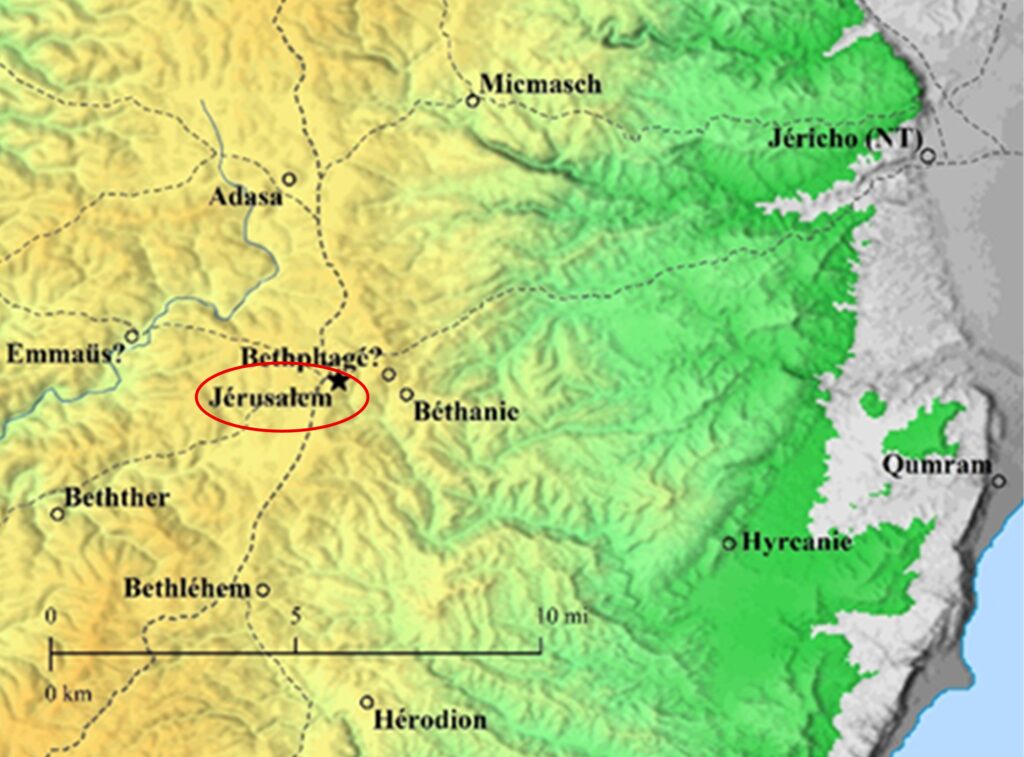
Map of Jerusalem and its region
Bar graph Tuesday, March 29

The Messiah Jesus proclaims a new about a meal.

Comments

We come to the third reported by Matthew, that of the wedding feast (Matthew 22.1-14).
This is not taken up by Mark or John, but a similar passage is found in Luke (Luke 14.15-24).
The two accounts present a striking resemblance, but they are not set at the same moment in Jesus' ministry.

In Luke, the scene takes place earlier, while the Messiah Jesus is still on His way to Jerusalem: He answers a guest at a meal in the house of a . The of the "great banquet" there illustrates the grace offered to all, even to those whom society despises (Luke 14.15-24).

In Matthew, by contrast, the context is far more solemn and tense. Jesus is already in Jerusalem, in the Temple, confronted by the religious leaders who refuse to recognize His authority. Matthew conveys its logic and continuity: the of the wedding feast follows directly after that of the murderous vinedressers (Matthew 21.33-46) and belongs to the same day, Tuesday, March 29 of the year AD 33, during Passion Week.

Dans ce cadre dramatique, Jésus avertit de manière prophétique des conséquences du rejet du Messie. Le roi de la , qui détruit la ville des meurtriers de ses serviteurs, évoque clairement le jugement de Dieu sur Jérusalem, lequel s’accomplira quelques décennies plus tard, en 70 apr. J.-C., lorsque le général Titus, fils de l’empereur Vespasien, rasera le Temple et fera massacrer des milliers de Juifs.

Matthew stresses this eschatological dimension and Israel's spiritual responsibility. To reject the King's invitation is to refuse divine grace, and no one can do so with impunity (John 3.16-17).

Finally, the scene of the man without a underlines another warning: one cannot enter the Kingdom of God without the righteousness that God Himself gives to those who believe in Christ.

This garment symbolizes the new nature that the believer puts on, not through merit, but by faith (Isaiah 61.10, Romans 13.14).

In other words, it is not enough to be invited; one must be transformed, truly saved, to take part in God's feast.