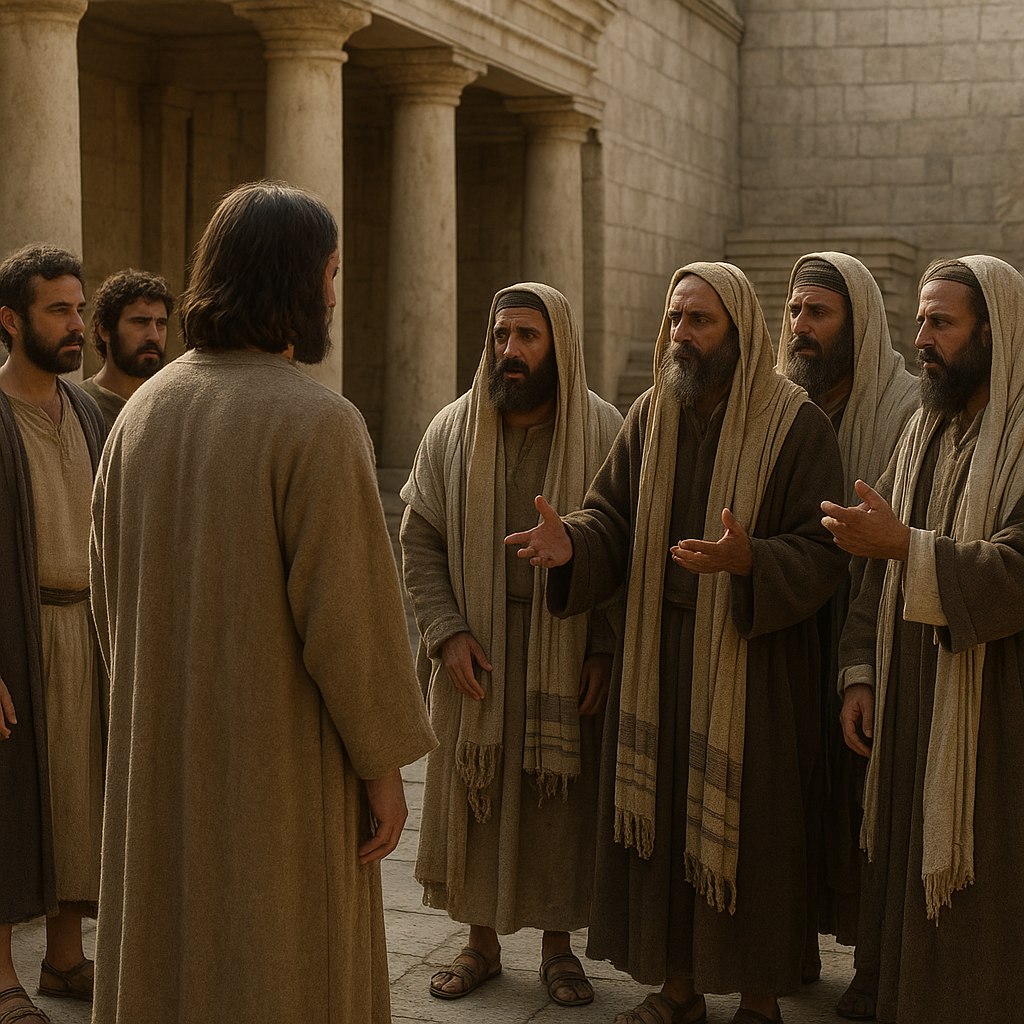


We must keep in mind the motives of these men who were questioning the Messiah Jesus. Their aim was not to understand, but to find a ground for accusation to bring before the court of the .
They asked him:
Their intention was clear: to provoke a statement that would allow them to accuse Jesus of blasphemy, a crime punishable by death according to Leviticus 24.16.
The could deliver a verdict, but did not have the power to carry out a capital sentence. However, a spontaneous popular lynching remained possible, an act of uncontrolled mob violence that the would have tolerated as a mere excess.
The Messiah Jesus is then in the temple in Jerusalem, during the Feast of Dedication (Hanukkah). It is in this setting that the Jews surround him and ask him to declare openly whether he is truly the Messiah.
The Messiah Jesus answers that he has already told them, but they refuse to believe. He points them to his works, his healings, his miracles and his teaching, which testify that he acts in the name of the Father. The signs he performs are so many visible proofs of his messianic identity.
The Messiah Jesus makes a distinction between those who listen to him and those who reject him. His sheep: listen to his voice, follow him with confidence, and are personally known by him. Here there is an intimate and spiritual relationship between the Shepherd and his flock, a mark of authentic belonging.
The Messiah Jesus promises his disciples eternal life and inviolable protection. No one can snatch them out of his hand, nor out of the Father’s hand, who is “greater than all.” This twofold affirmation highlights God’s faithfulness and the absolute security of believers in his plan of salvation.
By this statement, the Messiah Jesus reveals a perfect unity with God the Father, not in person, but in nature, will and action. This declaration, of major theological depth, immediately leads some to accuse him of blasphemy and to want to stone him (John 10.31).
In summary
The Messiah Jesus never hid his identity: he is the Messiah, the Son of God, the good shepherd. He offers his disciples: a personal relationship founded on listening and trust, the promised eternal life, and absolute security in his hands and in those of the Father.
Finally, he shows his deep unity with God, the essential foundation of the Christian faith: God and the Son work together, united in love and salvation.
The or the Dedication
The pilgrimage feasts?