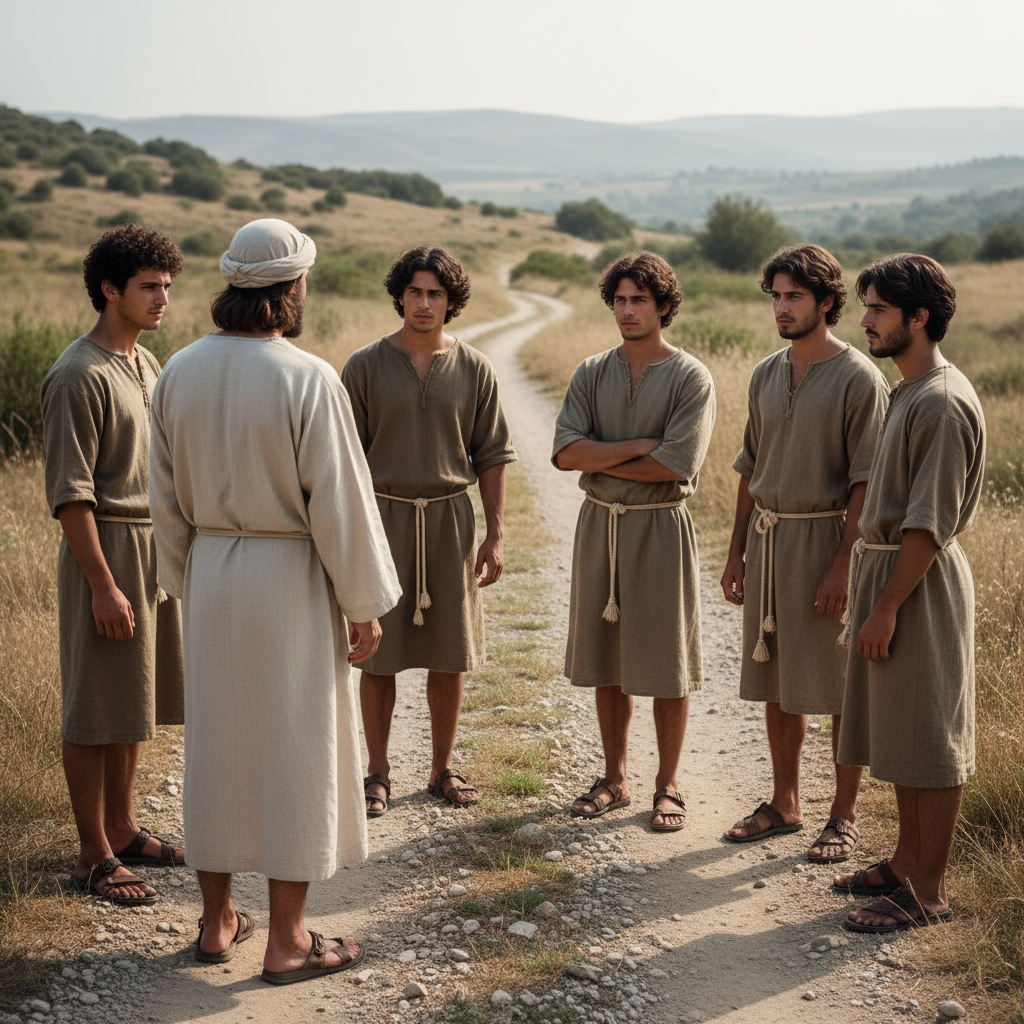

Luke presents three different situations of people who wish to follow the Messiah Jesus. It seems that Luke chose to present these three cases because they symbolize three aspects of commitment to the Messiah Jesus. The replies of the Messiah Jesus may seem, at first sight, discouraging and even disheartening. Although the desire to follow the Messiah Jesus may appear admirable, the Master explains through these three cases that this commitment remains difficult. We notice that these three people each voice a condition or a hesitation.
This passage from Luke 9.57-62 is a radical call to follow the Messiah Jesus without compromise. It presents three people who express the desire to follow him, but each with a condition or a hesitation. Here is one possible reading:
The first man says:
The Messiah Jesus replies to him that the Son of Man has nowhere to lay his head. This emphasizes that following him implies renouncing comfort and material security. It is clear that the issue raised here relates to this individual's situation. Not all the details were reported by Luke. The Messiah Jesus was going to Jerusalem, where the Master would be put to death; he did not own a dwelling.
The second wants first to bury his father. Jesus declares:
This reply, although surprising at first sight, means that the proclamation of the Kingdom of God must take precedence even over the most sacred family duties. It is a call to give absolute priority to the Gospel. The Master uses terms identical to those used to call his disciples (Luke 5.27) in order to invite this man.
If his father had already died, he would probably be present at the funeral, which leads to the conclusion that his father was dying. Did he wish to wait in order to receive his inheritance and settle the estate? The could be interpreted this way: leave it to those who are not saved or who are spiritually dead to take care of these matters, but you, devote yourself to proclaiming life in the person of the Messiah Jesus.
The third wants to say goodbye to his family
The Messiah Jesus explains that whoever looks back is not fit for the Kingdom, using the analogy of the plowman who must look straight ahead to cut a straight furrow. Following Jesus therefore requires a determination with no detours. However, Elijah had allowed Elisha to go back (1 Kings 19.19-20), because the context was not the same. We will examine this comparison in more detail later.
In conclusion:
This text offers a reflection on personal commitment: are we willing to reassess everything and to consider major changes in order to reach a specific goal? It is not a matter of ignoring our present responsibilities, but of recognizing that some priorities may require our full attention and wholehearted commitment.
The parallel between Luke 9.57-62 and 1 Kings 19.19-21 is fascinating.
In 1 Kings, Elijah calls Elisha by throwing his mantle over him — a strong symbolic gesture, signifying the transmission of the prophetic call. Elisha, surprised, asks to go back and say goodbye to his family. Elijah answers him:
This is not a refusal, but a way of saying: "I am not forcing you to anything, but think carefully about what this involves."
Unlike the Messiah Jesus in Luke 9.57-62, Elijah leaves Elisha a certain freedom. Yet Elisha, after offering a sacrifice with his oxen (a sign of a break with his former life), follows Elijah without turning back. He makes a radical choice, but a free one.
This contrast highlights two things:
God's call may be pressing or gentle, but it always demands a wholehearted response.
The Messiah Jesus, in Luke, embodies an eschatological urgency: the Kingdom is here, one must decide without delay. Whereas Elijah, in the Old Testament, acts in a context where the time for decision seems more spread out.
Although the precise actions of these individuals are not documented, Luke stresses the importance of an explicit commitment to the Messiah Jesus. It should be noted that the Messiah Jesus was heading toward Jerusalem and that, if these people did not act quickly, he would have continued on his way. It is likely that they informed their relatives of their intention to follow the Master, provided they made the decision to do so.