La captivité de Daniel commence en 605 av. J.-C., probablement alors qu’il a environ 14 ans. Après trois ans de formation, il aurait donc 17 ans. Les dates internes du livre montrent qu’il est encore actif en 534 av. J.-C., ce qui indique au moins 71 ans de service à Babylone.
S’il avait 14 ans au départ, il aurait environ 85 ans lors de la vision du chapitre 10. Les repères chronologiques disséminés dans le livre, comme en Daniel 9.1-2, permettent ainsi de situer précisément les événements.
Full text:
Le début de la captivité des quatre jeunes hommes, dont Daniel, est situé en 605 avant J.C. D’après les estimations, Daniel aurait eu 14 ans au moment de son départ pour Babylone. Cela signifie qu’à l’issue de la période de formation de trois ans, il aurait atteint l’âge de 17 ans.
L’incertitude demeure toutefois quant à l’âge exact de Daniel au commencement de sa captivité. Ce que l’on sait avec certitude, c’est que le chapitre 10 du livre de Daniel (Daniel 10.1-21) est daté de l’an 534 avant J.C. À partir de cette information, on peut en déduire que Daniel a passé au moins 71 ans à la cour des rois de Babylone. Aucun détail n’est donné concernant la fin de sa vie. En retenant l’hypothèse de 14 ans au début de la captivité, Daniel aurait donc environ 85 ans au moment de la vision rapportée près du fleuve (Daniel 10.1-21).
Les dates sont mentionnées dans les différents paragraphes du livre de Daniel, comme le précise le passage suivant :
Daniel 9.1-2 (King James Version) : In the first year of Darius the son of Ahasuerus, of the seed of the Medes, which was made king over the realm of the Chaldeans;aNotewhich: or, in which heIn the first year of his reign I Daniel understood by books the number of the years, whereof the word of the LORD came to Jeremiah the prophet, that he would accomplish seventy years in the desolations of Jerusalem.
King James Version (1769), domaine public — texte : eBible.org
Ces indications permettent de déterminer avec précision les dates des différents événements relatés.
Résumé du chapitre :
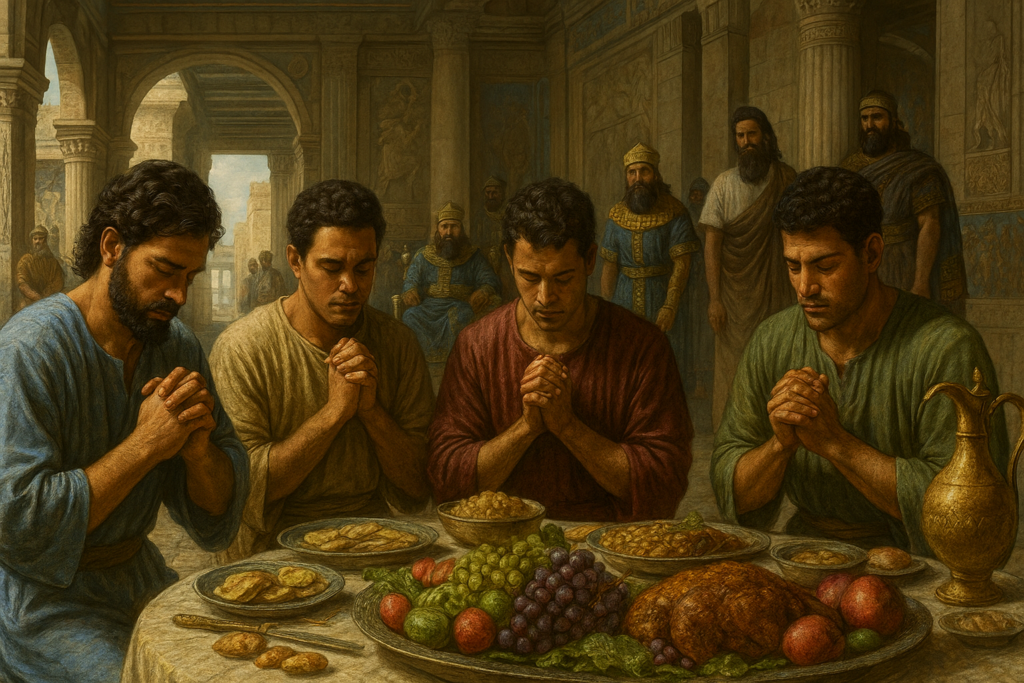
Le chapitre montre comment Daniel et trois autres jeunes Judéens, déportés à Babylone, sont intégrés dans un programme d’assimilation visant à remodeler leur identité. Malgré les nouveaux noms, la formation et les privilèges offerts, ils choisissent de rester fidèles à leurs convictions, notamment en refusant la nourriture royale et en proposant un test respectueux de dix jours.
Leur discipline les rend plus vigoureux que les autres, ce qui conduit à l’adoption officielle de leur régime. Doués et appliqués, ils excellent ensuite dans leurs études, et leur sagesse est reconnue par le roi.
Daniel servira longtemps, preuve que l’intégrité patiente peut traverser les épreuves, influencer un empire et préserver l’identité au cœur de l’exil.
Full text:
Arrivée à Babylone et sélection des jeunes judéens
Daniel 1.1 (King James Version) : In the third year of the reign of Jehoiakim king of Judah came Nebuchadnezzar king of Babylon unto Jerusalem, and besieged it.
King James Version (1769), domaine public — texte : eBible.org
Contexte historique simple : Jérusalem est assiégée par Babylone. Cela introduit une rupture : un peuple dominé, sa capitale encerclée.
Effet narratif : D’entrée, le livre place l’action dans une crise politique, posant la question : comment rester intègre quand tout vacille ?
Rôle de Daniel : Le décor explique pourquoi Daniel se retrouve à Babylone : non par choix, mais par l’histoire.
Daniel 1.2 (King James Version) : And the Lord gave Jehoiakim king of Judah into his hand, with part of the vessels of the house of God: which he carried into the land of Shinar to the house of his god; and he brought the vessels into the treasure house of his god.
King James Version (1769), domaine public — texte : eBible.org
Lecture sobre : La perte n’est pas seulement politique, elle est symbolique : les objets du Temple sont emportés.
Idée clé : Même dans la défaite, le texte affirme que rien n’échappe à Dieu. Ce n’est pas un chaos total : il y a une histoire plus large en cours.
Enjeu identitaire : Les symboles sacrés déplacés posent un défi : comment garder son identité quand les repères sont arrachés ?
Daniel 1.3 (King James Version) : And the king spake unto Ashpenaz the master of his eunuchs, that he should bring certain of the children of Israel, and of the king’s seed, and of the princes;aNotethe wine…: Heb. the wine of his drink
King James Version (1769), domaine public — texte : eBible.org
Stratégie impériale : Babylone récupère l’élite des vaincus pour les former. C’est une manière de contrôler les peuples.
Mouvement du récit : Daniel entre en scène via cette sélection : il est identifié comme issu d’un milieu éduqué.
Daniel 1.4 (King James Version) : Children in whom was no blemish, but well favoured, and skilful in all wisdom, and cunning in knowledge, and understanding science, and such as had ability in them to stand in the king’s palace, and whom they might teach the learning and the tongue of the Chaldeans.
King James Version (1769), domaine public — texte : eBible.org
Programme d’assimilation : Former des jeunes brillants à la langue et à la culture du pouvoir dominant.
Tension intérieure : Comment apprendre une nouvelle culture sans perdre la sienne ? L’enjeu de Daniel sera d’habiter ce “entre-deux”.
Daniel 1.5 (King James Version) : And the king appointed them a daily provision of the king’s meat, and of the wine which he drank: so nourishing them three years, that at the end thereof they might stand before the king.
King James Version (1769), domaine public — texte : eBible.org
Privilèges et loyauté : Nourriture royale et formation longue visent à créer de la loyauté.
Cadre d’épreuve : La table royale devient le lieu d’un choix intime : se conformer ou tracer une autre voie.
Daniel 1.6 (King James Version) : Now among these were of the children of Judah, Daniel, Hananiah, Mishael, and Azariah:
King James Version (1769), domaine public — texte : eBible.org
Personnes nommées : Le récit devient personnel : quatre figures, une petite communauté soudée.
Rôle du groupe : La fidélité se vit ensemble ; ils ne sont pas des héros isolés.
Daniel 1.7 (King James Version) : Unto whom the prince of the eunuchs gave names: for he gave unto Daniel the name of Belteshazzar; and to Hananiah, of Shadrach; and to Mishael, of Meshach; and to Azariah, of Abed-nego.
King James Version (1769), domaine public — texte : eBible.org
Renommage : Changer les noms, c’est tenter de redéfinir l’identité.
Résistance silencieuse : Ils acceptent les nouveaux noms, mais le récit montrera que leur cœur ne change pas de cap.
La décision de ne pas se “souiller” et l’essai de dix jours
Daniel 1.8 (King James Version) : But Daniel purposed in his heart that he would not defile himself with the portion of the king’s meat, nor with the wine which he drank: therefore he requested of the prince of the eunuchs that he might not defile himself.aNoteworse…: Heb. sadderbNotesort: or, term, or, continuance?cNoteMelzar: or, the stewarddNotepulse: Heb. of pulseeNoteto eat…: Heb. that we may eat, etc
King James Version (1769), domaine public — texte : eBible.org
Décision intérieure : Avant d’être visible, l’intégrité naît d’une résolution personnelle.
Méthode respectueuse : Daniel ne s’impose pas, il demande. Il combine conviction et tact.
Sens simple de “souiller” : Se préserver d’un mélange qui brouille l’identité ; ici, c’est la nourriture royale qui devient symbole de compromis.
Daniel 1.9 (King James Version) : Now God had brought Daniel into favour and tender love with the prince of the eunuchs.
King James Version (1769), domaine public — texte : eBible.org
Favori discret : La porte s’ouvre grâce à une relation humaine bienveillante.
Leçon pratique : L’intégrité attire parfois le respect, même chez ceux qui ne partagent pas nos choix.
Daniel 1.10 (King James Version) : And the prince of the eunuchs said unto Daniel, I fear my lord the king, who hath appointed your meat and your drink: for why should he see your faces worse liking than the children which are of your sort? then shall ye make me endanger my head to the king.
King James Version (1769), domaine public — texte : eBible.org
Réalité du risque : La hiérarchie est stricte ; aider Daniel peut coûter cher.
Empathie stratégique : Comprendre les peurs de l’autre permet d’adapter sa demande.
Daniel 1.11 (King James Version) : Then said Daniel to Melzar, whom the prince of the eunuchs had set over Daniel, Hananiah, Mishael, and Azariah,
King James Version (1769), domaine public — texte : eBible.org
Déplacement tactique : Daniel cherche l’interlocuteur qui peut agir concrètement.
Organisation sobre : Le récit montre une chaîne de responsabilités, Daniel l’utilise avec finesse.
Daniel 1.12 (King James Version) : Prove thy servants, I beseech thee, ten days; and let them give us pulse to eat, and water to drink.
King James Version (1769), domaine public — texte : eBible.org
Proposition testable : Un essai court, mesurable. C’est une négociation intelligente : faible coût, bénéfice possible.
Simplicité volontaire : Le choix de nourriture sobre devient une discipline qui garde l’identité.
Daniel 1.13 (King James Version) : Then let our countenances be looked upon before thee, and the countenance of the children that eat of the portion of the king’s meat: and as thou seest, deal with thy servants.
King James Version (1769), domaine public — texte : eBible.org
Evaluation objective : Daniel accepte un critère visible : l’apparence. Il ne demande pas un passe-droit, mais une comparaison honnête.
Principe pédagogique : Proposer un critère clair, partager le risque, laisser l’autre décider à partir des faits.
Daniel 1.14 (King James Version) : So he consented to them in this matter, and proved them ten days.
King James Version (1769), domaine public — texte : eBible.org
Accord obtenu : La combinaison respect + clarté + test court crée la confiance.
Rythme du récit : La tension est lancée : quel sera le résultat de ce pari ?
Daniel 1.15 (King James Version) : And at the end of ten days their countenances appeared fairer and fatter in flesh than all the children which did eat the portion of the king’s meat.
King James Version (1769), domaine public — texte : eBible.org
Résultat surprenant : La discipline ne les affaiblit pas, elle les renforce visiblement.
Message simple : L’intégrité n’est pas synonyme de perte ; elle peut produire une qualité de vie plus évidente.
Daniel 1.16 (King James Version) : Thus Melzar took away the portion of their meat, and the wine that they should drink; and gave them pulse.
King James Version (1769), domaine public — texte : eBible.org
Institution d’une pratique : L’essai devient routine autorisée.
Effet social : Un choix personnel devient une règle acceptée par l’environnement. Une petite victoire structurelle.
Connaissance, capacité, et reconnaissance royale
Daniel 1.17 (King James Version) : As for these four children, God gave them knowledge and skill in all learning and wisdom: and Daniel had understanding in all visions and dreams.aNoteDaniel…: or, he made Daniel understandbNotewisdom…: Heb. wisdom of understanding
King James Version (1769), domaine public — texte : eBible.org
Compétence et clarté d’esprit : Ils excellent dans les savoirs de leur milieu d’étude ; l’intégrité ne les marginalise pas, elle affine leur apprentissage.
Spécificité de Daniel : Une capacité à interpréter les symboles et les énigmes : lire sous la surface.
Leçon de fond : Être fidèle n’empêche pas d’être brillant dans la culture où l’on vit.
Daniel 1.18 (King James Version) : Now at the end of the days that the king had said he should bring them in, then the prince of the eunuchs brought them in before Nebuchadnezzar.
King James Version (1769), domaine public — texte : eBible.org
Epreuve formelle : Après la formation, vient l’évaluation officielle.
Progression narrative : Le cercle se resserre : du responsable au roi, du test de 10 jours à l’examen final.
Daniel 1.19 (King James Version) : And the king communed with them; and among them all was found none like Daniel, Hananiah, Mishael, and Azariah: therefore stood they before the king.
King James Version (1769), domaine public — texte : eBible.org
Excellence reconnue : Leur singularité est confirmée par le plus haut niveau.
Fidélité visible : Ce qu’ils ont cultivé en secret devient évident publiquement.
Daniel 1.20 (King James Version) : And in all matters of wisdom and understanding, that the king enquired of them, he found them ten times better than all the magicians and astrologers that were in all his realm.
King James Version (1769), domaine public — texte : eBible.org
Supériorité qualitative : “Dix fois” souligne une avance nette, pas marginale.
Enjeu pratique : La sagesse utile (résoudre des problèmes, comprendre) est au cœur de leur valeur.
Daniel 1.21 (King James Version) : And Daniel continued even unto the first year of king Cyrus.
King James Version (1769), domaine public — texte : eBible.org
Durée de service : Daniel traverse des règnes et des régimes. Son influence s’inscrit dans le temps long.
Idée finale : La fidélité durable : ce n’est pas un éclat bref, mais une trajectoire tenue malgré les changements.
Fils narratifs majeurs et applications pédagogiques
Identité dans l’exil : L’histoire montre comment préserver son identité au cœur d’une culture dominante sans agressivité ni fuite.
Art de la négociation : Daniel combine conviction personnelle, respect des personnes, propositions testables, et acceptation d’une évaluation objective.
Discipline et bien-être : Une pratique simple et cohérente peut améliorer la qualité de vie, même en milieu contraint.
Compétence culturelle : Apprendre la langue et les savoirs du milieu n’annule pas l’identité ; cela peut la rendre plus utile aux autres.
Durabilité de l’intégrité : La reconnaissance vient dans le temps ; le récit relie choix intérieurs, résultats visibles, et impact public.