The article explores biblical codices, key manuscripts in the preservation of the biblical texts. It reviews important examples of codices, their impact on the transmission of the Scriptures, and the absence of historical information about the earliest manuscripts.
It is noteworthy that many passages of the Bible, from both the Old Testament and the New Testament, were preserved thanks to the numerous copies made in that period.
Comparing these manuscripts ensures great reliability of the text. These documents are copies or translations that spread first through the Middle East and then to more distant regions.
The rapid rise of Christianity led to a proliferation of copies and translations, each community seeking to own a copy of these precious writings.
I. The Different Codices
A codex is a type of handwritten book made of sheets of paper, parchment or vellum bound together along one side, which makes it a forerunner of modern books. Unlike scrolls, which were in use before the invention of the codex, the codex allows the text to be consulted more easily and more quickly.
The oldest codices are ancient manuscripts created before the invention of printing. Here are some of the most famous:
The Codex Sinaiticus
Date: Around AD 330-360
Description: One of the oldest and most complete manuscripts of the Greek Bible, containing the text of the Septuagint.
The Codex Vaticanus
Date: Around AD 300-325
Description: Another important manuscript of the Greek Bible, also very close to the Septuagint.
The Codex Alexandrinus
Date: Around AD 400-440
Description: A manuscript of the Greek Bible, containing the Scriptures of the New Testament and the Old Testament.
The Codex Ephraemi Rescriptus
Date: Around AD 450
Description: A palimpsest manuscript, in which the original text was erased and written over, but the underlying text has been preserved.
The Codex Bezae
Date: Around AD 400
Description: A manuscript containing interesting textual variants, mainly of the New Testament.
The Codex Claromontanus
Date: Around AD 550
Description: A manuscript containing texts of the New Testament and the letters of Paul.
The Codex Gigas
Date: 13th century
Description: Known for its imposing size and for containing a complete copy of the Bible, along with other religious and historical texts.
The Codex Leningradensis
Date: around AD 1008
The Codex Leningradensis is the oldest complete manuscript of the Hebrew , using the Masoretic text and the Tiberian vocalization.
The Aleppo Codex
Date: AD 920
The Aleppo Codex, also known as Keter Aram Tsova (Crown of Aleppo), is a medieval manuscript of the .
These codices are precious witnesses to the history of the book and to the transmission of the biblical texts. They offer unique insights into the practices of copying and preserving ancient texts.
We would like to make two important observations. First, these texts are recognized as the original sources of the Bible. For example, when it is stated that a translation such as that of Louis Segond is based on the original texts, this means that Louis Segond relied on these sources to carry out his work.
Second, the oldest known document is the Codex Vaticanus, dated between AD 300 and 325, which creates an information gap of about three centuries.
II. The Lack of Information
We observe that the oldest codex discovered to date dates from the year 325, thus leaving a period of nearly three centuries without available documentation.
In reality, this is not a total absence of information, but rather a shortfall. During those three centuries, many copies and translations left significant traces. Archaeologists have discovered fragments of the Bible, including both the New Testament and the Old Testament. These discoveries do not include entire texts, but consist of passages of varying lengths. These fragments corroborate the accuracy of the translations found in the codices.
Sometimes an archaeologist discovers a fragment containing a single verse. This relic of the past bears witness to the desire of these people to obtain at least a portion of these texts regarded as sacred.
For a person living in the 21st century, it is hard to imagine the challenges associated with printing in the first centuries. Indeed, we are currently faced with an abundance of advertisements printed on paper, often ignored and quickly thrown away.
At that time, the exorbitant costs of printing forced people to memorize crucial information, such as the biblical texts. Copies were mainly reserved for communities.
Many fragments are regularly found during archaeological excavations at sites occupied by the first Christians.
III. The Fragments of the Scriptures
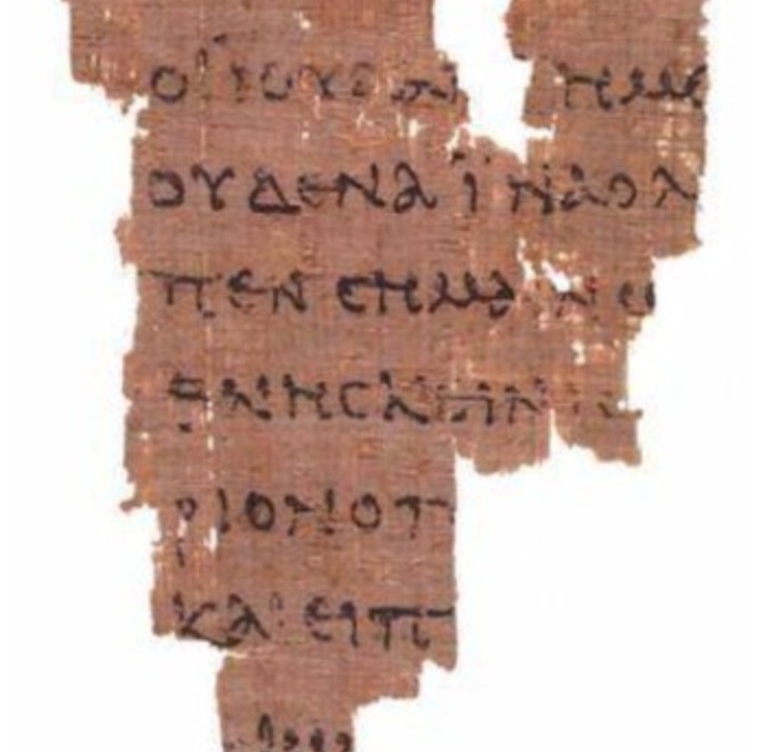
The oldest document discovered to date is designated P52, a name taken from its accession number in the library's collection. We will trace the history of the oldest fragments and take stock of the number of fragments of the Bible discovered to date.
The Nash Papyrus
The Nash Papyrus is a set of four papyrus fragments acquired in Egypt in 1898 by W. L. Nash, secretary of the Society of Biblical Archaeology. The fragments date from about 150 to 100 BC, although Stanley A. Cook initially dated them to the 2nd century AD
The oldest manuscript of the New Testament is Papyrus P52. It is a fragment of the Gospel of John dating from the 2nd century AD. This papyrus was discovered in Egypt and is currently displayed at the John Rylands University Library in Manchester, United Kingdom.
Biblical manuscripts are numerous and varied. For the Old Testament, there are several thousand complete or fragmentary manuscripts. Among the oldest and most important are the Ketef Hinnom scrolls, the Dead Sea Scrolls, the Aleppo Codex, and the Leningrad Codex.
For the New Testament, there are more than 5,800 Greek manuscripts, more than 10,000 Latin manuscripts, and about 9,300 manuscripts in other ancient languages such as Syriac, Coptic, Armenian, Ethiopic, Slavonic and Gothic. These manuscripts date from AD 125 to the 15th century.
This body of information on the biblical texts is remarkable and unique for an ancient document. All these data serve to confirm the accuracy of contemporary translations. Scholars unanimously acknowledge the quality and reliability of the translations derived from the codices.
A major discovery is about to transform the field of biblical translation. Will this discovery challenge or confirm current knowledge of the biblical texts? It is the sensational discovery of the Qumran manuscripts in 1947. We will address this subject in detail in a dedicated chapter.
Conclusion
To date, we do not possess the original documents of the Bible. However, it is possible that a future discovery will bring to light a document written by Matthew, Mark, Luke or John, since our study focuses mainly on the Gospels.
Nevertheless, a multitude of fragments of the existing biblical texts make it possible to confirm the current translations. The oldest known document, containing a verse of the Gospel of John, dates from around AD 125.
It is remarkable to see that these discovered passages attest to the reliability of the translations, challenging the well-known saying: “To translate is to betray.” No other book of such antiquity has survived through history with such accuracy and reliability, which is a truly exceptional fact.
A title, a person, a place, a reference (“Luke 15”)…
opens in a new window
Bible reference
INF048
Information note
INF048 - The Codex
The Codex
A codex is a type of handwritten book made of sheets of paper, parchment or vellum bound together along one side, which makes it a forerunner of modern books. Unlike scrolls, which were in use before the invention of the codex, the codex allows the text to be consulted more easily and more quickly.
Characteristics of the Codex
Format: Made up of individual leaves (called folios) that are bound together and can be turned, as in modern books. Materials: Mainly parchment (prepared animal skin), vellum (a finer form of parchment), or later paper. Use: Used for religious, legal, literary and scientific texts. The first codices were often copies of the Bible, classical works and official documents. Durability: More resistant and practical than scrolls, because the individual pages could be protected by a rigid cover.
History of the Codex
Origins: The codex appeared at the beginning of the Christian era (1st century AD), gradually replacing the scrolls used previously.
Adoption by the Christians: The early Christians adopted the codex for the transmission of the Scriptures, because it allowed quick access to different parts of the text. Development: Over time, the codex became the standard for manuscripts, developing with the introduction of paper and more advanced binding techniques.
Famous Examples
Codex Sinaiticus: One of the oldest complete manuscripts of the Greek Bible. Codex Vaticanus: Another important ancient manuscript of the Bible, held in the Vatican Library. Codex Alexandrinus: A manuscript of the Greek Bible, comprising the Old and New Testaments.
The codex was a major innovation in the history of the book and contributed to the spread and preservation of knowledge.
INF048
Information note
INF048 - The Codex Sinaiticus
The Codex Sinaiticus
The Codex Sinaiticus is one of the oldest and most important biblical manuscripts. Here are some key facts about it:
History
Date: Around AD 325-360. Discovery: The manuscript was discovered by Constantin von Tischendorf at Saint Catherine's Monastery on Mount Sinai in 1844. Composition: It contains the complete text of the Christian Bible in Greek, including the Old Testament and the New Testament, as well as additional texts such as the Epistle of Barnabas and the Shepherd of Hermas.
Importance
Text: The Codex Sinaiticus is an Alexandrian text, which means that it is very close to the original versions of the Scriptures. Condition:It is one of the few manuscripts to have been preserved in its entirety. Study: It is of crucial importance for textual criticism and the history of the biblical texts.
Preservation
Division: The manuscript is currently held in four parts: the British Library in London, the National Library of Russia in Saint Petersburg, Leipzig University and Saint Catherine's Monastery on Mount Sinai. Digitization: In 2005, an international project was launched to digitize the Codex Sinaiticus and make it accessible online. The Codex Sinaiticus website allows the manuscript to be consulted in high definition and translated into several languages.
The Codex Sinaiticus offers a unique window on the earliest biblical texts and on the way they were copied and transmitted down the centuries.
INF049
Information note
INF049 - Tischendorf's Discovery
Tischendorf's Discovery
The story of Constantin von Tischendorf's discovery of the Codex Sinaiticus at Saint Catherine's Monastery is one of the most famous in the history of biblical research:
Discovery
1844: On his first journey to Saint Catherine's Monastery on Mount Sinai, Constantin von Tischendorf noticed a basket full of old parchments destined to be burned. Searching through it, he found several leaves of what would prove to be one of the oldest manuscripts of the Bible, the Codex Sinaiticus. Tischendorf managed to recover 43 leaves, mainly from the Old Testament. 1853: On his second journey, he did not find any other parts of the manuscript. 1859: On his third journey, financed by Tsar Alexander II of Russia, he persuaded the monks to show him the complete manuscript, hidden in a cellar. Realizing the importance of his discovery, he managed to obtain permission to take the manuscript to Saint Petersburg so that it could be studied.
Importance
The Codex Sinaiticus is one of the oldest and most complete manuscripts of the Greek Bible, dating from the 4th century. It contains parts of the Old Testament, the complete New Testament, as well as additional texts such as the Epistle of Barnabas and the Shepherd of Hermas.
Consequences
Publication: Tischendorf published a first facsimile edition of the Codex Sinaiticus in 1862, arousing great interest in the academic and religious world. Preservation: The manuscript is divided among several institutions: the British Library in London, the National Library of Russia in Saint Petersburg, Leipzig University and Saint Catherine's Monastery.
This discovery had a major influence on textual criticism and the history of the biblical text, and it remains an emblematic example of the passion and perseverance of researchers in their quest for knowledge.
INF050
Information note
INF050 - The Codex Vaticanus
The Codex Vaticanus
The Codex Vaticanus is one of the oldest and most important biblical manuscripts. Here are some key facts about it:
History
Date: Around AD 300-325. Discovery: Preserved in the Vatican Apostolic Library for centuries, it was digitized and made accessible online in 2019. Composition: It contains the complete text of the Christian Bible in Greek, including the Old Testament and the New Testament, as well as additional texts such as the Epistle of Barnabas and the Shepherd of Hermas.
Importance
Text: The Codex Vaticanus is an Alexandrian text, which means that it is very close to the original versions of the Scriptures. Condition: It is one of the few manuscripts to have been preserved in its entirety. Study: It is of crucial importance for textual criticism and the history of the biblical texts.
Preservation
Location: The manuscript is currently held in the Vatican Apostolic Library in Rome. Digitization: In 2019, the Codex Vaticanus was digitized and made accessible online, allowing all researchers and enthusiasts to consult this precious document.
The Codex Vaticanus offers a unique window on the earliest biblical texts and on the way they were copied and transmitted down the centuries.
INF051
Information note
INF051 - The Codex Alexandrinus
The Codex Alexandrinus
The Codex Alexandrinus is a Christian manuscript of the fifth century. Here are some key facts about it:
History
Date:Around AD 400-440. Discovery: It takes its name from the city of Alexandria, where it is supposed to have been written. It was given to King Charles I of England by Patriarch Cyril Lucaris in 16282. Current owner: It is currently held in the British Library in London.
Composition
Text:It contains most of the Old Testament and the New Testament in Greek. Format: Written in uncials with two columns on each page, each column contains between 46 and 52 lines and each line between 20 and 25 letters. Materials: It is made up of 773 leaves of vellum.
Importance
Text:It belongs to the Byzantine family of the text, which means that it is very close to the original versions of the Scriptures. Condition: It is one of the few manuscripts to have been preserved in its entirety. Study: It is of crucial importance for textual criticism and the history of the biblical texts.
The Codex Alexandrinus is a precious witness to the history of the biblical text and the transmission of the Scriptures down the centuries.
INF052
Information note
INF052 - The Codex Ephraemi Rescriptus
The Codex Ephraemi Rescriptus
The Codex Ephraemi Rescriptus is a palimpsest manuscript of the fifth century. Here are some key facts about it:
History
Date: Around AD 400-440. Discovery: It was discovered by Constantin von Tischendorf at Saint Catherine's Monastery on Mount Sinai in 1840. Current owner: It is currently held in the National Library of France in Paris.
Composition
Text: It contains parts of the New Testament and a few books of the Old Testament. Format:Written in Greek uncial script on parchment, it is a palimpsest, which means that the original text was erased and overwritten in the 12th century with texts by Ephrem the Syrian. Condition: It is made up of 209 folios, of which 145 are for the New Testament and 64 for the Old Testament.
Importance
Text:It belongs to the Alexandrian family of the text, which means that it is very close to the original versions of the Scriptures. Study: It is of crucial importance for textual criticism and the history of the biblical texts.
The Codex Ephraemi Rescriptus is a precious witness to the history of the biblical text and the transmission of the Scriptures down the centuries.
INF053
Information note
INF053 - The Codex Bezae
The Codex Bezae
The Codex Bezae Cantabrigiensis, often called the Codex of Beza, is a bilingual Greek-Latin manuscript of the New Testament. Here are some key facts about it:
History
Date: Around AD 400-420. Discovery: It is named after Theodore Beza, who brought it to Cambridge in 1581. Current owner: It is currently held in Cambridge University Library.
Composition
Text: It contains the Gospels and the Acts of the Apostles. The Greek text is written on the left and the Latin translation on the right1. Format: It is written in uncials and has about 406 folios. Order: It follows a unique order of the Gospels: Matthew, John, Luke, then Mark.
Importance
Text: It belongs to the Western text, which is different from the other textual families. Condition: It is one of the few manuscripts to have been preserved in its entirety. Study: It is of crucial importance for textual criticism and the history of the biblical texts.
The Codex Bezae is a precious witness to the history of the biblical text and the transmission of the Scriptures down the centuries.
INF054
Information note
INF054 - The Codex Claromontanus
The Codex Claromontanus
The Codex Claromontanus, also known as Codex Dp or Codex 06, is a bilingual Greek-Latin manuscript of the sixth century. Here are some key facts about it:
History
Date: Around AD 550. Discovery: It is named after Theodore Beza, who bought it in a monastery at Clermont-en-Beauvaisis in the Oise. Current owner: It is currently held in the National Library of France in Paris.
Composition
Text: It contains the epistles of Paul as well as a stichometric catalogue of the Old and New Testaments. Format: It is made up of 533 folios (24.5 x 19.5 cm). Language: The text is written in Greek and in Latin on facing pages, which makes it a diglot manuscript. (A diglot manuscript is a document or text written in two different languages, usually arranged in parallel columns or on facing pages).
Importance
Text: It belongs to the Western text, which means that it is very close to the original versions of the Scriptures. Condition: It is one of the few manuscripts to have been preserved in its entirety. Study: It is of crucial importance for textual criticism and the history of the biblical texts.
The Codex Claromontanus is a precious witness to the history of the biblical text and the transmission of the Scriptures down the centuries.
INF055
Information note
INF055 - The Codex Gigas
The Codex Gigas
The Codex Gigas, also known as the Devil's Bible, is the largest known medieval manuscript. Here are some key facts about it:
History
Date: Around AD 1200. Discovery: It was produced in the Benedictine monastery of Podlažice in Bohemia (in the present-day Czech Republic). Current owner: It is currently held in the National Library of Sweden in Stockholm.
Composition
Text: It contains the complete Bible in Latin, along with other religious and secular texts, such as the Antiquities of the Jews by Flavius Josephus, the encyclopedia of Isidore of Seville, and medical treatises. Format:It measures 92 cm high, 50 cm wide and 22 cm thick, and weighs about 75 kg. Materials: It is made up of 310 leaves of vellum.
Importance
Text:It belongs to the Western text, which means that it is very close to the original versions of the Scriptures. Condition: It is one of the few manuscripts to have been preserved in its entirety. Study: It is of crucial importance for textual criticism and the history of the biblical texts.
Legend
According to a medieval legend, the Codex was written in a single night by a monk named Herman the Recluse, who is said to have sold his soul to the devil to accomplish this task. The page depicting the devil is often cited as evidence for this legend.
The Codex Gigas is a precious witness to the history of the biblical text and the transmission of the Scriptures down the centuries.
INF056
Information note
INF056 - The Codex Leningradensis
The Codex Leningradensis
The Codex Leningradensis is the oldest complete manuscript of the Hebrew Hebrew Bible, using the Masoretic text and the Tiberian vocalization. Here are some key facts about it:
History
Date: Around AD 1008. Discovery:It was produced in Cairo and is currently held in the National Library of Russia in Saint Petersburg. Current owner: It is also known as Codex Petropolitanus or Codex Petersburgensis.
Composition
Text: It contains the Hebrew text with vowels and cantillation marks. Format: It is written on parchment and bound in leather. Order of the books: It follows the traditional Tiberian order, which differs from that of the Sephardic manuscripts.
Importance
Text: It is based on the manuscripts of Aaron ben Moshe ben Asher and serves as the basis for the Biblia Hebraica (1937) and the Biblia Hebraica Stuttgartensia (1977). Condition: It is extremely well preserved after a thousand years. Study: It is a primary source for reconstructing the missing parts of the Aleppo Codex.
The Codex Leningradensis is a precious witness to the history of the biblical text and the transmission of the Scriptures down the centuries.
INF058
Information note
INF058 - Tiberian Vocalization
Tiberian Vocalization
Tiberian vocalization is a system of notation developed by the Jewish scholars of Tiberias between the 7th and 10th centuries to add indications of vowels and cantillation to the Hebrew consonants, in order to ensure a correct and uniform reading of the biblical texts. Here are some key points on this subject:
Characteristics
Nikkud: These are the dots and symbols added around the Hebrew consonants to indicate the vowels. Cantillation (Te'amim): These are cantillation marks used to indicate stress accents and pauses in the reading of the biblical texts. They serve to guide the chanted recitation of the Scriptures. System: The Tiberian vocalization system is the most complete and the most widespread among the Masoretic systems. It replaced other systems of notation, such as those of Babylon and Palestine.
Importance
Uniformity: This system made it possible to standardize the pronunciation and reading of the biblical texts across the different Jewish communities. Precision: It provides precise indications of vocalization and cantillation, thus facilitating the study and faithful transmission of the Hebrew Scriptures.
Use Masoretic Text: Tiberian vocalization is mainly used in the Masoretic text, which is the basis of many modern translations of the Hebrew Bible. Famous Manuscripts: It is found in important manuscripts such as the Aleppo Codex and the Codex Leningradensis.
Tiberian vocalization plays a crucial role in the preservation and transmission of the Hebrew Scriptures, ensuring that the text is read and understood correctly across the generations.
INF057
Information note
INF057 - The Masoretes
The Masoretes
The Masoretes were Jewish scholars who specialized in the transmission and preservation of the Hebrew biblical text. Here are some key facts about them:
History
Period:Their work began in the time of the Second Temple (from the 1st century BC to the 1st century AD) and continued until the 10th century. Purpose: They aimed to preserve the spelling, vocalization and pronunciation of the Scriptures, whose languages had become dead languages.
Contributions
Masorah: They developed a complex system of marks and critical notes, called the Masorah, to indicate how to read and pronounce each word. Masoretic Text: Their work led to the creation of the Masoretic Text, a version of the Hebrew Bible regarded as highly reliable and used as the basis for many later translations.
Importance
Transmission: The Masoretes played a crucial role in the faithful transmission of the biblical text down the centuries. Study: Their work is a primary source for textual criticism and the study of the Hebrew Scriptures.
The Masoretes thus contributed significantly to the preservation and transmission of the Hebrew Scriptures, ensuring that the text would be read and understood correctly through the generations.
INF059
Information note
INF059 - The Aleppo Codex
The Aleppo Codex
The Aleppo Codex, also known as Keter Aram Tsova (Crown of Aleppo), is a medieval manuscript of the Hebrew Bible. Here are some key pieces of information about it:
History
Date: It was written around AD 920 in Tiberias, under the Abbasid caliphate. Current owner: It is currently kept at the Shrine of the Book at the Israel Museum in Jerusalem. Discovery: It was preserved for about six centuries in the central synagogue of Aleppo, until it was damaged during the anti-Jewish riots in 1947.
Composition
Text:It contains the complete text of the Hebrew Bible, including the vocalization and cantillation. Format: It is written on parchment and measures about 32 cm in height and 23 cm in width. Condition: About 40% of the manuscript has been lost, including most of the Torah. Only 295 of the 487 original leaves have survived.
Importance
Text: It is considered the most authoritative and accurate version of the Hebrew Bible. Study: It was used by Moses Maimonides to establish the exact rules for writing the scrolls of the Torah. World Heritage: It was inscribed on the UNESCO World Heritage list on February 8, 2016.
The Aleppo Codex is a precious witness to the history of the biblical text and to the transmission of the Scriptures through the centuries.
INF060
Information note
INF060 - The Nash Papyrus
The Nash Papyrus
The Nash Papyrus is a set of four papyrus fragments acquired in Egypt in 1898 by W. L. Nash, secretary of the Society of Biblical Archaeology. Here are some key pieces of information about it:
History
Date: The fragments date from about 150 to 100 BC, although Stanley A. Cook initially dated them to the 2nd century AD. Discovery: They were first described by Stanley A. Cook in 1903 and are currently held at Cambridge University Library.
Composition Text: The papyrus contains the Ten Commandments in Hebrew, followed by the beginning of the Shema Israel prayer. Format: It is twenty-four lines long, with a few letters missing at each edge. Origin: Its exact origin is unknown, but it probably comes from the Fayum region of Egypt.
Importance
Text: The text of the Ten Commandments combines parts of Exodus 20.2-17 with parts of Deuteronomy 5.6-21. Variants: Some of the papyrus's substitutions are also present in the Septuagint version of Exodus, a Greek translation of the Hebrew Bible. Curiosity: One curiosity is the omission of the phrase "house of bondage" to designate Egypt, which could indicate where the papyrus was written.
The Nash Papyrus is a precious historical document that offers a glimpse of the ancient biblical texts and of their transmission through the centuries.
INF061
Information note
INF061 - The P52 papyrus
The P52 papyrus
The story of the discovery of Papyrus P52 is just as fascinating! Here is how it happened:
Discovery
Early 20th century: Bernard Pyne Grenfell and Arthur Surridge Hunt, two scholars from the University of Oxford, were digging through ancient rubbish heaps in the Fayum region of Egypt when they unearthed hundreds of papyrus fragments. 1920: Grenfell acquired a small papyrus fragment measuring about 9 cm by 6 cm. This fragment was among others acquired for the John Rylands Library in Manchester.
Identification
1935 : Colin Henderson Roberts, also of the University of Oxford, was sorting these ancient papyri for the library. He noticed a fragment with familiar Greek words1. 1936 : Roberts published his conclusions in an article entitled "An Unpublished Fragment of the Fourth Gospel in the John Rylands Library". He identified the fragment as verses from the Gospel according to John (John 18.31-33 on the front and John 18.37-38 on the back).
Importance
Dating: Using a method called paleography, Roberts was able to estimate that the fragment dated from the first half of the 2nd century, which makes it the oldest known fragment of the New Testament. Preservation: Papyrus P52 is now kept at the John Rylands Library in Manchester.
This unexpected discovery among the rubbish has made it possible to better understand the history and transmission of the biblical texts. It is a wonderful story of perseverance and passion for historical research!
INF062
Information note
INF062 - The Ketef Hinnom Scrolls
The Ketef Hinnom Scrolls
The Ketef Hinnom scrolls are two small silver fragments, in the form of scrolls, discovered in 1979 to the west of Jerusalem, in a tomb located in the Hinnom Valley. Here are some key pieces of information about them:
Discovery
Date: They were discovered in 1979 by the Israeli archaeologist Gabriel Barkay and his team. Location: They were found in a chamber of Cave 24 at Ketef Hinnom, an archaeological site located southwest of the Old City of Jerusalem.
Composition
Text: The scrolls contain a version of the priestly blessing found in the book of Numbers (Numbers 6.24-26) and are written in Paleo-Hebrew. Form: The scrolls are extremely small, the longer one measuring about 9.5 cm long and 2.5 cm wide.
Importance Age: They date from the end of the 7th century or the beginning of the 6th century BC, which makes them the oldest known biblical fragments. Significance: They are considered one of the greatest archaeological discoveries for biblical studies, since they prove the existence of biblical texts from the First Temple period.
The Ketef Hinnom scrolls are displayed at the Israel Museum in Jerusalem and continue to be studied by researchers to better understand the history and transmission of the biblical texts.
INF012
Information note
INF012 - The different Bible versions
The different Bible versions
There are not several Bibles, whether Protestant, Catholic or otherwise. There are different translations, all of which have the same origins: Greek texts for the New Testament and Hebrew texts for the Old Testament.
The Hebrew Bible contains only the Old Testament.
It is important to note that the so-called New World Translation is subject to criticism, particularly because certain translation choices were made to bring it into line with Jehovah's Witnesses' theology. Some scholars regard these choices as dishonest and indefensible.
The meanings of our words change over time, and some words disappear. It therefore becomes necessary to use terms that readers can understand, hence the successive adaptations.
These are often merely revisions, as we see with the different versions of Louis Segond's or Augustin Crampon's translations. Catholic Christians have added seven further books to their translations, exclusively in the Old Testament. These books are called deuterocanonical or apocryphal.