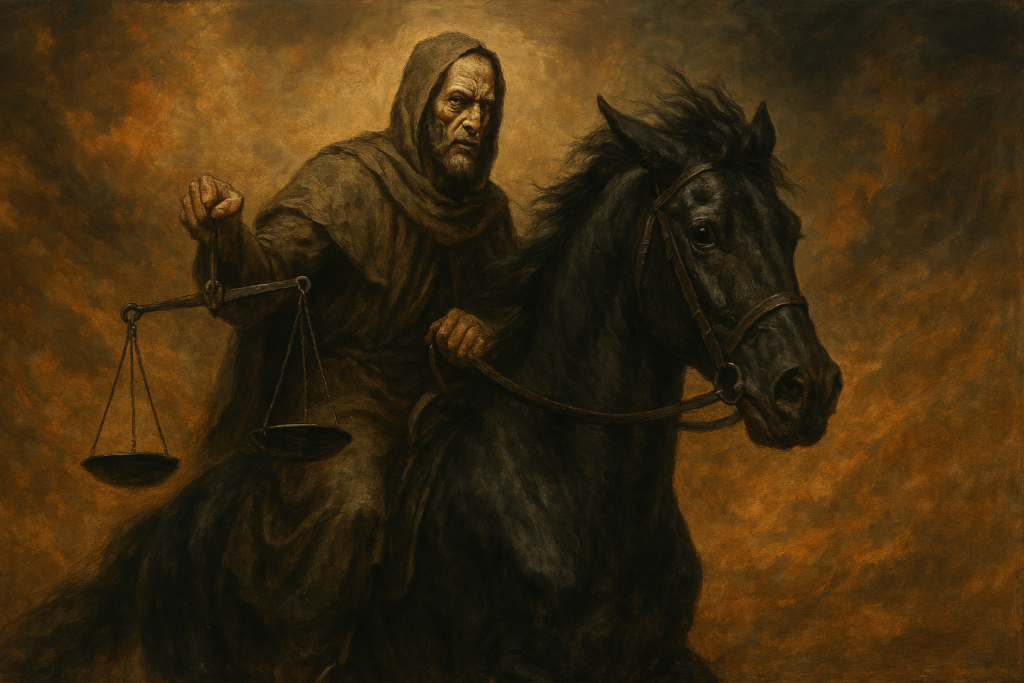
This analysis examines in detail the symbolic aspects of the third seal (Revelation 6.5-6). This passage presents a great wealth of images and meanings.
The symbolic elements of the third seal
1. The black horse
Black color: a symbol of mourning, deprivation, famine. In the Bible, black is associated with distress and the absence of light (cf.
Jeremiah 14.2 (King James Version) : Judah mourneth, and the gates thereof languish; they are black unto the ground; and the cry of Jerusalem is gone up.
King James Version (1769), domaine public — texte : eBible.org
).
Contrast with the other horses: after the white (conquest) and the red (war), the black announces the social and economic consequences: famine.
Pedagogical meaning: black is a color that immediately evokes lack and desolation.
2. The rider
Object held: a pair of scales in his hand.
Role: he carries no weapon of war but an instrument of measurement; famine is not a brutal destruction but an organized and controlled deprivation.
Symbolism: he embodies a distorted distributive justice, in which resources are counted down to the last detail, revealing the precariousness of human survival.
3. The scales
Instrument of measurement: used to weigh foodstuffs.
Symbol of rationing: provisions are so scarce that they must be weighed precisely.
Biblical link: Ezekiel 4.16-17 announces that the people will "eat their bread by weight and with anxiety", a sign of divine judgment.
Spiritual significance: the scales show that famine is a direct consequence of judgments, but also a revelation of economic injustice.
4. The voice in the midst of the four living creatures
Origin: it comes from the center, where God sits enthroned; this rationing is under divine control.
Message: “A measure of wheat for a denarius, and three measures of barley for a denarius; but do not harm the wine or the oil.”
Meaning: an announcement of exorbitant prices for basic foodstuffs, but a preservation of luxury goods (oil, wine).
Symbolism: social injustice; the poor suffer from famine, while the rich keep their privileges.
5. The price of wheat and barley
A denarius: a laborer’s wage for one day.
A measure of wheat: an amount sufficient to feed only one person; a worker cannot feed his family.
Three measures of barley: food of lesser quality, more accessible, but still insufficient.
Meaning: severe famine, inflation, economic imbalance.
Pedagogical significance: shows the fragility of economic systems and human dependence on resources.
6. The wine and the oil spared
Preserved products: symbols of luxury, joy and comfort.
Contrast: essential goods are lacking, but secondary products remain available.
Spiritual meaning: injustice and imbalance; the rich keep their privileges, the poor suffer.
Theological reading: God limits the judgment; the famine is not total, but it reveals social injustice.
Theological and pedagogical significance
Progression of the seals: conquest → war → famine → death. The third seal is a logical step: war brings scarcity.
Divine sovereignty: even famine is permitted and limited by God (“do not harm the wine or the oil”).
Spiritual message: human dependence on material goods is brought to light; only divine providence ensures true security.
Pedagogical application: this seal illustrates the fragility of economic balances and the need to seek justice and peace in Christ.
The third seal reveals famine and economic injustice through:
The black horse (deprivation, mourning).
The rider with a pair of scales (rationing, control).
The divine voice (judgment under sovereignty).
The price of wheat and barley (inflation, insufficiency).
The wine and the oil spared (social injustice, limited judgment).
Together, these symbols teach that war and conflict give rise to famine, that social injustices grow worse, and that God remains sovereign even in judgments.