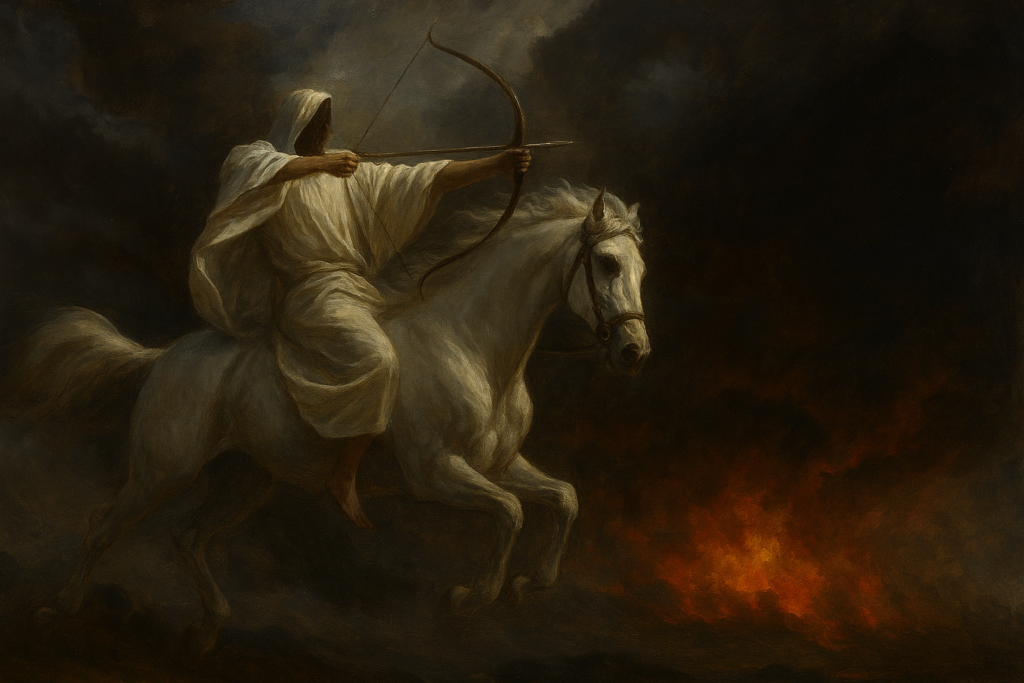
APO009 analyzes the first seal of Revelation (Rev 6.1-2) and the appearance of a rider on a white horse. Two theories compete: does this rider represent the victorious Messiah Jesus, or an impostor, even the Antichrist? The article sets out both positions, stresses that the exegetical debate remains open, and announces a parallel with Jesus’ discourse on the Mount of Olives.
71 min
first sealrider white horseRevelationAntichristprophecy
71 verses
14 books
This study of Revelation advances chapter by chapter and here focuses on the first seal. John sees a sealed scroll in the hand of God, and the opening of the first seal brings into view a rider on a white horse.
Two interpretations compete: some see in him the victorious Messiah Jesus, while others recognize an impostor, a deceptive imitation of Christ, even the .
The debate remains open among scholars. The study also stresses the importance of the parallel between Jesus’ discourse on the and the succession of plagues described in Revelation, a point that will be explored further.
In this in-depth study of the book of Revelation, we proceed with a chapter-by-chapter analysis, including specific insights on certain themes in order to make the interpretation easier to understand. Here we address the first seal and the consequences of its opening.
This revelation follows on from the manifestation of Jesus Christ (Revelation 1.1). The apostle John, after describing the heavenly vision and the throne of God, focuses his attention on one particular element: a scroll held in the right hand of the One seated on the throne. This scroll is sealed with seven seals, the first of which is about to be opened before our eyes.
The opening of this first seal brings about a major event: a rider on a white horse makes his entrance.
Two opposing theories compete regarding the identity and the action of this rider on the white horse:
The first theory identifies this rider as the Messiah Jesus himself. Several arguments support this hypothesis, which will be analyzed in more detail to show how this rider could indeed represent the victorious Messiah Jesus.
The second interpretation suggests that he is an impostor, an imitator of the Messiah Jesus, even of the . According to this hypothesis, the rider embodies satanic seduction. An analysis of the research carried out on this subject will explain this position and set out the reasons that lead us to favor it over the first.
It should be stressed that this debate remains open and that it still divides today the greatest exegetes who have examined this question.
One point deserves particular attention: the parallel between the discourse of the Messiah Jesus on the and the unfolding of the plagues presented in Revelation. This comparison will be examined in detail in the rest of the study.
We have reached the fourth section of the book, entitled “The things which shall be hereafter,” and we are now dealing with the second subject: the opening of the seven seals.
The outline of the book, chapter IV B
Section
Subsection
Description
References
I
—
Introduction
Revelation 1.1-3
II
—
The things past: “what you have seen”
Revelation 1.4-20
III
—
The things present: “what is,” message to the seven Churches
Revelation 2.1 à Revelation 3.22
IV
A
The throne of Christ; the sealed book
Revelation 4.1 à Revelation 5.14
B
Opening of the 7 seals
Revelation 6.1 à Revelation 8.1
C
Parenthesis: Jews and Gentiles saved during the tribulation
Revelation 7.1-17
D
Judgment announced by the seven trumpets
Revelation 8.2 to Revelation 9.21 and Revelation 11.15-19
E
Parenthesis: prelude to the seventh trumpet
Revelation 10.1 à Revelation 11.14
F
Dominant figures
Revelation 12.1-17
G
Advent and reign of the Beast and the false prophet
Revelation 13.1-18
H
Parenthesis: prophetic visions
Revelation 14.1-20
I
Judgments announced by the seven bowls of the wrath of God
Revelation 15.1 à Revelation 16.21
J
Condemnation of Babylon the Great
Revelation 17.1 à Revelation 19.6
K
Preparations for Armageddon and the thousand-year reign
Revelation 19.7 à Revelation 20.6
L
Last Judgment; description of the holy city
Revelation 20.7 à Revelation 22.5
V
—
Conclusion: the last message of the Bible
Revelation 22.6-21
This outline comes from Scofield’s commentaries.
I. The text
Revelation 6.1-2 (King James Version) :
And I saw when the Lamb opened one of the seals, and I heard, as it were the noise of thunder, one of the four beasts saying, Come and see.And I saw, and behold a white horse: and he that sat on him had a bow; and a crown was given unto him: and he went forth conquering, and to conquer.
King James Version (1769), domaine public — texte : eBible.org
John sees the Lamb open the first seal. One of the four living creatures calls out in a powerful voice: “Come”. Then a white horse appears, ridden by a rider holding a bow. A crown is given to him, and he goes out conquering, determined to win the victory.
In summary: the opening of the first seal reveals a rider on a white horse, sent out to conquer and to overcome.
It is clear that the seals that close the scroll are not all accessible at the same time. Indeed, the opening of the first seal conditions access to the next seal. There is therefore an orderly and rigorous progression in the revelation of these events.
This chronology implies that each stage, marked by the opening of a seal, must produce its effects and see its consequences fulfilled before the next phase can in turn begin.
Thus, the successive opening of the seals outlines a precise sequence, in which each action paves the way for the next, underscoring the importance of the gradual unfolding of the revealed plan.
II. The symbolic elements
The opening of the first seal in Revelation presents a highly symbolic scene in which every element carries a precise meaning. The introduces the action, underlining the solemnity of the moment.
The rider, the central figure, is entrusted with a specific mission. His white horse evokes victory or conquest, while his bow symbolizes offensive power. The crown he receives attests a conferred authority.
Finally, his conquest, going out “conquering and to conquer”, sums up the outcome of these symbols. The whole invites the reader to go beyond mere narrative and grasp the spiritual and symbolic scope of the message.
Every detail of the account of the opening of the first seal in Revelation carries symbolic significance, far beyond a simple narration of events. These elements are bearers of meaning and address a message to whoever reads the text. We will now examine precisely each of the six aspects mentioned:
The living creature : This is the first of the four living creatures, the one who speaks at the moment the seal is opened. His powerful voice introduces the action of the rider, underlining the importance of his role in the revelation of the events.
The rider : The central figure of the scene, he is appointed to carry out a specific mission. His posture and his attributes symbolize his active role in the sequence of judgments.
The white horse : The appearance of this white horse adds a particular dimension to the rider’s action. The color white often evokes purity, victory or conquest, which gives the scene a distinctive character.
The bow : The rider’s weapon, the bow suggests the ability to hit targets at a distance. It symbolizes offensive power or the authority conferred on the rider in the accomplishment of his mission.
The crown : Given to the rider, the crown is the sign of a recognized authority and of a power received. It attests the legitimacy of his mission and announces his coming victory.
The conquest : The text insists on the rider’s objective, as he goes out “conquering and to win the victory”.
This conquest is the direct consequence of all the preceding elements, and marks the fulfillment of the action initiated by the opening of the seal.
Each of these elements fits together precisely to convey a strong symbolic teaching, inviting the reader to go beyond the literal reading and to grasp the scope of the message conveyed.
In Revelation, the four living creatures described in Revelation 4.6-8, the Lion, the Ox, the Man and the Eagle, each possess their own symbolic identity representing strength, service, intelligence and vision. Together they form an ordered whole that reflects the totality of creation placed at the service of God.
In Revelation 6, each of these living creatures introduces one of the four horsemen: the lion calls the white rider (conquest), the ox the red rider (war), the man the black rider (famine), and the eagle the pale green rider (death).
According to this reading, a symbolic link unites each living creature to the rider it calls, reinforcing the idea of an intentional correspondence between the vision of chapter 4 and the judgments of chapter 6.
In Revelation, the four living creatures are presented in an order, and each has a distinct symbolic identity. John describes them in Revelation 4.6-8, and it is from this passage that one can “give them a name” or a designation:
The Revelation 4.7 : he looks like a lion. → Symbol of strength, royalty and majesty. He evokes the sovereign power of God and the vigor of creation.
The Revelation 4.7 : he looks like a young ox (or calf). → Symbol of service, sacrifice and fruitfulness. He recalls the animal of the offering and the sacrificial dimension of life.
The third living creature Revelation 4.7 : he has a face like that of a man. → Symbol of intelligence, reason and human dignity. He represents humanity in its calling to reflect the image of God.
The Revelation 4.7 : he looks like an eagle in flight. → Symbol of height, swiftness and penetrating vision. He embodies transcendence and the ability to see from above, close to heaven.
These four living creatures are therefore ranked in a precise order, each introducing one of the four horsemen in Revelation 6. They form a kind of “cosmic quartet”, representing the totality of the dimensions of creation (strength, service, intelligence and vision), placed at the service of God and associated with his judgments (see APO005 : the Study of chapter 4).
We can therefore name them thus: the Lion, the Ox, the Man, the Eagle.
Although each of these living creatures is clearly listed, they are not directly named with the first four seals. We believe that the order John gave them corresponds to the order of the horsemen. This link would also explain the reasons for John’s precise description in Revelation 4.6-8.
Consequently we obtain:
When the Lamb opens the seals, each horseman is called by one of the four living creatures standing around the throne.
(Majesty, conquest and authority), the one who looks like a lion, says “Come”. Then the first horseman appears, mounted on a white horse, holding a bow and receiving a crown. He goes out conquering and to conquer.
(strength, violence and war), the one who looks like a young ox, says “Come”. Then the second horseman springs forth, on a fiery red horse. He receives a great sword and the power to take peace from the earth, so that men kill one another.
Third living creature (Humanity, economy and famine), the one who has a face like that of a man, says “Come”. The third horseman appears, on a black horse. He holds a pair of scales in his hand, and a voice announces a measure of wheat for a denarius, a sign of famine and rationing.
(Swiftness, judgment and death), the one who looks like an eagle in flight, says “Come”. Then the fourth horseman springs forth, on a pale green horse. His name is Death, and Hades follows him. They are given to kill by the sword, famine, plague and the wild beasts.
In summary : each horseman is introduced by a different living creature, in the order lion, ox, man, eagle. The horsemen successively symbolize conquest, war, famine and death, inaugurating the judgments that unfold on the earth. We believe that a symbolism unites the pairs, living creature and horseman. A link, in our view, binds the living creature and the horseman.
The first horseman on the white horse is interpreted in two ways. Some see in him Christ, victorious and bearer of the Gospel, in connection with Revelation 19. Others recognize the Antichrist, a deceptive imitator, since Jesus opens the seals and cannot be the horseman who comes out of them.
In our model, this second reading is the most coherent: the rider inaugurates the historical diagnosis of the seals, which describe the forces at work in humanity before the future judgments.
1. The rider as an image of the Messiah Jesus
Some exegetes identify the rider on the white horse (Revelation 6.1-2) with Christ himself.
In Revelation 5.5, Jesus is called “the Lion of the tribe of Judah”, victorious and alone worthy to and its seals.
The rider is described as victorious, crowned and going out to conquer: an image of the spread of the Gospel and of spiritual conquest.
The white horse symbolizes purity and divine victory.
The crown recalls messianic kingship.
The bow can be understood as a spiritual instrument, the Word that touches hearts.
This reading is reinforced by Revelation 19.11-16, where the Messiah Jesus himself appears on a white horse, “faithful and true”, “King of kings and Lord of lords”. Thus the first rider would be Christ inaugurating the history of salvation, distinct from the three other riders who bring calamities.
2. The rider as an impostor: the Antichrist
Other traditions see in this rider an imitator of Christ, probably the Antichrist.
The Messiah Jesus is the one who opens the seals: he therefore cannot be at the same time the rider who comes out of them.
The context is that of judgment and of the great tribulation, a period in which Jesus does not intervene directly.
Christ has already won the victory at the cross; he has no need to “go out to conquer” nor to receive an additional crown.
The bow is never associated with Jesus in the New Testament, who is linked to the sword of the Word (Revelation 1.16, Revelation 19.15).
The rider inaugurates a series of catastrophes (war, famine, death), which corresponds more to a false peace or a deceptive seduction than to the redemptive work of Christ.
From this perspective, the white horse and the crown would be deceptive attributes, a counterfeit intended to seduce and lead astray.
Conclusion
Two readings are in opposition:
The Messiah Jesus: victorious, inaugurating the history of salvation through the spread of the Gospel.
The Antichrist, or the spirit of the Antichrist: an impostor, imitating the attributes of Christ in order to deceive and bring about the judgments.
The interpretation of the vision of the rider rests mainly on the analysis of several symbolic elements: the white horse, the crown and the bow. It is essential to distinguish the Lamb, that is, the Messiah Jesus, who opens the seals, from the rider who appears afterward. This distinction structures the whole reflection on the meaning to be given to this vision.
After examining the various possible hypotheses, it appears that only the second, namely the identification of the rider with the Antichrist or the spirit of the Antichrist, proves coherent with the context studied.
As we have previously demonstrated in chapter APO004bis, the seven seals are an integral part of the history of humanity. Contrary to certain interpretations, they do not belong to the specific chronology of Daniel’s last week.
In reality, these seven seals must be understood as a diagnosis made on humanity as a whole. This finding, established through the opening of the seals, precedes and prepares the treatment that will take place later, specifically during the seventieth week, as described in Daniel 9.24-27.
Having set out above the reasons that lead us to identify the first rider not with the Messiah Jesus, but rather with an imitator, a usurper, namely the Antichrist, it is fitting to continue the analysis in this direction. Our current interpretation is therefore based on this conclusion and highlights the particularly deceptive nature of the symbolism associated with the rider. All the elements mentioned show how much appearance can mislead and conceal the true identity of this actor, who presents himself as legitimate while being only an impostor.
1. The white color
The white horse of Revelation 6: a symbolism of deception
The white horse appears first in the series of the four horses of Revelation 6. Its color, its place in the sequence and its symbolic role make it a key element for understanding the dynamics of the judgments. Here is a reading focused exclusively on the animal and on what it represents.
White: an ambivalent color
In the Bible, white often evokes purity, victory and holiness. But in Revelation 6, this color functions differently: it serves as a façade.
White here becomes:
a mask of legitimacy,
an appearance of righteousness,
a visual signal that inspires trust,
a diverted symbol used to deceive.
In other words: the white horse does not bear purity, but an illusion of purity. It imitates the visual codes of Christ (Revelation 19), but without bearing the reality.
2. The horse: a symbol of military power
In biblical culture, the horse is the animal of war, conquest and domination. It is never associated with peace or redemption. The kings of Israel were not to multiply horses (Deuteronomy 17.16), precisely so as not to base their security on military power.
Thus, the white horse combines two elements:
military force (the horse),
the appearance of holiness (the white).
This blend creates a powerful image: a conquest that presents itself as just, a domination adorned with light, a warlike force disguised as spiritual victory.
It should be stressed that, in the Israelite context, rulers used horses for travel connected with war, whereas in times of peace they generally rode donkeys, as Matthew 21.5-7, Mark 11.7, Luke 19.35 and John 12.14-15 illustrate.
Taken in isolation, the white horse represents:
a seductive victory,
an appearance of peace,
an authority that seems legitimate,
a purity that is only superficial.
It does not symbolize true peace, but an artificial peace, a victory that attracts, reassures and deceives.
The white horse is therefore the image of a deceptive beginning: it opens the series of judgments not by direct violence, but by visual seduction.
4. The pedagogical role of the symbol
The white horse teaches a major spiritual truth:
evil often begins by imitating good,
deception presents itself in reassuring colors,
seduction precedes destruction.
It is the first horse because deception is the first judgment: before war, famine and death comes illusion.
Conclusion
The white horse of Revelation 6 is not a symbol of Christ’s victory, but a visual imitation, a counterfeit that borrows the codes of purity the better to deceive. It represents a seductive conquest, a false peace, an appearance of light that opens the way to the judgments that follow.
By focusing on the animal itself, we see clearly that its whiteness is not a sign of holiness, but a tool of spiritual seduction, an antichristic symbol that advances under the colors of Christ without bearing his truth.
Summary of the paragraph
The bow of the first rider is intriguing, because in the Old Testament it often symbolizes deliverance or the powerful action of God. One might therefore see in it a messianic sign. But placed back in the context of Revelation, this bow takes on the opposite meaning: the rider’s arrows do not set free, they turn humanity away from God.
The weapon becomes an instrument of seduction and spiritual rupture. This rider therefore does not embody Christ, but an impostor who, like the other riders, contributes to the judgments that fall upon the earth.
Full text
The mention of the bow in Revelation 6.1-2 is intriguing, because John does not specify the presence of arrows, even though the weapon is obviously intended to shoot them. In the Old Testament, the bow and the arrow often carry strong symbolic weight. When the prophet Elisha asks King Joash to shoot an arrow (2 Kings 13.17), it is a prophetic gesture announcing Israel’s deliverance from the Syrians.
Other texts reinforce this symbolism:
In Isaiah 49.2, the arrow represents the prophet himself, a sharpened instrument in the hand of God.
In Zechariah 9.14, the arrow evokes the swift and powerful intervention of the .
In these passages, the arrow expresses either divine deliverance or the effective action of the Word of God.
At first sight, one might therefore think that the rider armed with a bow symbolizes the Messiah Jesus, shooting arrows of deliverance to set his people free. This interpretation rests on the prophetic and spiritual dimension associated with the bow in Scripture.
However, analysis of the apocalyptic context leads to a different conclusion. This rider’s arrows are not aimed at saving, but at turning humanity away from God. The weapon then becomes an instrument of seduction and spiritual rupture, not of deliverance.
Thus, far from embodying the redemptive action of Christ, this rider acts like the other riders: he takes part in the unfolding of the judgments upon the earth. His bow is not a sign of salvation, but a tool of deception, revealing his true identity as an impostor.
The crown of the white rider of Revelation 6.2, called stephanos, is not a royal crown but that of a mere victor. It is “given” to him, a sign of a power received and temporary, not of a legitimate authority like that of Christ.
This crown creates the illusion of a righteous victory, but is only an instrument of seduction. It imitates the true kingship of Christ, without having its nature. By inaugurating the judgments that follow, war, famine and death, it reveals that this apparent triumph is in reality the beginning of chaos.
The crown therefore symbolizes a false power, a false legitimacy and a false messiah.
Here is a clear explanation, centered on the symbolism of the crown in Revelation 6.2, and on what it implies if one understands this rider as an antichristic figure.
1. The word used: stephanos, the victor’s crown
In Revelation 6.2, the text says:
“A crown (stephanos) was given to him.”
The term stephanos designates:
the victor’s crown in the games,
the honorary reward,
a sign of success or triumph.
It is not the royal crown (diadēma) that Christ wears in Revelation 19.12.
? The receives a victor’s crown, not a king’s crown. This is an essential detail.
2. A crown “given”: a power received, not innate
The text specifies:
“a crown was given to him”.
This means:
he does not possess it by nature,
he does not win it by himself,
he receives it from an outside authority.
In the Bible, when Christ receives a crown, it is by right, by nature, by essence. Here, the rider receives a crown as a temporary mandate, a permitted power.
? The is not sovereign: he is authorized.
3. A crown: the appearance of legitimacy
The horse is white, the crown is that of a victor: everything in the image gives an impression of victory, purity, legitimacy.
But this crown:
is not royal,
is not eternal,
is not divine,
is not linked to justice,
is only a symbol of apparent success.
It serves to deceive, to give the illusion of a righteous reign.
? The crown is an instrument of visual seduction.
4. The crown as a sign of imitation
The creates nothing: he imitates.
In Revelation 19.11-13, Christ appears on a white horse, wearing many crowns (diadēmata). The rider of Revelation 6 also appears on a white horse, but with a single crown, and an inferior crown.
It is a counterfeit:
the same color,
the same posture,
the same symbolism of victory,
but not the same nature.
? The crown of the white rider is an imitation of the true kingship of Christ.
5. A crown that opens the way to chaos
The white rider is the first of the four. His crown inaugurates:
war (red horse),
famine (black horse),
death (pale horse).
This shows that his “victory” is not saving, but destructive.
? His crown is not a sign of peace, but the beginning of judgment.
Synthesis
The crown of the white rider of Revelation 6.2, understood in an antichristic reading, means:
a power received, not innate;
an apparent victory, not a real one;
an imitation of Christ, not his manifestation;
a visual seduction, not an authentic justice;
a temporary mandate, not a reign;
the beginning of deception, not the fulfillment of salvation.
It is the symbol of a false triumph, of a false legitimacy, of a false messiah.
The white rider “goes out conquering”, but his victory is only a deceptive imitation of that of Christ. In Revelation, every true victory already belongs to Jesus, whose cross is the definitive triumph, and whose later victories, the spread of the Gospel, the judgment of the rebellious powers, the final destruction of death, cannot be attributed to anyone else.
The rider of Revelation 6.1-2 belongs to none of these works: on the contrary, he inaugurates a series of judgments leading to chaos. His conquest is not redemptive, but lying. He represents the Antichrist, who imitates the symbols of Christ in order to deceive, without possessing their reality.
The white rider “goes out conquering”: this expression describes an assurance of victory, a domination that seems total and uncontested. But if this rider is not Christ, and everything in the text shows that he is not, then his “victory” is not that of the cross. It is a deceptive victory, a lying conquest that imitates the true victory of the Messiah.
1. The framework of Revelation: everything begins with the glorified Jesus
Revelation 1.1 (King James Version) :
The Revelation of Jesus Christ, which God gave unto him, to shew unto his servants things which must shortly come to pass; and he sent and signified it by his angel unto his servant John:
King James Version (1769), domaine public — texte : eBible.org
:
This verse places the whole of Revelation under the authority of the risen Christ. The cross is already the founding event: the victory over sin and death has been won. Nothing and no one can add to this victory.
Thus, when the white rider of Revelation 6 appears, he cannot represent a new victory of Christ, for that victory is already accomplished and unique. His “victory” is therefore a counterfeit, an imitation intended to seduce.
2. Revelation reveals several victories… but all belong to Christ
Revelation describes different manifestations of Christ’s victory in history:
Victory of the Gospel spreading throughout the world
Victory over hostile powers (Revelation 17.14: “The Lamb will overcome them…”)
Final victory at the return of Christ (Revelation 19.16: “King of kings and Lord of lords”)
None of these victories is entrusted to anyone other than Jesus. They are the extensions of the cross, never rival victories.
This is why the white rider of Revelation 6 cannot be Christ: he inaugurates a series of judgments that lead to war, famine and death. He does not extend the cross: he prepares chaos.
3. The last victory of Christ: the destruction of death
The Bible clearly describes the final victory of the Messiah:
Revelation 20.14: death and Hades are thrown into the lake of fire
Revelation 21.4: “there shall be no more death”
1 Corinthians 15.26: “the last enemy that shall be destroyed is death”
The last victory of Jesus is therefore eschatological: the definitive disappearance of death and of all evil.
This victory has nothing to do with the deceptive conquest of the white rider.
4. Theological meaning
The cross: inaugural, definitive victory over sin and Satan.
The intermediate victories: the advance of the Gospel, judgments on the rebellious powers.
The final victory: destruction of death and establishment of the reign.
The white rider belongs to none of these categories. He is not an agent of redemption, but the first act of judgment, an initial deception that opens the way to the following riders.
5. Pedagogical synthesis
First victory: the cross — already accomplished, unique, perfect.
Final victory: the end of death and evil — yet to come.
In between: Christ acts, judges, saves, leads history.
The white rider does not belong to this dynamic. He represents the Antichrist, the one who imitates Jesus the better to deceive, the one who seizes the symbols of Christ (white horse, crown, victory) without possessing their reality.
What, then, are the conquests and victories of this white rider whom we have identified with the Antichrist?
The
The or the spirit of the
The
IX. The Mount of Olives Discourse
Summary of the paragraph
The passage establishes a close parallel between the first six seals of Revelation 6 and Jesus’ announcements in : seduction, war, famine, mortality, persecution of believers and cosmic catastrophes.
This correspondence shows that the revelation given to John deepens the teaching already given by the Messiah Jesus on the . These phenomena recur throughout human history, reflecting the condition of humanity.
However, the rider on the white horse seems to represent a particular and continuing action: his influence, interpreted as a work of seduction undermining divine authority, would have begun in the earliest days of the Church and would still continue today, with no indication of its completion.
Full text
The events of Revelation 6.1-17 closely resemble the prophecy of the Lord Jesus in (Matthew 24.5-35. On the , the Son of God foretold events that would become, for John, the object of a new and more detailed revelation; the parallel can be drawn as follows:
1_ Seduction: Matthew 24.5 would correspond to the first seal and to the rider on a white horse of Revelation 6.1-2.
2_ War: Matthew 24.6-7 would correspond to the second seal and to the rider on a fiery red horse of Revelation 6.3-4.
3_ Famine: Matthew 24.7 would correspond to the third seal and to the rider on a black horse of Revelation 6.5-6.
4_ Mortality: Matthew 24.6-7 would correspond to the fourth seal and to the rider on a pale green horse of Revelation 6.7-8.
5_ The martyrs: Matthew 24.9-10 and Matthew 24.16-22 would correspond to the fifth seal and to the martyrs who cry out in Revelation 6.9-11.
6_ Cosmic catastrophes and terror: Matthew 24.29-35 would correspond to the sixth seal and to the cosmic catastrophes of Revelation 6.12-17.
This comparison highlights how the vision received by John confirms and deepens the information already delivered by the Messiah Jesus in his discourse on the . The indications given by the Master during this teaching in fact find an echo throughout human history. These warnings are seen to have been fulfilled at different times and, in a certain way, they manifest themselves recurrently, being intimately bound up with the very nature of humanity.
However, the event linked to the white rider seems to correspond to a particular fact. Adopting the hypothesis according to which the seals represent what takes place in humanity through the centuries corresponding to the life of the Church, we observe that the white rider has begun his action and that he continues it even today. Nothing in John’s vision indicates that the work of this white rider would be completed.
Thus, it appears that this white rider tirelessly continues to undermine divine authority, maintaining his influence over time, in accordance with our conclusions.
The
In both books, this figure enjoys an initial but limited success, which then prepares the rupture, chaos and judgment. Thus, the first seal would correspond to the phase of deceptive peace announced by Daniel, before the following seals express the consequences of this initial seduction.
It is interesting to want to verify and refine the links between the information in Daniel and that in Daniel.
1. The texts under consideration
X. The Link with the Book of Daniel
First seal – Revelation 6.1-2
A white horse.
A rider with a bow.
A crown is given to him.
He goes out conquering and to conquer.
Prophecies of Daniel (Antichrist / future leader)
Daniel 9.27: a “leader” makes a firm covenant for one week, then breaks it in the middle.
Daniel 7.1-28: a “little horn” that rises, receives authority, persecutes the saints for a limited time.
Daniel 8.23-25: a cunning, strong king who succeeds “by his cunning”, “destroys many who live in peace”.
Daniel 11.21-24: a contemptible king who obtains the kingdom “by intrigue”, succeeds in times of peace.
We put forward the following hypothesis: the white rider = the Antichrist at the beginning of the 70th week. Let us look at the possible links.
2. Contextual link: the beginning of the 70th week
In Daniel 9.27, the 70th week begins with:
A confirmed covenant,
A period in which everything seems to hold,
A political framework that appears stabilized.
In Revelation 6.1-17, the first seal does not bring war immediately, but an initial conquest that has the appearance of a controlled success.
In the Antichrist hypothesis:
Daniel shows the beginning through a covenant.
Revelation shows the beginning through a seductive conquest.
These are two different angles on the same phase: an apparently positive rise to power.
3. Link in the mode of action: conquest without open war
Daniel insists on:
Cunning,
Intrigues,
Agreements in times of peace,
A success that does not rest first of all on brute force (Daniel 8.25, Daniel 11.21-24).
Revelation 6.2 shows:
A rider with a bow, but with no mention of arrows;
No battle scene;
A victory that seems to be obtained without immediate carnage.
In an antichristic reading:
Daniel describes a leader who wins through diplomacy and manipulation.
Revelation pictures this by a white rider who advances as a conqueror, without our yet seeing blood.
We can therefore speak of a political and ideological conquest, more than a military one at the outset.
4. Link in the nature of the “victory”: apparent, not definitive
In Daniel, this figure:
Succeeds for a time,
Prospers,
Overthrows the mighty,
But ends up judged and destroyed.
In John, the rider of the first seal:
Receives a crown (a granted, limited power),
Goes out conquering,
But his action opens the way to the following riders (war, famine, death).
In your reading:
Daniel: the Antichrist experiences a phase of spectacular but provisional success.
Revelation: the white rider inaugurates a series that goes beyond him and leads to judgment.
It is the same logic: a real victory on the historical level, but false and condemned on the eschatological level.
5. Theological link: deceptive peace and judgment
Daniel 9.27, Daniel 8.25, Daniel 11.21-24, outline a scenario: apparent peace → covenant → control → rupture → distress.
Revelation 6.1-17 outlines a similar dynamic: white rider (seduction, false peace) → red horse (war) → black horse (famine) → pale horse (death).
In our hypothesis:
The first seal corresponds to the peace / covenants / seduction phase described by Daniel.
The following seals reflect the rupture and the consequences of this lying peace.
We cannot demonstrate textually that John “comments on” Daniel 9.27, but we can say:
Both books describe one and the same figure,
One and the same inaugural period of deception,
One and the same logic: deceptive peace → chaos → judgment.
6. A possible pedagogical formulation
Under the Antichrist hypothesis:
Daniel 9.27 shows the beginning of the 70th week as a period of peace and covenant, dominated by a deceptive leader.
Daniel 8.1-27 and Daniel 11 specify that this leader succeeds by cunning, in times of peace.
Revelation 6.1-2 depicts this same reality under the image of a white horse: a seductive conquest, an apparent victory, a crowned authority that prepares the drama.
Even if the link is not explicitly mentioned in the text, it remains coherent when the Antichrist is regarded as the main figure: one can interpret the first seal as the apocalyptic opening of Daniel’s 70th week, in which the Antichrist seduces from the very beginning.
Conclusion
Summary of the paragraph
The first rider of Revelation 6.1-2 does not represent Christ, but the Antichrist, who imitates the symbols of the Messiah in order to deceive. Mounted on a white horse and crowned with a temporary power, he advances with the appearance of victory and authority, but is only a seductive counterfeit.
This false peace opens the way for the three following horsemen, who pour out the divine judgments. Thus the initial seduction of the first horseman prepares the gradual entry of chaos.
Full text
We have just analyzed the passage of Revelation 6.1-2, and according to the hypothesis we adopt, this first rider does not evoke the Messiah Jesus, but the Antichrist, or rather the spirit of the Antichrist, the one who presents himself as a savior while usurping the symbols of Christ. He appears mounted on a white horse, a color that normally evokes purity and victory, but which he uses here as a mask, an imitation intended to deceive. Even though the text does not mention his tunic, we can imagine that it is white as well, reinforcing this illusion of legitimacy.
He goes out "conquering and to conquer," displaying total assurance, as if he possessed unquestionable authority. His crown, which is given to him, symbolizes a power granted for a time, not a true kingship. It is not the glorified Christ returning to complete His work: it is a strong man, a seductive leader, a false king who advances under the appearance of triumph.
The honor with which he seems to be surrounded in this vision has nothing to do with the heavenly worship reserved for the true Lamb. No king, even the most powerful, has ever received such respect on earth — and yet this horseman is only a counterfeit.
After this first scene, three other horsemen will appear, each linked to the opening of a seal. The order is precise and intentional: the first horseman opens the way, and the following ones pour out on the earth the plagues that manifest the wrath of God. We will see in the following chapters how this sequence unfolds and how the initial seduction of the first horseman gradually leads to chaos.
A title, a person, a place, a reference (“Luke 15”)…
opens in a new window
Bible reference
INF251
Information note
INF251 - The distribution of the seals during Daniel’s last week
The distribution of the seals during Daniel’s last week
The first horseman in the first 3.5 years: consistent with a period of deceptive peace
If we understand the white horseman as the Antichrist in his phase of seduction, then his appearance at the beginning of the 70th week is perfectly logical.
Daniel 9.27 says:
That he will confirm a covenant (or a pact),
That he will establish a period of apparent peace,
That he will reveal his true face only at the middle of the week.
This first half is often interpreted as:
A period of stability,
Of seduction,
Of false peace,
Of nonviolent conquest.
? The white horseman corresponds exactly to this dynamic: a victory without war, an alluring domination, a deceptive peace.
The other seals: logically placed in the second half
If we follow this reading, seals 2 to 4 (war, famine, death) seem far more compatible with the great tribulation, that is, the second half of the week.
Seal 2: the red horse → world war
This corresponds to the breaking of the covenant, to the chaos unleashed by the Antichrist.
Seal 3: the black horse → famine
A direct consequence of the conflicts, of economic collapse and of total control.
Seal 4: the pale horse → mass death
A dramatic intensification, consistent with the period when the Antichrist exercises open tyranny.
? These seals do not look like a peaceful period. They correspond rather to the rise of chaos after the breaking of the covenant.
The problem: Revelation does not explicitly give a chronological division
We must be honest: John never says that the seals are divided between the two halves of the week.
But a typological and theological reading allows for coherence:
Seal 1: seduction, deceptive peace → first half
Seals 2–4: war, famine, death → second half
Seals 5–7: eschatological intensification → end of the second half
This reading is consistent with:
Daniel 9.1-19
Matthew 24.1-51 (where Jesus first describes “birth pains,” then a “great tribulation”)
1 Thessalonians 5.1-28 (“peace and safety,” then sudden destruction)
Why are the first 3.5 years “peaceful”?
Because the peace is not real: it is political, psychological, diplomatic, but not spiritual.
The white horseman:
Does not wage war,
Destroys nothing,
Provokes no catastrophes,
But sets up a system of soft domination.
It is a deceptive peace, not a divine peace.
Synthesis
According to your reading — and it is coherent — here is the structure:
First 3.5 years: a period of deceptive peace
Seal 1: the white horseman
Worldwide seduction
Covenant confirmed
Soft political domination
Appearance of stability
Last 3.5 years: the great tribulation
Seal 2: war
Seal 3: famine
Seal 4: death
Seal 5: persecution
Seal 6: cosmic upheavals
Seal 7: opening of the trumpets
? Le premier sceau correspond à la séduction initiale. Les sceaux suivants correspondent à la rupture et au chaos.
INF265
Information note
INF265 - The Antichrist or the spirit of the Antichrist
The Antichrist or the spirit of the Antichrist
The Antichrist according to the Scriptures: cross perspectives from Daniel, Paul and John
The in-depth study of the figure of the Antichrist has already been carried out in appendix ANN122: The spirit of the Antichrist. Here we will merely set out the broad outlines and the main perspectives drawn from that work, without going into the detail of that analysis.
A figure traditionally identified from Daniel and Paul
The identification of the Antichrist rests most often on the descriptions given by Daniel and Paul. According to these texts, he is a specific person, who must meet well-defined conditions. Daniel, in particular, announces that a man will rise up, embodying all opposition to God: he will be the Antichrist, the central figure of the final revolt against the Lord.
John's particular contribution: a reality that is both manifold and already present
However, several texts of John seem to contradict this monolithic perspective. John indeed asserts that several antichrists are already at work in the world, and he is speaking of his own time, the first century. This vision broadens our understanding of the Antichrist: it is not only a future, single individual, but a manifold phenomenon and a spirit at work throughout human history.
All the details John gives on this subject are gathered in the note INF266: The Antichrists according to John. We can nevertheless retain here that, according to him, a man will one day rise up to oppose God head-on and will impose himself in this world, drawing behind him a multitude of people into open revolt against the Lord. This figure does not appear suddenly and in isolation: his coming is preceded and prepared by other similar figures and influences.
The spirit of the Antichrist at work throughout history
Thus, as John says, other antichrists have already acted and made themselves known throughout human history, seeking to turn the greatest possible number of people away from God. We can speak of a genuine "spirit of the Antichrist" that animates various figures and influencers, whose aim is to turn their contemporaries away from the salvation offered in Jesus Christ.
Reading Revelation 6.1-2: the first horseman
In this perspective, the first horseman of Revelation 6.1-2 does not represent the Antichrist in person, but rather the spirit of the Antichrist described by John. This horseman symbolizes those figures who, through their influence, encourage the rejection of God and physically oppose the people of God, targeting the Jews first of all.
INF243
Information note
INF243 - The Second Living Creature, the Bull
The Second Living Creature, the Bull
The second living creature of Revelation 4.7 deserves careful analysis, because its translation and its symbolism are not trivial.
The Greek word
The text says: « τὸ δεύτερον ζῷον ὅμοιον μόσχῳ » — to deuteron zōon homoion moschō.
ζῷον (zōon)** = “living creature”, a generic term that stresses vitality.
μόσχος (moschos)** = “young bovine”, “calf”, sometimes “bullock”.
It is not the word for “adult ox” (bous) nor for “wild bull” (tauros). ? The most literal translation would therefore be “like a calf”, but many versions prefer “ox” or “bull” to convey the symbolic weight.
What does this second creature represent?
Sacrificial dimension: The calf/ox is the animal of the sacrifices in the Temple (cf. Leviticus 4.3-4). It evokes offering, service and consecration.
Domesticated strength: Unlike the lion (royal power), the ox symbolizes strength placed at the service of others, patience and labor.
Christological link: Some exegetes see in it an allusion to Christ in his role as servant and sacrificial victim, in contrast with the lion of Judah (Revelation 5.5).
Complementarity: In the series of the four living creatures, it embodies the dimension of creation devoted to service and sacrifice, alongside kingship (lion), intelligence (man) and transcendence (eagle).
Its role in the rest of Revelation
Revelation 6.3–4: The second living creature says “Come!” and introduces the red horseman (war).
Revelation 7.11: It takes part in the worship with the other living creatures and the angels.
Revelation 15.7: One of the living creatures gives the angels the seven bowls of wrath. ? It is therefore not merely symbolic: it acts concretely in the unfolding of the judgments.
Why this description?
Link with Ezekiel: John takes up the figures of the cherubim (Isaiah 1.10), where one of the faces is that of an ox.
Link with Isaiah: He gives them six wings, like the seraphim (Isaiah 6.2).
Teaching purpose: The description shows that the whole creation, in its strength, its service, its intelligence and its transcendence, is involved in worship and in the divine plan.
Theology: The second living creature reminds us that heavenly worship is inseparable from the notion of sacrifice and service, values that are central in biblical revelation.
Synthesis
The Greek word μόσχος is better translated “calf” or “young bovine”, but “ox” or “bull” are interpretive choices meant to reinforce the symbolism.
This second creature represents the sacrificial and serving dimension of creation.
It acts actively in the revelation (seals, praise, handing over of the bowls).
Its description aims to show that heavenly worship includes service and sacrifice, in addition to kingship, intelligence and transcendence.
INF253
Information note
INF253 - To whom is the command “Come” addressed?
To whom is the command “Come” addressed?
In Revelation 6.1-8, at the opening of each of the first four seals, one of the four living creatures says: “Come” (or “Come and see,” according to some translations).
Two main interpretations
A call addressed to John (the seer)
Meaning: the living creatures invite John to draw near and behold the vision that is about to unfold.
Argument: John’s role is to “see” and to “report” what he beholds. The “Come” is therefore a liturgical invitation to take part in the revelation.
Consequence: this underlines that the revelation is given to the Church through John.
A call addressed to the horseman
Meaning : the living creatures call the horseman to go forth and fulfil his mission.
Argument: immediately after the “Come,” the horse and its rider appear. The word works as an order to enter the scene.
Consequence: this underlines that the judgments are set in motion by divine authority, relayed by the living creatures.
Linguistic nuance
The Greek simply says “Erchou” = “Come.”
The text does not explicitly state who is being addressed.
Both readings are possible, and many commentators recognize a double function:
For John: an invitation to see.
For the horseman: an order to go forth.
Theological significance
If addressed to John: this highlights the prophetic calling, to see and to pass on.
If addressed to the horseman: this highlights divine sovereignty; the judgments are set in motion only at heaven’s command.
Integrated reading: the two meanings complement each other. John is invited to see what God commands, and the horsemen go forth because God calls them.
Synthesis
When the living creatures say “Come,” the text can be understood both as an invitation to John (come and behold) and as an order to the horseman (come and act). This ambiguity is deliberate: it underlines that the revelation is given to the prophet, but that the judgments are also set in motion by divine authority.
INF245
Information note
INF245 - The Fourth Living Creature, the Eagle
The Fourth Living Creature, the Eagle
The fourth living creature of Revelation 4.7, “like an eagle in flight”, is rich in symbolism.
The Greek word
The text says: « τὸ τέταρτον ζῷον ὅμοιον ἀετῷ πετομένῳ » — to tetarton zōon homoion aetō petomenō.
ζῷον (zōon)** = “living creature”, a generic term for an animate creature.
ἀετός (aetos)** = “eagle”.
πετόμενος (petomenos)** = present participle of “to fly”, hence “in flight”. The translation “like an eagle in flight” is accurate and faithful to the Greek.
What does this fourth creature represent?
Transcendence and height: The eagle is the bird that flies the highest, a symbol of divine vision and of closeness to heaven.
Vigilance and swiftness: In the Bible, the eagle is associated with vigilance and strength (Deuteronomy 32.11; Isaiah 40.31).
Spiritual dimension: It embodies the capacity of creation to rise toward God, to see from afar and to act swiftly.
Complementarity: With the lion (strength), the ox (sacrifice), and man (intelligence), the eagle represents transcendence and spiritual vigilance.
Its role in the rest of Revelation
Revelation 6.7–8: The fourth living creature says “Come!” and introduces the pale horseman (death).
Revelation 4.8: Like the others, it takes part in the perpetual praise (Holy, Holy, Holy).
Revelation 7.11: It joins the angels and the other living creatures in worship. ? It is therefore active in the unfolding of the judgments and in the heavenly liturgy.
Why this description?
Link with Ezekiel 1.10: One of the faces of the cherubim is that of an eagle. John takes up this image but makes it a distinct creature.
Link with Isaiah 6.2: Like the seraphim, each of the living creatures has six wings and proclaims the holiness of God.
Theology: The eagle in flight symbolizes the transcendent dimension of creation, which rises toward God and takes part in his plan.
Teaching purpose: Its description completes the picture of the four living creatures, representing the whole of creation:
Lion → royal power
Ox → sacrifice and service
Man → intelligence and relationship
Eagle → transcendence and vigilance
Synthesis
The Greek word is well translated: “eagle in flight”.
This fourth creature represents the transcendence, the vigilance and the spiritual dimension of creation.
It acts actively in the revelation (seals, praise, handing over of the judgments).
Its description aims to show that the whole creation, in all its dimensions, is associated with worship and with the divine plan.
INF256
Information note
INF256 - The death of a quarter of humanity
The death of a quarter of humanity
The text
Revelation 6.8 says: “Power was given to them over a fourth of the earth, to kill with the sword, with famine, with death, and by the wild beasts.”
Analysis
The fourth seal introduces Death and the realm of the dead. The text specifies that their power extends over a quarter of the earth. The means of death mentioned (sword, famine, pestilence, wild beasts) overlap with the judgments already introduced by the previous horsemen (war and famine).
Interpretation
Not a cumulative addition: the quarter of the earth is not the sum of the deaths of the previous seals plus those of the fourth.
The previous horsemen (red and black) announce war and famine as realities.
The fourth seal encompasses these realities and associates them with death itself.
An overall figure: the quarter of the earth represents the total portion affected by Death and Hades, including the effects of wars, famines and pestilences.
In other words, the deaths from war and famine are counted within this quarter, since they are explicitly mentioned as instruments of Death.
Symbolic scope: the quarter is not an exact statistic, but a limit set by God.
This shows that the judgment is severe but not total. God keeps sovereignty by setting bounds to the extent of death.
Synthesis
The deaths linked to war and famine are included in the quarter of humanity struck by the fourth seal. This figure is not added to the previous ones, but represents an overall whole: Death and Hades are given power over a quarter of the earth, through all the instruments of destruction (sword, famine, pestilence, wild beasts).
INF237
Information note
INF237 - What does it mean to open the scroll?
What does it mean to open the scroll?
What does it mean to “open the scroll”?
Access the hidden content
The scroll is sealed: no one can read it or even look inside.
Opening means making accessible what was closed: unveiling the divine plan and understanding the meaning of history.
Setting events in motion
Each broken seal brings a consequence (the horsemen, the upheavals, and so on).
To open the scroll is not merely to read it; it is to set in motion a series of events that transform the world.
An act of legitimacy
Only the Lamb is “worthy” to open the scroll.
The opening is therefore an act of moral authority: it is not a matter of curiosity, but of a right won through the victory of sacrifice.
Progressive revelation
The scroll is not opened all at once: each seal corresponds to a stage.
This shows that revelation is gradual, like learning that happens step by step.
Educational dimension
To open the scroll is to pass from incomprehension to understanding.
John weeps when no one can open it: this underlines that access to its meaning is vital.
The opening becomes a metaphor of illumination: understanding what was hidden and entering into the logic of the divine plan.
Synthesis
“Opening the scroll” means unveiling the complete divine plan, until then inaccessible, and at the same time setting in motion the events that flow from it. It is an act of legitimacy reserved for the Lamb, who has overcome through his sacrifice. The opening is not merely a reading, but the setting in motion of history, revealed step by step, up to the universal praise.
INF170
Information note
INF170 - Analysis of Matthew 24.3-51
Analysis of Matthew 24.3-51
Here is a verse-by-verse exegetical analysis of Matthew 24.3-51.
Matthew 24.3 The disciples ask Jesus the Messiah privately about three events: the destruction of the Temple, his coming, and the end of the world. Their question reveals a confusion between historical and eschatological events, which Jesus the Messiah will gradually clarify.
Matthew 24.4-5 Jesus the Messiah begins with a warning against false messiahs. He insists on the danger of spiritual deception: many will come in his name, claiming to be the Christ, and will deceive many.
Matthew 24.6-8 He announces worldwide upheavals, wars, famines, earthquakes, but specifies that these are only “the beginning of birth pains,” an expression that evokes the pains of childbirth: a suffering that precedes a birth.
Matthew 24.9-13 The disciples will be persecuted, betrayed, hated. Love will grow cold, and many will fall away. But the one who endures to the end will be saved. Faithfulness in trial becomes the criterion of salvation.
Matthew 24.14 The Gospel of the Kingdom will be proclaimed throughout the whole world, as a testimony to all the nations. This verse introduces a missionary and universal perspective, stressing that human history is oriented toward a divine fulfillment.
Matthew 24.15-22 Jesus the Messiah refers to “the abomination of desolation” (a reference to Daniel), the sign of a dramatic turning point. He calls for immediate flight, with no turning back. The urgency and gravity of the moment are underscored, especially for the most vulnerable.
Matthew 24.23-26 He returns to the theme of false messiahs and false prophets, who will even perform wonders. The warning is clear: do not trust appearances or rumors, but stay centered on the revealed truth.
Matthew 24.27 The coming of the Son of Man will be like lightning: sudden, visible, universal. It will be neither hidden nor localized, but unmistakable.
Matthew 24.28 An enigmatic image: “Where the carcass is, there the vultures will gather.” It probably evokes judgment, corruption, or the inescapable revelation of evil.
Matthew 24.29-31 After a great tribulation, cosmic signs will precede the coming of the Son of Man. He will come with power and glory, and the angels will gather the elect. This is the awaited eschatological fulfillment.
Matthew 24.32-35 Jesus the Messiah uses the image of the fig tree: when its branches become tender, summer is near. In the same way, the announced signs indicate that the end is near. He affirms that his words will not pass away, underscoring their eternal authority.
Matthew 24.36 The day and the hour are unknown, even to the Son. This underscores the sovereignty of the Father and calls for humility and watchfulness.
Matthew 24.37-39 Jesus the Messiah compares his return to the days of Noah: people lived normally, with no suspicion of the imminent judgment. Heedlessness is the chief danger.
Matthew 24.40-41 Two people side by side, one taken, the other left. This image of separation underscores the personal and unpredictable character of judgment.
Matthew 24.42-44 The call to keep watch is repeated. Like the master of a house who does not know the hour of the thief, the disciple must be ready at every moment. Watchfulness becomes a permanent spiritual posture.
Matthew 24.45-51 Jesus the Messiah concludes with a parable: the faithful servant is the one who acts wisely in the master’s absence. The unfaithful servant, who abuses his power, will be taken by surprise and judged severely. The teaching is clear: faithfulness while waiting is the key to the Kingdom.
INF241
Information note
INF241 - The first living creature, the lion
The first living creature, the lion
The first “living creature” (ζῷον, zōon) of Revelation 4.7 deserves careful analysis.:
The Greek term
The word used is ζῷον (zōon)**, which literally means “living being,” “living creature.”
It is not the usual word for “animal” (thērion), but a broader term that stresses vitality and animation.
The translation “living creature” is therefore correct and underlines that these beings are more than animals: they are heavenly figures, close to the cherubim of Ezekiel (Ezekiel 1.5–10) and the seraphim of Isaiah (Isaiah 6.2–3).
The first creature: “like a lion”
The lion is a symbol of strength, majesty and kingship. In the Bible, it often evokes divine power and sovereignty (cf. Genesis 49.9; Amos 3.8).
In the heavenly context, this first living creature probably represents the royal power of God and his authority over creation.
Some exegetes also see in it an allusion to Christ himself, “the lion of the tribe of Judah” (Revelation 5.5), although the text does not identify him directly.
Role in the rest of Revelation
These four living creatures appear on several occasions:
Rev 4.8–9: they sing ceaselessly of the holiness of God (Holy, Holy, Holy…).
Rev 6.1–7: each of the four living creatures introduces the opening of the first four seals, saying “Come!” — which triggers the going forth of the four horsemen.
Rev 7.11: they join the angels in worshiping God.
Rev 15.7: one of them hands the angels the seven bowls of wrath.
Their role is therefore active: they are not merely decorative, but take part in the revelation and in the carrying out of the judgments.
Why this description?
Link with the Old Testament: John takes up the visions of Ezekiel and Isaiah, but adapts them to show the fullness of creation worshiping God.
Pedagogical symbolism: each living creature embodies a dimension of creation:
Lion → strength and kingship
Ox → power and service
Man → intelligence and relationship
Eagle → swiftness and transcendence
Together, they represent the totality of created life, placed before the throne to glorify God.
Their description serves to show that all creation is involved in the heavenly worship and in the accomplishment of the divine plan.
Synthesis
The Greek word ζῷον is correctly translated as “living creature.”
The first creature, like a lion, symbolizes royal power and divine majesty.
It takes part in the rest of the revelation, notably by opening the seals and by participating in the heavenly worship.
Its description aims to show that the whole creation, in its strengths and qualities, is associated with divine worship and judgment.
INF250
Information note
INF250 - The Victories of the Antichrist
The Victories of the Antichrist
What, then, are the conquests and victories of this white horseman whom we have identified as the Antichrist?
A victory of appearance: seducing before dominating
The first “victory” of the Antichrist is not military, but psychological and spiritual.
He conquers:
Minds by an alluring discourse,
Hearts by an appearance of peace,
Nations by a false legitimacy.
It is a victory of illusion, made possible by his white horse and his crown: he presents himself as a savior, a peacemaker, a substitute messiah.
? His first conquest: worldwide seduction.
A political victory: unifying what seemed impossible
In biblical logic, the Antichrist obtains a form of global authority. At first he does not rule by brute force, but by:
Alliances,
Agreements,
Compromises,
An ability to bring opposing powers together.
He appears as the one who “solves” crises.
? His second conquest: a political domination presented as a solution.
A victory of false peace
Paul says that the end will come “when people say: peace and safety” (1 Thess 5.3). This peace is not the peace of Christ, but an imposed peace, fragile and deceptive.
The white horseman goes out “conquering” because he imposes a peace that seems effective, but that prepares catastrophe.
? His third conquest: establishing a lying peace that disarms vigilance.
A religious victory: imitating Christ in order to deceive better
The Antichrist is not content with governing: he imitates the attributes of Christ in order to divert worship.
He conquers:
The symbolism (white horse, crown, victory),
Religious language,
The hope of the peoples,
The spirituality of those who do not discern.
He does not destroy religion: he perverts it.
? His fourth conquest: a spiritual influence that usurps the place of the true Messiah.
A permitted victory: God allows him a time to act
In Revelation 6, his crown “was given to him.” This means:
His power is authorized,
Limited in time,
Integrated into God’s plan to judge the world.
He does not win by his own strength: he wins because he is the first stage of the judgment.
? His fifth conquest: a temporary mandate to act, permitted by God.
A destructive victory: opening the way for the following horsemen
The white horseman does not bring lasting peace: he opens the door to:
War (red horse),
Famine (black horse),
Death (pale horse).
His “victory” is therefore the beginning of chaos.
? His sixth conquest: triggering a spiral of destruction.
Educational synthesis
The “victories” of the Antichrist are:
Worldwide seduction: he wins minds.
Political domination: he unifies and governs.
False peace: he reassures in order to deceive better.
Spiritual usurpation: he imitates Christ.
Permitted mandate: his power is temporary.
Unleashing of chaos: he opens the way for the judgments.
These victories are not those of Christ: they are counterfeits, imitations, illusions that prepare the downfall.
INF266
Information note
INF266 - The Antichrists according to John
The Antichrists according to John
Here is a clear, structured and faithful summary of what John calls “the antichrists” in his epistles. It is a key theme of his theology, and it does not correspond at all to the single, future figure found in some apocalyptic readings.
? Les antéchrists selon Jean
(1 John and 2 John)
John is the only New Testament author to explicitly use the word Antichrist (antichristos). And his definition is very different from the popular idea of a “world super-tyrant.”
? 1. Il n’y a pas un Antichrist, mais plusieurs
John says explicitly:
“Many antichrists have come” (1 John 2.18)
For John, the Antichrist is not a single figure, but a multiple phenomenon, already present in his time.
? 2. Les antéchrists sont déjà dans le monde
John insists:
“Even now many antichrists have appeared” (1 John 2.18)
“The spirit of the Antichrist… is already in the world now” (1 John 4.3)
So: ✔️ it is not future ✔️ it is not eschatological ✔️ it is a present reality in the history of the Church.
? 3. L’Antichrist est défini par la négation de Jésus
John gives three very precise definitions:
a) The one who denies that Jesus is the Christ
“Who is the liar but the one who denies that Jesus is the Christ? This is the Antichrist.” (1 John 2.22)
b) The one who denies the Father and the Son
“Whoever denies the Father and the Son, this one is the Antichrist.” (1 John 2.22)
c) The one who denies the incarnation
“Every spirit that does not confess Jesus Christ come in the flesh is not of God; this is the spirit of the Antichrist.” (1 John 4.3)
So the Antichrist, according to John, is not a political tyrant, but: a teacher, a doctor, a religious influencer who distorts the identity of Jesus.
? 4. Les antéchrists sont des apostats : ils sortent de l’Église
John states:
“They went out from among us, but they were not of us.” (1 John 2.19)
For John, the Antichrist is not an outside enemy, but: a former member of the community who broke away by rejecting the truth about Jesus.
? 5. L’Antichrist est un esprit, pas seulement une personne
John speaks of:
“the spirit of the Antichrist” (1 John 4.3)
It is an influence, an ideology, a doctrinal movement.
? Synthèse : la théologie johannique de l’antéchrist
Several antichrists
Already present in the 1st century
Apostates from the Christian community
False teachers who deny Jesus (Messiah, Son, incarnate)
A spirit of error, not a political tyrant
A historical and doctrinal reality, not a future figure
? Conclusion
For John, the antichrist is not an eschatological individual, but an anti-christic doctrinal movement already active in the history of the Church. It is a theological category, not an apocalyptic character.
INF305
Information note
INF305 - The Mount of Olives
The Mount of Olives
The Mount of Olives is one of the most important places in biblical geography. Located east of Jerusalem, it is separated from the city by the Kidron Valley (2 Samuel 15.30 ; John 18.1). Its name comes from the many olive trees that once covered its slopes.
Geographical Setting
The Mount of Olives forms a long ridge running north to south, reaching about 820 meters in elevation, slightly higher than Jerusalem. From its summit one enjoys a remarkable view of the city and of the site of the Temple.
Its proximity to Jerusalem explains why Jesus and his disciples went there frequently (Luke 21.37). According to Luke, the place of the ascension was about one “Sabbath day’s journey” from Jerusalem, or approximately one kilometer (Acts 1.12).
A Place Associated with Many Biblical Events
In the Old Testament
David crossed the Kidron brook and climbed the Mount of Olives weeping as he fled from his son Absalom (2 Samuel 15.30).
The prophet Ezekiel describes the glory of God leaving Jerusalem and stopping on the mountain east of the city, generally identified with the Mount of Olives (Ezekiel 11.23).
The prophet Zechariah announces that on the day of the Lord, the feet of the Eternal will stand on the Mount of Olives (Zechariah 14.4).
In the Life of the Messiah Jesus
The Mount of Olives holds a special place in the Gospels:
Jesus stays there frequently (Luke 22.39);
he gazes upon Jerusalem and weeps over the city (Luke 19.41-44);
there he delivers the eschatological discourse on the end of the age (Matthew 24.3 ; Mark 13.3);
he spends his nights on this mountain during the last days before his death (Luke 21.37);
at the foot of the mountain lies the garden of Gethsemane, where he prays before his arrest (Matthew 26.36 ; Luke 22.39-46);
it is also from the area around Bethany, on the eastern slope of the mountain, that he blesses his disciples and is taken up into heaven (Luke 24.50-51 ; Acts 1.9-12).
The Mount of Olives and the Ascension
Acts indicates that the disciples returned to Jerusalem “from the mount called Olivet” after the ascension (Acts 1.12). Luke specifies in his Gospel that Jesus led them as far as Bethany before leaving them (Luke 24.50).
These two indications are perfectly compatible, since Bethany is located on the eastern slope of the Mount of Olives, about three kilometers from Jerusalem (John 11.18).
A Prophetic Dimension
For several interpreters, the choice of the Mount of Olives as the place of the ascension is probably no accident. The prophet Zechariah already announced that on the day of the Eternal, he would stand on this mountain (Zechariah 14.4). Thus, the place from which Jesus leaves his disciples could also be the one associated with his glorious return, in keeping with the words of the angels:
“This same Jesus, who was taken up from you into heaven, will come in the same way as you saw him go into heaven” (Acts 1.11).
Thus, the Mount of Olives appears as a place steeped in history and symbolism. It is at once the stage of the Messiah’s sufferings, of his teaching about the times to come, of his ascension and, according to several prophetic interpretations, of the place associated with his future return.
INF038
Information note
INF038 - YHWH
YHWH
The tetragrammaton YHWH is the proper name of God used in the Hebrew Bible. Here is some key information:
Meaning and origin
Name of God:YHWH is regarded as the most sacred name of God in Judaism. It is often rendered "the LORD" or "Jehovah" in English.
Origin: The term "tetragrammaton" means "four letters" in Greek, referring to the four Hebrew letters יהוה (yod, heh, waw, heh).
Pronunciation
Unknown: The exact pronunciation of the tetragrammaton is unknown because, in Jewish tradition, it was forbidden to pronounce this name in order to avoid profaning it.
Substitutes: In its place, substitutes such as "Adonai" (Lord) or "HaShem" (The Name) are used.
Usage
Sacred text:The tetragrammaton appears frequently in the Torah and other writings of the Hebrew Bible. Ritual and prayers: In prayers and rituals, Jews generally use "Adonai" to replace YHWH when they read the sacred texts aloud.
Theological importance
Monotheism:YHWH underscores the uniqueness and exclusivity of God in the Jewish faith. Divine relationship:It expresses the personal relationship between God and the people of Israel, marking a divine revelation and a covenant.
The tetragrammaton is therefore a central and sacred element in Jewish theology and religious practice.