APO003

Appearance or Truth

APO003 analyzes chapter 3 of Revelation and its three letters to the Churches of Sardis, Philadelphia and Laodicea. These messages from the risen Christ set out three timeless spiritual diagnoses: lifeless appearance, humble faithfulness and self-satisfied lukewarmness. Each letter follows a precise structure and speaks to every generation of believers, inviting them to discern their true spiritual condition and to persevere in the faith.

20 min Revelation Sardis Philadelphia Laodicea letters to the Churches 21 verses 1 book

Further information

Introduction

Chapter 3 of Revelation brings together three letters addressed to three Churches of Asia Minor: Sardis, Philadelphia and Laodicea. These messages, dictated by the risen Christ, are not mere historical documents: they reveal three ways of existing spiritually and three diagnoses that the Spirit addresses to every generation of believers.

Each letter follows a precise structure:

  • presentation of Christ,
  • diagnosis,
  • call to respond,
  • promise to the one who overcomes,
  • universal call to hear the Spirit.

These three Churches represent three dangers and three paths:

  • Sardis: lifeless appearance,
  • Philadelphia: humble faithfulness,
  • Laodicea: self-satisfied lukewarmness.

To understand this chapter is to discern how Christ evaluates spiritual life, how he calls to restoration, and what promises he holds for those who persevere.

The outline of the book, chapter III

SectionSubsectionDescriptionReferences
I—IntroductionRevelation 1.1-3
II—The things past: “what you have seen”Revelation 1.4-20
III—The things present: “what is,” message to the seven ChurchesRevelation 2.1 à Revelation 3.22
IVAThe throne of Christ; the sealed bookRevelation 4.1 à Revelation 5.14
BOpening of the 7 sealsRevelation 6.1 à Revelation 8.1
CParenthesis: Jews and Gentiles saved during the tribulationRevelation 7.1-17
DJudgment announced by the seven trumpetsRevelation 8.2 to Revelation 9.21 and Revelation 11.15-19
EParenthesis: prelude to the seventh trumpetRevelation 10.1 à Revelation 11.14
FDominant figuresRevelation 12.1-18
GAdvent and reign of the Beast and the false prophetRevelation 13.1-18
HParenthesis: prophetic visionsRevelation 14.1-20
IJudgments announced by the seven bowls of the wrath of GodRevelation 15.1 à Revelation 16.21
JCondemnation of Babylon the GreatRevelation 17.1 à Revelation 19.6
KPreparations for Armageddon and the thousand-year reignRevelation 19.7 à Revelation 20.6
LLast Judgment; description of the holy cityRevelation 20.7 à Revelation 22.5
V—Conclusion: the last message of the BibleRevelation 22.6-21

This outline comes from Scofield’s commentaries.

I. Letter to the Church of SARDIS (Revelation 3.1 6)

Theme: lifeless appearance

Revelation 3.1 (King James Version) :
And unto the angel of the church in Sardis write; These things saith he that hath the seven Spirits of God, and the seven stars; I know thy works, that thou hast a name that thou livest, and art dead.

Initial diagnosis

“You have a reputation of being alive, but you are dead.” Christ, who holds the “ of God” and the “seven stars,” reveals a contrast between reputation and reality. The Church is active in appearance, but spiritually extinguished.

Revelation 3.2 (King James Version) :
Be watchful, and strengthen the things which remain, that are ready to die: for I have not found thy works perfect before God.

Call to awaken

“Be watchful, and strengthen the things which remain.” Like the city of Sardis, twice taken by surprise, the Church must rouse itself from sleep and save what can still live.

Revelation 3.3 (King James Version) :
Remember therefore how thou hast received and heard, and hold fast, and repent. If therefore thou shalt not watch, I will come on thee as a thief, and thou shalt not know what hour I will come upon thee.

Return to the origins

“Remember therefore how you have received and heard the word…” The path of restoration runs through memory, faithfulness and repentance. The image of the “thief” recalls the history of the city: vigilance or surprise.

Revelation 3.4 (King James Version) :
Thou hast a few names even in Sardis which have not defiled their garments; and they shall walk with me in white: for they are worthy.

The faithful remnant

“A few have not defiled their garments.” Even in a weakened community, a faithful core remains. The “white garments” symbolize purity and dignity.

Revelation 3.5 (King James Version) :
He that overcometh, the same shall be clothed in white raiment; and I will not blot out his name out of the book of life, but I will confess his name before my Father, and before his angels.

Promise to the one who overcomes

Three promises:

  • ,
  • name kept in the book of life,
  • acknowledgment before the Father. To overcome = to stay awake and faithful.

Revelation 3.6 (King James Version) :
He that hath an ear, let him hear what the Spirit saith unto the churches.

Universal call

“He who has an ear, let him hear…” The message goes beyond Sardis: it is addressed to all the Churches.

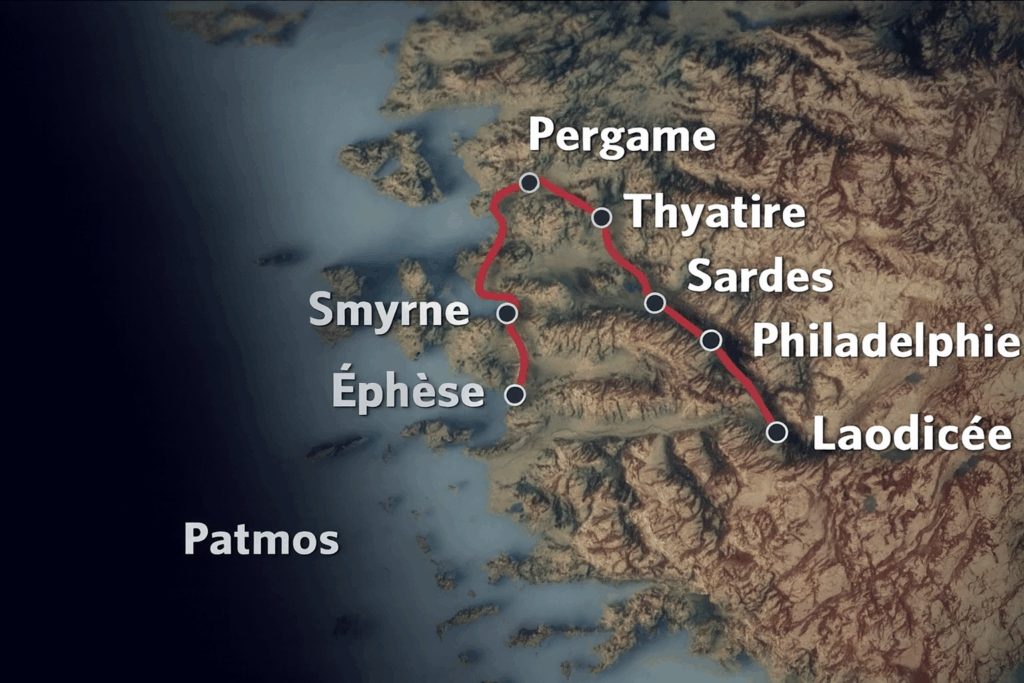
Map of the 7 Churches

II. Letter to the Church of PHILADELPHIA (Revelation 3.7 13)

Theme: humble faithfulness


Revelation 3.7 (King James Version) :
And to the angel of the church in Philadelphia write; These things saith he that is holy, he that is true, he that hath the key of David, he that openeth, and no man shutteth; and shutteth, and no man openeth;

Authority of Christ

“He who has the key of David…” He holds the sovereign authority to open and to shut.

Revelation 3.8 (King James Version) :
I know thy works: behold, I have set before thee an open door, and no man can shut it: for thou hast a little strength, and hast kept my word, and hast not denied my name.

The open door

“You have a little strength, and have kept My word.” The open door is not a fragile opportunity, but a mission guaranteed by God.

Revelation 3.9 (King James Version) :
Behold, I will make them of the of Satan, which say they are Jews, and are not, but do lie; behold, I will make them to come and worship before thy feet, and to know that I have loved thee.

Public recognition

Adversaries will acknowledge that this Church is loved by Christ.

Revelation 3.10 (King James Version) :
Because thou hast kept the word of my patience, I also will keep thee from the hour of temptation, which shall come upon all the world, to try them that dwell upon the earth.

Protection in trial

“I will keep you from the hour of testing…” Faithfulness does not spare one from trial, but it receives divine protection.

Revelation 3.11 (King James Version) :
Behold, I come quickly: hold that fast which thou hast, that no man take thy crown.

Holding fast

“Hold fast what you have.” The crown represents the reward of perseverance.

Revelation 3.12 (King James Version) :
Him that overcometh will I make a pillar in the temple of my God, and he shall go no more out: and I will write upon him the name of my God, and the name of the city of my God, which is new Jerusalem, which cometh down out of heaven from my God: and I will write upon him my new name.

Promise to the one who overcomes

  • a pillar in the temple: lasting stability,
  • a new name: renewed identity,
  • belonging to the new Jerusalem.

Revelation 3.13 (King James Version) :
He that hath an ear, let him hear what the Spirit saith unto the churches.

Universal call

The message applies to all the Churches.

III. Letter to the Church of LAODICEA (Revelation 3.14 22)

Theme: self-satisfied lukewarmness

Revelation 3.14 (King James Version) :
And unto the angel of the church of the Laodiceans write; These things saith the Amen, the faithful and true witness, the beginning of the creation of God;

Presentation of Christ

“The Amen, the faithful witness, the originator of creation.” His diagnosis is reliable and sovereign.

Revelation 3.15-16 (King James Version) :
I know thy works, that thou art neither cold nor hot: I would thou wert cold or hot.So then because thou art lukewarm, and neither cold nor hot, I will spue thee out of my mouth.

Lukewarmness

“You are neither cold nor hot…” Comfortable neutrality is unbearable to Christ. The image of “spewing out” expresses a rejection of lukewarmness.

Revelation 3.17 (King James Version) :
Because thou sayest, I am rich, and increased with goods, and have need of nothing; and knowest not that thou art wretched, and miserable, and poor, and blind, and naked:

The illusion of wealth

“You say: I am rich… but you are poor, blind and naked.” Laodicea, economically prosperous, is spiritually destitute.

Revelation 3.18 (King James Version) :
I counsel thee to buy of me gold tried in the fire, that thou mayest be rich; and white raiment, that thou mayest be clothed, and that the shame of thy nakedness do not appear; and anoint thine eyes with eyesalve, that thou mayest see.

Three remedies

  • refined gold: true wealth,
  • white garments: dignity restored,
  • eye salve: spiritual sight healed. Each image refers to the specialties of the city.

Revelation 3.19 (King James Version) :
As many as I love, I rebuke and chasten: be zealous therefore, and repent.

Correction out of love

“I rebuke those whom I love.” Severity is an act of love.

Revelation 3.20 (King James Version) :
Behold, I stand at the door, and knock: if any man hear my voice, and open the door, I will come in to him, and will sup with him, and he with me.

Personal invitation

“Behold, I stand at the door and knock.” The relationship begins with a willing opening and leads to intimate communion.

Revelation 3.21 (King James Version) :
To him that overcometh will I grant to sit with me in my throne, even as I also overcame, and am set down with my Father in his throne.

Promise to the one who overcomes

“To sit with Me on My throne.” The highest promise: to share the authority of Christ.

Revelation 3.22 (King James Version) :
He that hath an ear, let him hear what the Spirit saith unto the churches.

Universal call

As with the other two Churches: listen and act.

IV. God’s view and men’s view of the seven Churches

The seven Churches of Revelation 2–3 can be viewed in two very different ways:

  • according to men, who judge appearance, success and reputation;
  • according to Christ, who looks at faithfulness, perseverance and the truth of the heart.

This gap reveals a major principle: what seems strong in human eyes may be weak before God, and what seems insignificant may be precious to him.

1. Ranking by human criteria

(from the most envied to the most neglected)

Men value wealth, influence and visibility.

  1. Laodicea – prosperous and self-sufficient.
  2. Ephesus – active, structured, influential.
  3. Pergamum – prestigious and resilient.
  4. Thyatira – dynamic and committed.
  5. Sardis – renowned, despite its decline.
  6. Smyrna – poor and persecuted.
  7. Philadelphia – small and fragile.

Human logic: what shines rises, what suffers falls.

2. Ranking by divine criteria

(from the most faithful to the most endangered)

Christ values loyalty, perseverance and inner truth.

  1. Philadelphia – weak but faithful.
  2. Smyrna – poor but spiritually rich.
  3. Ephesus – solid but grown cold.
  4. Thyatira – loving but too tolerant.
  5. Pergamum – courageous but compromised.
  6. Sardis – alive in appearance, dead in reality.
  7. Laodicea – lukewarm and blind to its need.

Divine logic: faithfulness is worth more than apparent strength.

3. The essential contrast

  • For men: Laodicea is the most envied, Philadelphia the weakest.
  • For God: Philadelphia is the most faithful, Laodicea the most endangered.

This reversal reminds us that:

  • wealth can hide inner poverty,
  • weakness can shelter deep faithfulness,
  • reputation does not guarantee life,
  • perseverance in trial is worth more than visible success.

4. Lessons to remember

  • Human and divine criteria do not coincide.
  • Faithfulness matters more than visibility.
  • Wealth can deceive.
  • Vigilance is essential.
  • A living relationship with Christ is the true criterion.

The seven Churches show that God does not judge as men do.

What shines outwardly may be spiritually empty, and what seems weak may be rich in faithfulness.

Jesus the Messiah seeks hearts that are watchful, persevering and true.

It falls to each person to choose: appearance or life, lukewarmness or commitment, self-sufficiency or communion with him.

VIII. The chronological hypothesis of the seven Churches: existence, limits and spiritual scope

The “chronological hypothesis” proposes that the seven Churches of Revelation 2–3 do not describe only communities of the first century, but also seven great periods in the history of the Church, from its beginnings until today. This idea, formulated as early as the seventeenth century by authors such as Holzhauser, sees a stage in each Church: Ephesus for the early Church, Smyrna for the persecutions, Pergamum for the imperial era, Thyatira for the Middle Ages, Sardis for the Reformation, Philadelphia for the missionary movements, and Laodicea for the modern era.

This reading has a few arguments in its favor:

  • the letters end with a universal call (“He who has an ear, let him hear…”),
  • certain features seem to correspond to historical realities (persecution, compromise, lukewarmness),
  • the seven-stage pattern recalls other biblical structures.

However, this approach remains debated. Many exegetes consider that it forces the text to fit precise periods and that it rests more on a theoretical construction than on a natural reading of the passage. They point out that these letters are above all spiritual messages addressed to all the Churches of all times, and not a coded chronology of Christian history.

This is precisely what gives them their strength today: the seven Churches function as a mirror in which every community — and every believer — can recognize itself. They reveal recurring dangers (lukewarmness, compromise, loss of first love, lifeless appearance) and offer paths of restoration (memory, repentance, faithfulness, perseverance).

Thus, even if the chronological hypothesis exists and can offer an interesting historical perspective, the most solid reading remains the one that sees in these letters timeless diagnoses. They help the Church today to discern where it stands, to distinguish divine values from human values, and to welcome the solutions that Christ offers it.

Conclusion

Revelation 3 presents three Churches that embody three spiritual realities that remain relevant today:

  • Sardis: lifeless appearance — a call to awaken.
  • Philadelphia: faithful weakness — a call to perseverance.
  • Laodicea: self-satisfied lukewarmness — a call to repentance.

To each of them, Jesus the Messiah addresses:

  • a precise diagnosis,
  • a fitting call,
  • a strong promise.

The refrain “He who has an ear, let him hear” shows that these messages go beyond their historical context. They invite every believer and every Church to choose real life rather than appearance, faithfulness rather than self-sufficiency, and warmth rather than neutrality.

Revelation 3 is not a chapter of condemnation, but a chapter of hope: the door is open, restoration is possible, and communion with Jesus the Messiah is offered to whoever listens and responds.