ANN128

The servant in the Bible: from the Servant of the Lord to the washing of feet

The article explores the biblical notion of the servant, illustrated by Jesus in the washing of the disciples’ feet, a symbolic act of service and devotion to God, central to the message of Scripture.

33 min servant Bible foot washing humility Isaiah 48 verses 15 books

Further information

Introduction

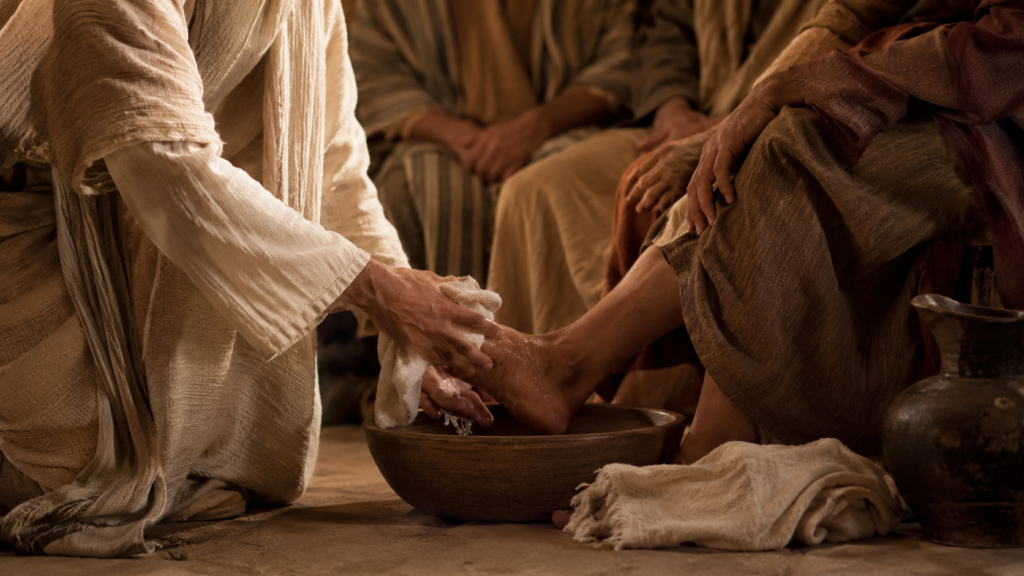
The account of the foot washing (John 13.1-17) is one of the most striking episodes in the Gospel of John. At first sight, it may appear to be a simple example of humility or a moral lesson meant for the disciples. Yet this act carries a far deeper theological significance. It is not an isolated episode, but the culmination of a major theme that runs through the whole of biblical revelation: that of service rendered in obedience to God and in the giving of oneself.

From the Old Testament onward, God calls men to become his servants in order to carry out his will. Moses, Joshua, David and the prophets all receive this honorific title, which expresses a privileged relationship with the Lord and complete availability for his work. However, these figures are only foreshadowings of a unique Servant, announced with remarkable precision by the prophet Isaiah (Isaiah 42.1-9 ; Isaiah 49.1-6 ; Isaiah 50.4-9 ; Isaiah 52.13-53.12). The New Testament recognizes in Jesus Christ the perfect fulfillment of this prophecy.

The Gospels show indeed that Jesus did not content himself with teaching service as one virtue among others. He embodied it throughout his ministry and presented it as the true measure of greatness in the Kingdom of God (Matthew 20.25-28 ; Mark 10.42-45 ; Luke 22.24-27). The foot washing is its most striking illustration: the Master voluntarily makes himself the servant of his disciples, thus anticipating the supreme humiliation of the cross.

This appendix proposes to follow this guiding thread through the whole of Scripture. It will highlight the remarkable unity of biblical revelation, from the first “servants of the ” of the Old Testament to the apostolic Church, by way of the suffering Servant announced by Isaiah and fully revealed in Jesus Christ. It will thus help us to understand better that the foot washing is not merely an example of humility, but a true synthesis of the redemptive work of Christ and of the call addressed to all who want to walk in his footsteps.

I. Service: a fundamental notion of biblical revelation

In biblical thought, serving is not a demeaning activity. On the contrary, service is presented as one of the highest expressions of faithfulness to God.

From the Old Testament onward, many men are called “servants of the ”. This title is given in particular to Moses (Joshua 1.1-2), to Joshua (Joshua 24.29), to David (2 Samuel 7.5) and to the prophets (Amos 3.7).

To be a servant of God means to live in obedience to his will and to devote one’s life to his work.

However, these figures point to a unique Servant whose mission will surpass that of all the others.

II. The Servant announced by Isaiah

Chapters 42 to 53 of the book of Isaiah gradually present an exceptional figure known as the “Servant of the ”.

The first song reveals a Servant chosen by God to establish justice among the nations (Isaiah 42.1-9).

The second describes his calling from before his birth and his universal mission (Isaiah 49.1-6).

The third stresses his perfect obedience in spite of sufferings and humiliations (Isaiah 50.4-9).

Finally, the fourth song reaches its climax by presenting the suffering Servant who bears the sins of his people (Isaiah 52.13-53.12).

The New Testament explicitly identifies Jesus with this Servant announced several centuries earlier (Matthew 12.17-21 ; Luke 22.37 ; Acts 8.30-35 ; 1 Peter 2.21-25).

The disciples still cherish the hope of an earthly kingdom and regularly discuss the place each one will occupy beside the Messiah (Matthew 20.20-24 ; Mark 10.35-41 ; Luke 22.24).

Jesus answers by completely overturning their way of thinking:

“Whoever wants to become great among you must be your servant” (Matthew 20.26 ; Mark 10.43).

Then he adds:

“The Son of Man came not to be served but to serve, and to give his life as a ransom for many” (Matthew 20.28 ; Mark 10.45).

In the Kingdom of God, true greatness therefore does not consist in exercising domination, but in voluntarily putting oneself at the service of others.

This statement directly prepares for the foot washing recounted by John.

IV. The foot washing: a parable in action

At the beginning of the last meal, Jesus himself does what he has been teaching since the beginning of his ministry.

He lays aside his outer garment, takes a towel, wraps it around himself and washes his disciples’ feet (John 13.4-5).

This act goes far beyond the customs of Eastern hospitality.

The Master voluntarily takes the position of the lowliest of servants.

John does not merely report an act of courtesy.

He presents a living .

The Lord shows in concrete terms what service according to God is.

A few moments later, he will explain it himself:

“I have given you an example, that you also should do as I have done to you” (John 13.15).

V. Service leads to the cross

The foot washing already foreshadows the supreme humiliation of Christ.

By laying aside his garment and then taking it up again (John 13.4 ; John 13.12), Jesus prefigures the voluntary gift of his life.

A few hours later, the Servant will fully accomplish his mission by offering his life for the salvation of the world (John 10.17-18).

Thus, service is not merely a moral model.

It becomes the very path of redemption.

The Servant of the bears the sins of his people in order to reconcile them with God (Isaiah 53.4-6 ; Isaiah 53.10-12).

VI. The hymn of Philippians

The apostle Paul admirably sums up this dynamic in the Christological hymn of the letter to the Philippians.

He describes a double movement.

The Son of God:

  • humbles himself voluntarily;
  • takes the form of a servant;
  • becomes obedient to the point of death on the cross (Philippians 2.6-8).

Then God:

  • exalts him supremely;
  • gives him the name above every name (Philippians 2.9-11).

This progression corresponds exactly to the movement already announced by Isaiah.

Humiliation precedes glorification.

Service leads to victory.

VII. The disciple called to follow his Master

Jesus’ teaching does not stop at his own person.

He calls each of his disciples to adopt the same attitude.

The Christian is invited to serve rather than to seek the places of honor (Luke 22.26-27).

Peter will take up this exhortation when he asks the elders to shepherd the flock of God not as lords, but as examples (1 Peter 5.2-3).

Paul will express the same thought:

“Serve one another through love” (Galatians 5.13).

Service thus becomes one of the distinguishing marks of the Christian life.

VIII. Service in the early Church

The book of Acts shows that this conception of service deeply marks the first Christian communities.

The apostles distinguish the ministry of the Word from the serving of tables (Acts 6.1-6).

The deacons are appointed to meet the material needs of the believers.

The Greek word diakonos, generally translated “servant” or “deacon”, is a reminder that every responsibility in the Church is above all a ministry of service.

Thus, from its very origins, the Church understands that spiritual authority is exercised in humility and devotion, after the image of its Lord.

IX. A remarkable unity of revelation

The theme of the servant runs through the whole Bible.

Moses serves God.

The prophets serve God.

The Servant announced by Isaiah perfectly fulfills this calling.

Jesus fully accomplishes this prophecy.

The apostles in turn become servants of Christ (Romans 1.1 ; James 1.1 ; 2 Peter 1.1 ; Jude 1).

Finally, all believers are called to live according to this same model.

This continuity reveals the profound unity of biblical revelation.

X. The true face of God

The foot washing ultimately reveals one of the most overwhelming aspects of Christian revelation.

The almighty God shows his greatness not through domination, but through service.

The King becomes a servant.

The Lord kneels before his disciples.

The Creator washes the feet of his creatures.

Divine omnipotence is paradoxically revealed in humility, love and self-giving.

This revelation reaches its climax at the cross, where the Servant of the voluntarily gives his life for the salvation of the world (John 3.16-17 ; Romans 5.6-8).

Conclusion

The theme of the servant is one of the guiding threads of the whole of biblical revelation. From the first servants of the Old Testament to the apostles, by way of Isaiah’s Servant songs, God gradually prepares the coming of the one who will perfectly fulfill this calling: Jesus Christ.
The foot washing therefore does not represent a mere gesture of humility, but a living synthesis of his whole work. By voluntarily taking the place of the servant, Jesus reveals the true character of the Kingdom of God and announces the sacrifice of the cross. Far from being opposed, service and glory come together in him: it is precisely because he humbled himself to the point of giving his life that the Father supremely exalted him (Philippians 2.9-11). Thus the disciple discovers that following Christ means walking the same path of humility, love and service, in the hope of one day sharing his glory.

2 Corinthians 5.20 : “We are therefore ambassadors for Christ, as though God were making his appeal through us; we implore you on behalf of Christ: be reconciled to God!”