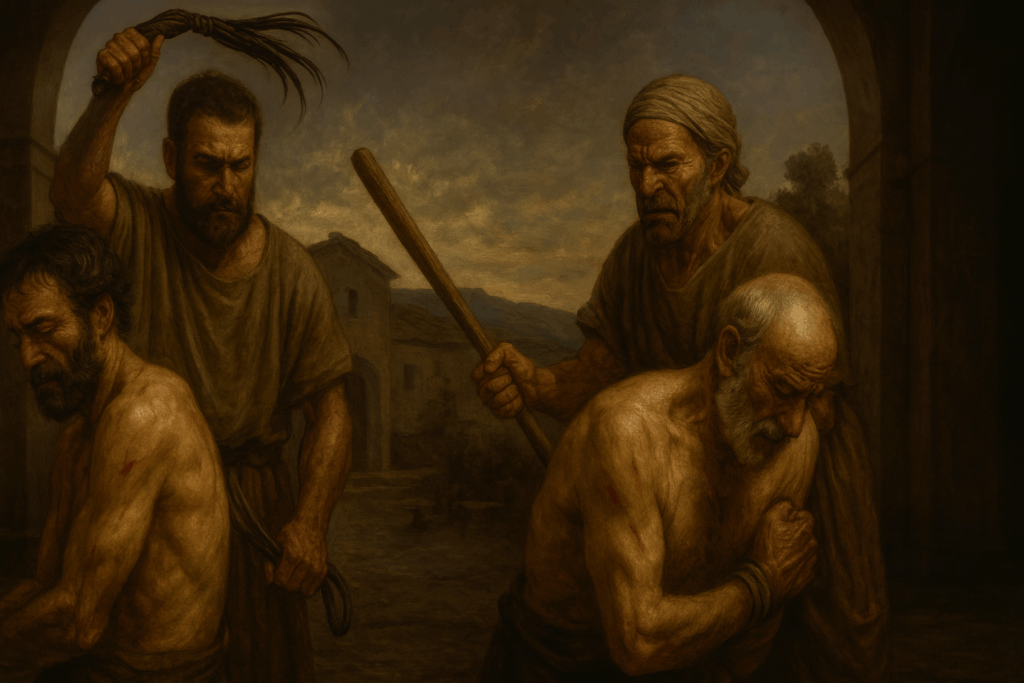
The article "ANN120 - The different judgments" analyzes Luke 12.46-48, where Jesus speaks of the nuances in divine judgment. This passage, which evokes a hierarchy of condemnations according to faithfulness and knowledge, seems to contradict the grace of salvation. The author aims to clarify these biblical concepts.
33 min
judgmentLuke 12faithfulnesssalvationparable
35 verses
11 books
Certain passages in Scripture prove difficult to understand and may give rise to various interpretations, sometimes far removed from the original central thought (2 Peter 3.15-16). This complexity therefore calls for great vigilance when commenting on such texts.
The passage in Luke 12.46-48 highlights a hierarchy of condemnations that stems from our position and our behavior on this earth. Indeed, Luke does not propose a new doctrine here, but simply reports faithfully what the Master proclaimed publicly. In other words, the Messiah, Jesus, evokes through these words, as taken up by Luke, the existence of nuances in punishment or condemnation.
At first sight, this idea seems to contradict the grace of salvation and the binary view of judgment, namely being saved or lost.
In this study, we will analyze the Master's statements as recorded in Luke 12.46-48, in order to determine their precise meaning. We will also examine whether other passages of Scripture contain similar information.
I - Context
The Messiah Jesus delivers the message recorded in Luke 12.46-48 in the context of a teaching on vigilance, faithfulness and the responsibility of servants in view of his return. He uses a to illustrate the consequences of unfaithfulness and willful ignorance.
Immediate context of Luke 12.46-48
This passage is part of a broader discourse of the Messiah Jesus on vigilance and spiritual readiness in view of his return, often called the discourse on the faithful and unfaithful servants (Luke 12.35-48).
Luke 12.35-40: Jesus urges his disciples to be ready, like servants waiting for their master with their lamps lit.
Luke 12.41: Peter asks whether this is addressed to everyone or only to the disciples.
Luke 12.42-45: The Messiah Jesus answers by speaking of a faithful steward and of another who abuses his authority, thinking that the master is slow to return.
It is in this setting that the Messiah Jesus utters the verses of Luke 12.46-48 that particularly interest us.
The severity of the judgment for the unfaithful servant who acts in full knowledge.
Responsibility proportional to knowledge: the more one knows, the more one is responsible.
Divine justice: even the one who is ignorant of the master's will is judged, but with less severity, because his ignorance is often willful or negligent.
Theological meaning
II - Analysis of the information
The master represents the Messiah Jesus, and the servants are the believers, particularly those who have received a mission or a responsibility.
The master's return symbolizes the return of the Messiah Jesus at the end of times.
The blows received illustrate the gravity of the judgment according to faithfulness or negligence.
This passage teaches that knowing God's will entails increased responsibility, and that willful unfaithfulness will be severely judged. It warns against spiritual laziness and calls for active vigilance.
Key verses
Luke 12.47 (King James Version) :
And that servant, which knew his lord’s will, and prepared not himself, neither did according to his will, shall be beaten with many stripes.
King James Version (1769), domaine public — texte : eBible.org
Luke 12.48 (King James Version) :
But he that knew not, and did commit things worthy of stripes, shall be beaten with few stripes. For unto whomsoever much is given, of him shall be much required: and to whom men have committed much, of him they will ask the more.
King James Version (1769), domaine public — texte : eBible.org
It seems difficult to conceive of a judgment that is more or less severe in the matter of obtaining salvation. Indeed, one cannot be more or less saved; one either is or is not.
So what judgment is in question here?
III - Will there be a judgment for Christians?
Christians are saved by faith in the Messiah Jesus and will not be condemned. However, the Bible teaches that they will go through a judgment of evaluation, often called the judgment seat of Christ, to give an account of their lives and works.
No condemnation for believers
Romans 8.1 (King James Version) :
There is therefore now no condemnation to them which are in Christ Jesus, who walk not after the flesh, but after the Spirit.
King James Version (1769), domaine public — texte : eBible.org
Salvation in Christ frees us from the judgment of condemnation. Sin is forgiven, the debt is canceled.
John 5.24 (King James Version) :
Verily, verily, I say unto you, He that heareth my word, and believeth on him that sent me, hath everlasting life, and shall not come into condemnation; but is passed from death unto life.
King James Version (1769), domaine public — texte : eBible.org
The believer does not go through the judgment that leads to eternal death.
But a judgment of works and faithfulness
2 Corinthians 5.10 (King James Version) :
For we must all appear before the judgment seat of Christ; that every one may receive the things done in his body, according to that he hath done, whether it be good or bad.
King James Version (1769), domaine public — texte : eBible.org
This judgment concerns the believer's actions, not for salvation, but for reward.
1 Corinthians 3.13-15 (King James Version) :
Every man’s work shall be made manifest: for the day shall declare it, because it shall be revealed by fire; and the fire shall try every man’s work of what sort it is.If any man’s work abide which he hath built thereupon, he shall receive a reward.If any man’s work shall be burned, he shall suffer loss: but he himself shall be saved; yet so as by fire.
King James Version (1769), domaine public — texte : eBible.org
Works will be tested. If they are solid, they will be rewarded. Otherwise, they will be lost, but the believer himself will be saved.
Romans 14.10-12 (King James Version) :
But why dost thou judge thy brother? or why dost thou set at nought thy brother? for we shall all stand before the judgment seat of Christ.For it is written, As I live, saith the Lord, every knee shall bow to me, and every tongue shall confess to God.So then every one of us shall give account of himself to God.
King James Version (1769), domaine public — texte : eBible.org
Each believer will give an account of his life, his words, his choices.
Summary – A judgment without condemnation, but with responsibility
Christians will not be judged in order to be condemned, for their salvation is assured in Jesus the Messiah. But they will be evaluated on their faithfulness, their works, their heart. This judgment is a moment of truth, of reward, and sometimes of loss, but never of rejection. It invites us to live each day with seriousness, love and commitment, knowing that everything we do for Christ has eternal value.
IV - What does this condemnation or approval consist of?
The judgment seat of Christ: a judgment for believers
The judgment seat of Christ is a solemn moment when each believer will be evaluated by the Lord, not for his salvation (already obtained), but for his faithfulness, his works and his motives.
2 Corinthians 5.10 (King James Version) :
For we must all appear before the judgment seat of Christ; that every one may receive the things done in his body, according to that he hath done, whether it be good or bad.
King James Version (1769), domaine public — texte : eBible.org
Romans 14.12 (King James Version) :
So then every one of us shall give account of himself to God.
King James Version (1769), domaine public — texte : eBible.org
This judgment concerns believers only, and it determines the heavenly rewards.
What do the rewards consist of?
1- Spiritual crowns – Heavenly rewards for believers
The Bible mentions several crowns as symbols of reward for those who have lived faithfully for Christ. Each reflects a particular dimension of the Christian life:
_ The crown of life is promised to those who persevere in trial and remain faithful to the end. It is mentioned in James 1.12 and Revelation 2.10.
_ The crown of righteousness will be given to those who have loved Christ's appearing, that is, those who have lived in fervent expectation of his return. It is cited in 2 Timothy 4.8.
_ The incorruptible crown rewards those who have mastered their spiritual life, refusing the passions of the world in order to run the race of faith with discipline. It appears in 1 Corinthians 9.25.
_ The crown of glory is reserved for faithful pastors and servants who have fed God's flock with love and integrity. It is mentioned in 1 Peter 5.4.
_ The crown of rejoicing is for those who have led others to Christ, the soul-winners who have sown and seen lives transformed. It is mentioned in 1 Thessalonians 2.19.
2- Responsibilities in the Kingdom
The Messiah Jesus teaches that faithfulness on earth determines authority in the Kingdom:
Luke 19.17 (King James Version) :
And he said unto him, Well, thou good servant: because thou hast been faithful in a very little, have thou authority over ten cities.
King James Version (1769), domaine public — texte : eBible.org
Matthew 25.21 (King James Version) :
His lord said unto him, Well done, thou good and faithful servant: thou hast been faithful over a few things, I will make thee ruler over many things: enter thou into the joy of thy lord.
King James Version (1769), domaine public — texte : eBible.org
:
There will therefore be different roles, according to each person's faithfulness.
3- Greater closeness to the Messiah Jesus
Revelation 3.21 (King James Version) :
To him that overcometh will I grant to sit with me in my throne, even as I also overcame, and am set down with my Father in his throne.
King James Version (1769), domaine public — texte : eBible.org
Daniel 12.3 (King James Version) :
And they that be wise shall shine as the brightness of the firmament; and they that turn many to righteousness as the stars for ever and ever.
King James Version (1769), domaine public — texte : eBible.org
The reward includes a particular intimacy with the Messiah Jesus, a spiritual glory, and eternal joy.
4- And if there is no fruit?
1 Corinthians 3.15 (King James Version) :
If any man’s work shall be burned, he shall suffer loss: but he himself shall be saved; yet so as by fire.
King James Version (1769), domaine public — texte : eBible.org
:
The believer will be saved, but without reward. His works will be burned up, if he has lived for himself.
5- Summary – Living for the eternal reward
The judgment seat of Christ is a moment of truth and love, when the Lord will evaluate the life of his children. It is not a matter of fear, but of joyful responsibility. Every believer is called to live for the glory of God, knowing that everything done for the Messiah Jesus will have an eternal resonance.
V - Will there be different statuses among the saved in heaven?
According to biblical teaching, all believers will be saved, but there will be different rewards, responsibilities and degrees of glory in heaven, depending on each person's faithfulness on earth.
1- All saved, but not all rewarded in the same way
Salvation is equal for all: everyone enters eternal life through faith in Jesus Christ. But at the judgment seat of Christ, each believer's works will be evaluated, and this will determine the reward and sometimes the position in the Kingdom.
1 Corinthians 3.14-15 (King James Version) :
If any man’s work abide which he hath built thereupon, he shall receive a reward.If any man’s work shall be burned, he shall suffer loss: but he himself shall be saved; yet so as by fire.
King James Version (1769), domaine public — texte : eBible.org
Salvation is assured, but rewards can be lost.
Luke 19.17 (King James Version) :
And he said unto him, Well, thou good servant: because thou hast been faithful in a very little, have thou authority over ten cities.
King James Version (1769), domaine public — texte : eBible.org
Faithfulness on earth determines authority in the heavenly Kingdom.
Matthew 5.19 (King James Version) :
Whosoever therefore shall break one of these least commandments, and shall teach men so, he shall be called the least in the kingdom of heaven: but whosoever shall do and teach them, the same shall be called great in the kingdom of heaven.
King James Version (1769), domaine public — texte : eBible.org
There are distinctions in the Kingdom, without injustice or jealousy.
2- Different responsibilities and degrees of glory
Responsibilities: Some will have particular roles in the Kingdom (reigning, teaching, serving).
Crowns: Specific rewards will be given according to faithfulness, love and perseverance.
Closeness to the Messiah Jesus: Some will shine more brightly, like the stars (see Daniel 12.3).
But beware: no reward will be a of pride or division. In heaven, everything is pure, joyful, and centered on the Messiah Jesus. The differences will be expressions of grace, not human privileges.
3- Summary – Unity in salvation, diversity in reward
All believers will be in eternal glory, but faithfulness on earth will have an impact. There will be roles, crowns, responsibilities, and a greater or lesser closeness to Christ, not to create human hierarchies, but to honor faithfulness in love.
VI - Would a hierarchical system be possible among Christians in heaven?
We note that the Messiah Jesus affirms that there are different dwelling places in the Father's house.
Jean 14.2 ()
2 There are many dwelling places in my Father's house. If it were not so, I would have told you. I am going to prepare a place for you.
1- What does "many dwelling places" mean?
This expression evokes the diversity of places reserved for believers in God's eternal presence. Here are some possible interpretations:
Richness and abundance of the Kingdom: Heaven is neither uniform nor limited; it is vast, welcoming, and prepared for each person.
Individuality within unity: Each believer receives a "prepared" place, a dwelling that reflects his journey, his faithfulness, his calling.
Possibility of degrees of glory: Some theologians see in it an allusion to levels of reward or of closeness to God, according to the life lived in Christ (cf. 1 Corinthians 3.14-15, Matthew 25.21).
2- Link with the angelic hierarchy
Just as angels are organized into heavenly orders according to their mission and their closeness to God, some think that believers could also experience a diversity of functions or of glory in eternity, not as a hierarchy of domination, but as a harmony of roles in the Kingdom.
3- Conclusion
Jesus' word about "dwelling places" is a promise of personal preparation, of an welcome, and perhaps of a glorious diversity in communion with God. It does not speak of inequality. Yes, the principle of "different dwelling places" or of "varied rewards" in heaven is mentioned in several places in the Bible, suggesting a diversity in the glory or function of believers in eternity.
1- John 14.2: the basis of the concept
Jesus declares: "There are many dwelling places in my Father's house…" This verse is often interpreted as a promise of a place prepared for each believer, but also as an allusion to a diversity of heavenly experiences.
2- Other biblical passages that support this idea
Here are some verses that reinforce the idea of distinct rewards or differentiated roles in the Kingdom of God:
1 Corinthians 3.14-15: Each person's works will be tested by fire. This implies that some will receive a greater reward according to their faithfulness.
Matthew 5.19: "The least in the kingdom of heaven…" Jesus distinguishes "ranks" in the Kingdom according to obedience to the commandments.
Matthew 25.21: "You have been faithful over a little; I will set you over much." This suggests increased responsibility in eternity according to earthly faithfulness.
Luke 19.17: "You shall have authority over ten cities." A that illustrates rewards proportional to commitment.
Daniel 12.3: "Those who have taught righteousness will shine like the stars." An image of glory differentiated according to works.
3- Theological interpretation
Some theologians, such as Augustine, Thomas Aquinas, or modern thinkers, see in these texts a hierarchy of glory, based not on human merit but on grace received and the response to the divine call.
This does not mean an unjust inequality, but a heavenly harmony, where each person finds his place according to what he was called to live.
4- Conclusion
The Bible does not speak of a "social hierarchy" of Christians in heaven, but it speaks of multiple dwelling places, varied rewards, and distinct roles according to faithfulness, love and service. Salvation is offered to all, but glory may differ according to the response to the divine call.
VII - Will there be different statuses among the lost in Hell?
By analyzing the principle of the judgment of the lost and the differentiation of sentences, could one imagine different places in hell, or simply all lost?
Yes, several biblical passages and theological interpretations suggest that there are degrees of punishment in hell, which implies a form of hierarchy or differentiation in the sentence of the lost, even though all are separated from God.
1- Proportionate justice: the biblical foundation
The Bible presents hell as a place of judgment, but also as a place where the severity of the punishment varies according to guilt:
Matthew 10.15: "The land of Sodom and Gomorrah will be treated less severely than that town." ➤ Jesus indicates a gradation in judgment according to the light received and rejected.
Matthew 11.22-24: "Tyre and Sidon will be treated less severely than you…" ➤ Those who had more access to the truth but rejected it will suffer a heavier judgment.
Luke 12.47-48: "The servant who knew… will be beaten with many blows; the one who did not know… with few blows." ➤ A clear principle of proportional responsibility.
2- Theological teaching
Thinkers such as Albert N. Martin or Thomas Aquinas developed the idea that:
The punishment is for all, but more intense for some.
The criteria include: the degree of sin in life, the negative influence on others, the light of the Gospel rejected. This does not mean distinct geographical "places," but rather levels of suffering or retribution adapted to each case.
3- Can we speak of "places" in hell?
Symbolically yes: as heaven has "many dwelling places," hell could have several degrees of separation, suffering or shame.
But all are lost: separation from God is total, even if divine justice nuances the sentence.
4- Conclusion
The Bible teaches a nuanced divine justice, in which the judgment of the lost takes into account their knowledge, their influence and their rebellion. It is therefore reasonable to imagine degrees of punishment in hell, without speaking of "places" in a spatial sense, but rather of measures of retribution adapted to each person.
Examining the biblical texts relating to retributions and condemnations, it appears that divine judgment involves a certain adaptation: there are degrees in the way each person is judged. This observation has led some to suppose the existence of different places, both in heaven and in hell, corresponding to each individual according to his actions, whether good or bad.
Nevertheless, the Bible does not explicitly define this situation. It specifies that salvation is accessible and that each person can, if he so wishes, enter the kingdom of God or not. On the other hand, the exact position occupied in that place, whether the kingdom of God or hell, remains less clearly established, which leads mainly to hypotheses.
In the course of this study, some of these hypotheses have been taken up in an attempt to answer the questions one may ask. Thus, factual elements suggest the existence of various condemnations or retributions depending on the case, but there are no clear statements as to the precise consequences of these sentences.
Finally, it should be remembered that applying our human principles to divine judgment would be inappropriate. God's judgment is perfectly just and surpasses our human conceptions: the one who chooses to pay all the workers the same sum acts according to principles that escape our perception of justice.
2 Corinthians 5.20 : “We are therefore ambassadors for Christ, as though God were making his appeal through us; we implore you on behalf of Christ: be reconciled to God!”
A title, a person, a place, a reference (“Luke 15”)…
Bible reference
INF043
Information note
INF043 - The Deuteronomist Source
The Deuteronomist Source
La source Deutéronomiste (ou Deutéronomique), souvent abrégée en D, est l'une des quatre sources hypothétiques de la Torah selon l'hypothèse documentaire. Voici quelques points essentiels :
Origin and Definition
Hypothèse Documentaire : Cette hypothèse propose que la Torah est composée de quatre sources distinctes : Jahviste (J), Élohiste (E), Deutéronomiste (D) et Sacerdotale (P).
Name: The Deuteronomist source is so named because of its close association with the Book of Deuteronomy.
Characteristics
Style and Theme: It is characterized by a homiletic style and a theological perspective centered on faithfulness to the covenant between God and Israel, with an emphasis on laws and religious reforms. Attributed Passages: Besides Deuteronomy, Deuteronomistic influences are often attributed to the historical books such as Joshua, Judges, 1 Samuel, 2 Samuel, 1 Kings and 2 Kings.
Dating and Origin
Dating: The Deuteronomist source is generally dated to the 7th century BCE, in the time of King Josiah of Judah. Composition: It may have been written by priests and scribes close to the Temple in Jerusalem, as part of Josiah's religious reforms aimed at centralizing worship in the Temple in Jerusalem.
Validity and Acceptance
Validité : Bien que largement acceptée par de nombreux chercheurs, l'existence de la source Deutéronomiste reste une hypothèse, et d'autres modèles ont également été proposés pour expliquer la formation de la Torah.
The Deuteronomist source is thus an important theoretical component for understanding the structure and development of the biblical texts, particularly with regard to the laws and the covenant.
INF181
Information note
INF181 - Parable or Metaphor
Parable or metaphor
The number of parables in the Gospels varies considerably depending on the scholar. Some are explicitly identified in the text, where we find that Jesus the Messiah announces a parable. However, many others are more difficult to classify.
Here, then, is a clear summary of the differences between parables, metaphors, imagery, and allegories, with biblical examples to illustrate them:
Parable: a symbolic story with a moral or spiritual message
Definition: A parable is a short, narrative story—often fictional—that illustrates a moral, spiritual, or theological truth.
Structure: It consists of characters, a plot, and sometimes a twist or a surprise ending.
Function : It invites an interpretation—often indirect—and prompts reflection or a change of heart.
Examples: The Sower (Matthew 13.1-23), The Good Samaritan (Luke 10.25-37), The Prodigal Son (Luke 15.11-32)
A parable is a narrative device that both conceals and reveals; it requires active listening and interpretation.
Metaphor: a figure of speech based on an implicit analogy
Definition: A metaphor is the transfer of a term to another semantic field without the use of a comparison.
Structure: It is brief, often consisting of a single sentence or phrase.
Function: It illuminates an abstract reality through a concrete image, but without a narrative.
Examples: “I am the light of the world” (John 8:12), “You are the salt of the earth” (Matthew 5:13)
A metaphor condenses a truth into a striking image, but it does not tell a story.
Image: a general term for any figurative representation
Definition: “Image” is an umbrella term that refers to any figurative representation, whether narrative (parable), stylistic (metaphor), or visual.
Function: It serves to make the invisible visible and to give form to the abstract.
Examples: The lamb (a symbol of Christ), the rock (a symbol of God in the Psalms).
The image is the common ground of parables and metaphors; it is their raw material.
In summary:
A parable is a symbolic narrative, usually lengthy, intended to teach a lesson or prompt reflection. It takes the form of a story, often featuring characters and a plot. A classic biblical example is the Parable of the Prodigal Son (Luke 15.11-32).
A metaphor is a brief figure of speech based on an implicit analogy. It serves to shed light on a reality or make a strong impression through a vivid image, without resorting to a narrative. For example: “I am the vine” (John 15.1 and John 15.5).
An image, on the other hand, is a more general concept. Its length is variable, and its function is to represent or embody an abstract reality. It can be visual, poetic, or symbolic. Examples that come to mind here include figures such as the lamb or the rock, which are frequently used in Scripture.
INF082
Information note
INF082 - The Segond 21 Bible (S21)
The Segond 21 Bible (S21)
The Segond 21. Here is some key information about this version:
Background and aims
Publication date: 2007 Modernisation: The Segond 21 aims to modernise the language of Louis Segond's translation while remaining highly faithful to the original Hebrew and Greek texts. Clarity and accessibility: The emphasis is on making the text clear and accessible to contemporary readers.
Main features
Faithfulness to the original texts: The Segond 21 draws on the most reliable ancient manuscripts to ensure an accurate and faithful translation. Linguistic revision: The language was revised to reflect modern French usage better while preserving the richness and depth of the biblical text. Notes and references: The version often includes explanatory notes and references to help readers understand and study Scripture.
Importance
Widespread use: The Segond 21 is widely used in French-speaking Protestant circles, particularly for Bible study and personal reading. Accessibility: Its modernised language makes it accessible to a wider audience, including new generations of readers.
The Segond 21 was produced by a multidisciplinary team of translators, linguists and theologians and took approximately twelve years of work to complete.
These revisions show how Louis Segond's translation has evolved to adapt to linguistic changes and readers' needs over time.
INF038
Information note
INF038 - YHWH
YHWH
Le tétragramme YHWH est le nom propre de Dieu utilisé dans la Bible hébraïque. Voici quelques informations clés :
Meaning and origin
Nom de Dieu : YHWH est considéré comme le nom le plus sacré de Dieu dans le judaïsme. Il est souvent traduit par "L'Éternel" ou "Jehovah" en français.
Origine : Le terme "tétragramme" signifie "quatre lettres" en grec, se référant aux quatre lettres hébraïques יהוה (yod, hé, waw, hé).
Pronunciation
Unknown: The exact pronunciation of the tetragrammaton is unknown because, in Jewish tradition, it was forbidden to pronounce this name in order to avoid profaning it.
Substitutes: In its place, substitutes such as "Adonai" (Lord) or "HaShem" (The Name) are used.
Usage
Texte Sacré :Le tétragramme apparaît fréquemment dans la Torah et d'autres écrits de la Bible hébraïque. Rituel et Prières : Dans les prières et les rituels, les Juifs utilisent généralement "Adonaï" pour remplacer YHWH lorsqu'ils lisent les textes sacrés à haute voix.
Theological importance
Monothéisme :YHWH souligne l'unicité et l'exclusivité de Dieu dans la foi juive. Relation Divine :Il exprime la relation personnelle entre Dieu et le peuple d'Israël, marquant une révélation divine et une alliance.
The tetragrammaton is therefore a central and sacred element in Jewish theology and religious practice.