ANN124

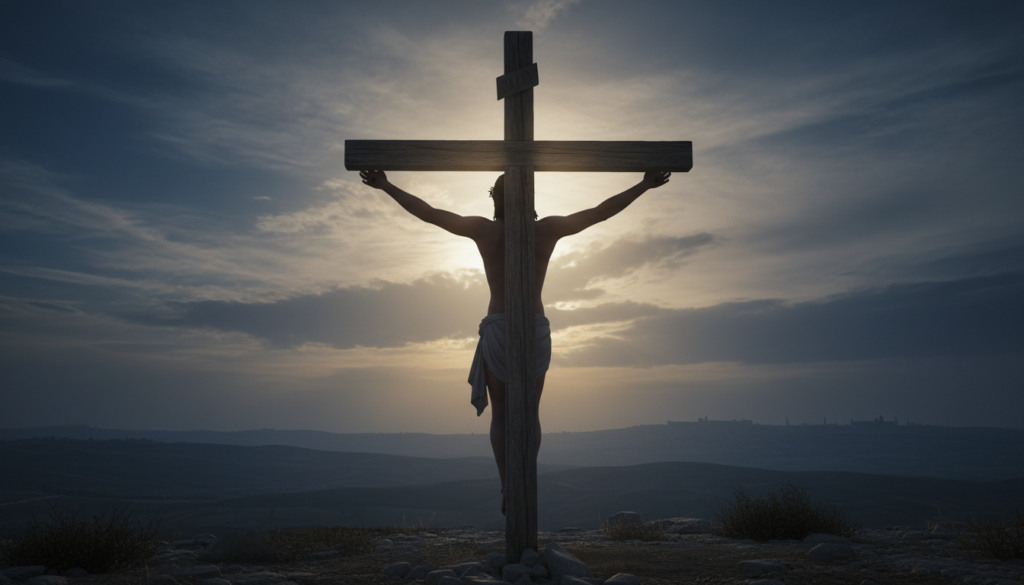
Jesus’ seven sayings on the cross.

This article examines the seven sayings of Jesus on the cross, exploring their theological meaning and their place in God’s plan of salvation.

43 min Jesus Words from the Cross Redemption 47 verses 27 books

Further information

Introduction

The study of the Passion of Christ leads us to recognize that the death of Jesus is not an event he merely underwent, but a fully voluntary and conscious act. According to his own testimony, he freely offers his life:

John 10.18 (King James Version) :
No man taketh it from me, but I lay it down of myself. I have power to lay it down, and I have power to take it again. This commandment have I received of my Father.

This supreme gift is part of God’s redemptive purpose, established “before the foundation of the world” (1 Peter 1.20). By giving himself on the cross to redeem a lost humanity, Jesus literally fulfills the Scriptures and manifests the Father’s faithfulness to his plan of salvation:

John 3.16-17 (King James Version) :
For God so loved the world, that he gave his only begotten Son, that whosoever believeth in him should not perish, but have everlasting life.For God sent not his Son into the world to condemn the world; but that the world through him might be saved.

The death of Jesus is therefore neither a matter of chance nor a tragic defeat. It corresponds to a prophetic and saving fulfillment, announced by the prophets and symbolized throughout the Old Testament. Every act, every word and every moment of the Passion belongs to this divine economy: Scripture does not merely report historical facts, but the progressive revelation of a timeless plan.

Among the words spoken by Jesus on the cross, Christian tradition singles out seven, known as “the seven words of Christ.” These brief statements, of exceptional theological density, express the whole mystery of redemption: forgiveness offered to sinners, the promise of salvation, filial compassion, redemptive suffering, the fulfillment of prophecies, and the trusting surrender of the spirit to the Father.

This study sets out to examine these seven sayings in their scriptural and theological dimension, relating them to the texts of the Old Testament, and more particularly to Psalm 22. This psalm, often called “the psalm of the righteous sufferer,” expresses prophetically the experience of abandonment, suffering and the final victory of the Messiah. It is an essential hermeneutical key for understanding the spiritual and prophetic significance of the words of Jesus on the cross.

Thus, our approach will seek to demonstrate that these last words are neither fortuitous nor isolated, but that they bear witness to a deep coherence between the Old and the New Covenant. In the crucified Jesus, the inspired Word finds its fulfillment, and the Father’s purpose is unveiled in all its redemptive fullness.

I. The seven sayings of Jesus on the cross

The Gospel accounts present the crucifixion of Christ as the summit of salvation history. At the heart of this scene, the seven sayings spoken by Jesus are a unique testimony to his messianic consciousness and his redemptive mission. They mark out, so to speak, the spiritual path of the cross: from the forgiveness offered to his executioners to the trusting surrender into the Father’s hands.

These sayings, reported by the four evangelists, form a coherent whole, although scattered across the texts. They reflect the fullness of the divine love manifested in suffering, but also the fulfillment of the messianic prophecies. In meditating on them, we discover a theological and spiritual progression: they reveal in turn the mercy of the Son, the promise of salvation, compassion, the depth of suffering, the thirst to fulfill Scripture, the victory of salvation, and finally the perfect peace of returning to the Father.

The traditional order in which Christian tradition brings them together is not arbitrary: it builds a true catechesis of the cross.

Thus the first saying opens the Passion with forgiveness; the last concludes it with trust. Between the two, the Son passes through abandonment, thirst and distress, without ever breaking communion with his Father. Together these sayings weave a complete theological discourse, in which justice and mercy, human sorrow and divine victory meet.

Before approaching each one individually, it is fitting to consider them as a whole: an ultimate testimony of redeeming love. In this perspective, the study that follows will analyze each saying in turn, showing its own meaning, its link with the Old Testament — particularly Psalm 22 — and the way it contributes to the unity of the divine plan.

II. List of the seven sayings

Here is the complete list of the seven sayings of Jesus on the cross, as traditionally established from the four Gospels. They are presented in the order generally adopted by Christian tradition:

1. The saying of forgiveness

Luke 23.34 (King James Version) :
Then said Jesus, Father, forgive them; for they know not what they do. And they parted his raiment, and cast lots.

This first saying reveals divine mercy at the heart of suffering. Jesus prays for his executioners and thus shows the very nature of his redemptive work: forgiveness offered to those who rejected him.

2. The saying of promise

Luke 23.43 (King James Version) :
And Jesus said unto him, Verily I say unto thee, To day shalt thou be with me in paradise.

Addressed to the repentant criminal, this saying proclaims the freeness of salvation and the immediate power of grace. The cross becomes the place of passage from death to life.

3. The saying of filial relationship

John 19.26-27 (King James Version) :
When Jesus therefore saw his mother, and the disciple standing by, whom he loved, he saith unto his mother, Woman, behold thy son!Then saith he to the disciple, Behold thy mother! And from that hour that disciple took her unto his own home.

By this gesture, Jesus entrusts the beloved disciple to Mary and, through him, the whole community of believers. This saying symbolically establishes the spiritual brotherhood among the disciples of Christ.

4. The saying of abandonment

Matthew 27.46 (King James Version) :
And about the ninth hour Jesus cried with a loud voice, saying, Eli, Eli, lama sabachthani? that is to say, My God, my God, why hast thou forsaken me?

Mark 15.34 (King James Version) :
And at the ninth hour Jesus cried with a loud voice, saying, Eloi, Eloi, lama sabachthani? which is, being interpreted, My God, my God, why hast thou forsaken me?

A direct quotation from Psalms 22.1, this cry expresses both the depth of human suffering and the fulfillment of the Scriptures. Far from being despair, it is a prayer rooted in the faith of the righteous sufferer.

5. The saying of thirst

John 19.28 (King James Version) :
After this, Jesus knowing that all things were now accomplished, that the scripture might be fulfilled, saith, I thirst.

Short and poignant, this saying underlines the true humanity of Jesus and points to the prophetic fulfillment: “My tongue clings to my jaws” (Psalms 22.15). It expresses both physical suffering and the spiritual desire to accomplish the will of God.

6. The saying of fulfillment

John 19.30 (King James Version) :
When Jesus therefore had received the vinegar, he said, It is finished: and he bowed his head, and gave up the ghost.

This solemn declaration affirms the completion of the redemptive work. The plan of salvation announced by the prophets reaches its fullness: the mission of the Son is accomplished, the victory over sin is sealed.

7. The saying of surrender into the Father’s hands

Luke 23.46 (King James Version) :
And when Jesus had cried with a loud voice, he said, Father, into thy hands I commend my spirit: and having said thus, he gave up the ghost.

The last saying before death, it takes up Psalms 31.6 and expresses the Son’s absolute trust in the Father. Having given everything, Jesus surrenders himself completely to the One who sent him.

III. The first saying of Jesus on the cross

Luke 23.34 (King James Version) :
Then said Jesus, Father, forgive them; for they know not what they do. And they parted his raiment, and cast lots.

Here is the first saying spoken by Jesus on the cross. It immediately expresses the saving and merciful dimension of his death. Jesus does not respond to violence with complaint or condemnation; he prays for those who crucify him, thus fulfilling the prophecy of the Suffering Servant:

Isaiah 53.12 (King James Version) :
Therefore will I divide him a portion with the great, and he shall divide the spoil with the strong; because he hath poured out his soul unto death: and he was numbered with the transgressors; and he bare the sin of many, and made intercession for the transgressors.

The Greek verb aphiēmi (“to forgive”) stresses a total remission of the debt, a deliberate and active erasing. By imploring forgiveness for his executioners, Jesus reveals the nature of the Father and the universal reach of his mission:

Luke 19.10 (King James Version) :
For the Son of man is come to seek and to save that which was lost.

The ignorance he mentions does not excuse the fault, but shows God’s compassion for an erring humanity. This saying inaugurates the cross as the place of forgiveness and reconciliation, where the most unjust crime becomes the space of universal salvation.

IV. The second saying of Jesus on the cross

Luke 23.43 (King James Version) :
And Jesus said unto him, Verily I say unto thee, To day shalt thou be with me in paradise.

The second saying attributed to Jesus on the cross holds a central place in the Passion narrative. Spoken in response to the repentant criminal, it reveals the immediate grace of the salvation granted to the one who places his faith in Christ.

While everything seems lost, Jesus affirms the sovereignty of divine forgiveness: no one is too far away to be saved. The word “today” underlines the urgency and the certainty of deliverance; salvation is not postponed to an uncertain future, it becomes present in the encounter with the Savior.

Despite his state of suffering and humiliation, Jesus remains attentive to those around him; in his compassion he offers consolation and hope even from the cross, showing thereby that his divine nature does not fail. He remains fully the Son of God, master of salvation and source of life.

This saying fulfills the promise of the prophet:

Habakkuk 2.4 (King James Version) :
Behold, his soul which is lifted up is not upright in him: but the just shall live by his faith.

It confirms that the cross is the threshold of the kingdom. The condemned man is no longer defined by his offense, but by the faith he places in Jesus. The presence of Christ transforms his torment into hope; where human justice condemns, divine mercy opens paradise.

The ?

V. The third saying of Jesus on the cross

John 19.26-27 (King James Version) :
When Jesus therefore saw his mother, and the disciple standing by, whom he loved, he saith unto his mother, Woman, behold thy son!Then saith he to the disciple, Behold thy mother! And from that hour that disciple took her unto his own home.

The third saying of Jesus on the cross displays the tenderness and compassion of the Son in the very midst of suffering. As he is dying, Jesus entrusts his mother Mary to the disciple whom he loved, John according to our conclusions, and vice versa, establishing between them a new bond founded not on the flesh, but on faith and love. In this act he symbolically inaugurates the community of believers, a spiritual family united in fidelity to Christ.

Despite the intensity of his physical and moral pain, Jesus remains attentive to those around him: he cares for the fate of his mother and provides for her consolation. His gaze goes beyond the cross; even in the depths of his weakness he acts with majesty and authority, confirming that he remains the Son of God, master of the situation and author of a work of love.

By these words, Jesus fulfills the prophecy of the Compassionate Servant (Isaiah 53.4-5) and shows that his work is not limited to personal redemption, but founds a community called to live in spiritual brotherhood. By entrusting his mother to the beloved disciple, Jesus creates a bond of love and mutual responsibility among his disciples; he institutes a new human relationship nourished by faith in him. The scene illustrates the birth of a spiritual communion around the cross: where everything seems to collapse, Jesus transforms sorrow into gift and death into a source of shared life.

The presence of the disciple at the foot of the crucified one would represent, according to a theological interpretation firmly grounded in tradition, believing humanity welcoming Mary, a figure of the Church, and receiving through her the testimony of grace. Here again, the cross is not a place of abandonment, but of communion: Jesus transforms sorrow into gift and death into the birth of a new people.

VI. The fourth saying of Jesus on the cross

Matthew 27.46 (King James Version) :
And about the ninth hour Jesus cried with a loud voice, saying, Eli, Eli, lama sabachthani? that is to say, My God, my God, why hast thou forsaken me?

Mark 15.34 (King James Version) :
And at the ninth hour Jesus cried with a loud voice, saying, Eloi, Eloi, lama sabachthani? which is, being interpreted, My God, my God, why hast thou forsaken me?

The fourth saying of Jesus on the cross is at once the most overwhelming and the most deeply theological. By this cry, Jesus expresses the reality of human suffering carried to its extreme, while fulfilling the Scriptures.

He quotes the first verse of Psalms 22.1, the prayer of the persecuted righteous man who passes through trial in faithfulness to God. Far from being a cry of despair, this saying is a true confession of faith: in the pain of abandonment, Jesus continues to call God “my” God, the sign of a relationship that remains intact despite the trial.

Nailed to the cross, laden with the sin of the world (2 Corinthians 5.21, Isaiah 53.6), Jesus feels the separation that sin causes between God and humanity. He fully assumes this rupture in order to overcome it. The Father’s silence does not mark an absence, but the fulfillment of the mystery of redemption: the Son enters into the very night of the human condition in order to set humanity free from it.

Thus, at the heart of this cry the paradox of the Christian faith is revealed: the moment of apparent desolation becomes that of the victory of love. The Psalms 22.1, whose opening words Jesus takes up, ends in praise and exaltation:

Psalms 22.23-32 (King James Version) :
Ye that fear the LORD, praise him; all ye the seed of Jacob, glorify him; and fear him, all ye the seed of Israel.For he hath not despised nor abhorred the affliction of the afflicted; neither hath he hid his face from him; but when he cried unto him, he heard.My praise shall be of thee in the great congregation: I will pay my vows before them that fear him.The meek shall eat and be satisfied: they shall praise the LORD that seek him: your heart shall live for ever.All the ends of the world shall remember and turn unto the LORD: and all the kindreds of the nations shall worship before thee.For the kingdom is the LORD’s: and he is the governor among the nations.All they that be fat upon earth shall eat and worship: all they that go down to the dust shall bow before him: and none can keep alive his own soul.A seed shall serve him; it shall be accounted to the Lord for a generation.They shall come, and shall declare his righteousness unto a people that shall be born, that he hath done this.

Likewise, the Passion leads to the resurrection. Even in extreme suffering, Jesus remains the Son of God: he bears the Father’s silence as the last act of obedience, transforming distress into victory and abandonment into perfect communion.

VII. The fifth saying of Jesus on the cross

John 19.28 (King James Version) :
After this, Jesus knowing that all things were now accomplished, that the scripture might be fulfilled, saith, I thirst.

The fifth saying of Jesus on the cross reveals both the intensity of his human suffering and the fullness of his obedience to the Father’s purpose. The evangelist John stresses that he speaks these words “that the Scripture might be fulfilled,” an evident reference to the Psalms:

Psalms 22.15 (King James Version) :
My strength is dried up like a potsherd; and my tongue cleaveth to my jaws; and thou hast brought me into the dust of death.

Psalms 69.22 (King James Version) :
Let their table become a snare before them: and that which should have been for their welfare, let it become a trap.

Thus, even in his agony, Jesus acts in complete conformity with the Scriptures.

This simple, almost defenseless saying attests the full reality of his incarnation. The Son of God does not escape the thirst of the tortured: he shares the human condition entirely, to the point of physical exhaustion.

But beyond the bodily need, this thirst also expresses a spiritual thirst: that of the fulfillment of the mission, of the salvation of men, and of communion restored with his own. Jesus had already said:

John 4.34 (King James Version) :
Jesus saith unto them, My meat is to do the will of him that sent me, and to finish his work.

Now, his thirst marks the completion of this obedience.

Even in extreme suffering, he remains the sovereign Master of salvation: it is he who chooses the moment to speak these words and to “drink the cup” to the very end (Matthew 26.39). By this brief saying, he unites human weakness and divine power; he makes his exhaustion the ultimate sign of redeeming love. Jesus, thirsting on the cross, manifests God’s thirst for lost humanity and opens the way to the total fulfillment of salvation.

VIII. The sixth saying of Jesus on the cross

John 19.30 (King James Version) :
When Jesus therefore had received the vinegar, he said, It is finished: and he bowed his head, and gave up the ghost.

The sixth saying of Jesus on the cross resounds as the summit of salvation history. The Greek expression tetelestai, translated “It is finished,” means literally “all is completed, fully accomplished.” It is not a cry of defeat, but the proclamation of a total victory: the work entrusted to the Son by the Father is now fully accomplished. Every prophecy has found its fulfillment, every demand of divine justice has been satisfied, and the redemption of humanity has been made possible.

This saying symbolically closes the mission for which Jesus came into the world:

John 4.34 (King James Version) :
Jesus saith unto them, My meat is to do the will of him that sent me, and to finish his work.

It expresses the perfect awareness that the Son keeps of the unity between his will and the Father’s. By this declaration, Jesus affirms that nothing has been left unfinished: the debt of sin is paid, the promise of salvation is sealed.
On the spiritual level, “It is finished” marks the passage from the earthly ministry of Jesus to the fullness of his redemptive work. Where Adam had failed (Romans 5.19), Christ, obedient unto death, entirely accomplishes the divine plan. Even in the weakness of the cross, he remains the sovereign Son, master of his mission and victor over evil.

This brief and solemn saying announces the restoration of communion between God and humanity. The cross thus becomes the sign not of an end, but of the perfect fulfillment of divine love.

IX. The seventh saying of Jesus on the cross

Luke 23.46 (King James Version) :
And when Jesus had cried with a loud voice, he said, Father, into thy hands I commend my spirit: and having said thus, he gave up the ghost.

The seventh and last saying of Jesus on the cross closes his redemptive work in sovereign peace and absolute trust. Quoting Psalms 31.6, Jesus expresses a prayer known to the people of Israel, often recited before the night’s rest. By these words he utters not a cry of despair, but a confession of faith and a complete surrender of himself to the Father’s will. Having accomplished everything, he willingly gives up his spirit, not to death, but to God.

This saying manifests the ultimate harmony between the Son and the Father. While everything seems to be annihilated, Jesus asserts his sovereignty: he dies freely, master of the moment and of the meaning of his death (John 10.17-18). Far from being a capitulation, his last saying is an act of obedience and love, by which he lays down the life he had received in order to save it for others.

By surrendering his spirit into the Father’s hands, Jesus inaugurates a new era: that of a humanity reconciled with God. The cross becomes the place where trust triumphs over fear, where faithfulness overcomes suffering. Even in agony he remains fully the Son of God; his rest in the Father opens the way to the resurrection and eternal life. Thus ends the testimony of the crucified Christ: his last breath is a prayer, and his death a victory.

Commentary

Here is the complete list of the seven sayings of Jesus on the cross, with the evangelists who report them:

Traditional orderText of the sayingBible referencesEvangelist(s)
1“Father, forgive them, for they do not know what they are doing.”(Luke 23.34)Luke
2“Truly I say to you, today you will be with me in paradise.”(Luke 23.43)Luke
3“Woman, behold your son! … Behold your mother.”(John 19.26-27)John
4“My God, my God, why have you forsaken me?”(Matthew 27:46; Mark 15:34)Matthew and Mark
5“I thirst.”(John 19.28)John
6“It is finished.”(John 19.30)John
7“Father, into your hands I commit my spirit.”(Luke 23:46)Luke

The evangelists do not all report the same sayings of Jesus on the cross, because each writes from a particular theological perspective. These differences do not reflect a divergence of meaning, but a complementarity in understanding the mystery of the Passion.

Luke reports three sayings: the first (Luke 23.34), the second (Luke 23.43) and the seventh (Luke 23.46). They form a spiritual progression that highlights mercy, grace and trust. Luke, faithful to his theology of divine compassion, shows Jesus exercising forgiveness toward his executioners, promising immediate salvation to the repentant criminal, and then committing his spirit into the Father’s hands. In his account, the cross becomes the place par excellence of grace offered to all. Jesus appears as the merciful Righteous One, perfectly faithful to the Father’s will and bearer of salvation for sinners.

John reports three other sayings: the third (John 19.26-27), the fifth (John 19.28) and the sixth (John 19.30). The evangelist gives the cross a dimension of glory and fulfillment. There Jesus remains sovereign even in death: he takes care of his own by entrusting his mother to the disciple, shows his true humanity in thirst, and then proclaims the perfect completion of the work of salvation. In John, the cross is not the place of defeat, but of the revelation of the glorified Son, where God’s absolute love and Christ’s total mastery over his destiny are unveiled.

Finally, Matthew (Matthew 27.46) and Mark (Mark 15.34) report the same saying: “My God, my God, why have you forsaken me?”, the cry of abandonment taken from Psalm 22. This cry is the heart of the redemptive mystery: it expresses the depth of human suffering taken on by Christ, but also the unshakable faithfulness of the Son to the Father in the darkness. By focusing their account on this single saying, Matthew and Mark underline the reality of the sacrifice, the truth of the incarnation and the communion of Christ with fallen humanity.

Thus the four Gospels, taken together, offer a complete vision of the mystery of the cross. Luke reveals the active mercy of the Savior, John shows its glory and fulfillment, while Matthew and Mark unveil the saving depth of the cry of abandonment. The seven sayings, coming from these different perspectives, unite to compose the complete symphony of salvation: forgiveness, promise, compassion, suffering, fulfillment and the final trust of the Son of God delivered up for the world.

Conclusion

The study of the seven sayings of Jesus on the cross shows that only the synthesis of the four Gospels allows us to grasp the fullness of the mystery of the Passion. No evangelist, on his own, reports all the sayings; each, inspired by the Spirit, chooses the words of Christ that best serve his theological and pastoral purpose. Thus the Gospel accounts do not repeat one another: they complement one another harmoniously. Matthew presents the promised Christ, fulfillment of the Scriptures; Mark reveals the suffering Christ, the Servant obedient unto death; Luke shows the merciful Christ, universal Savior; John contemplates the glorified Christ, the divine Word triumphant in love. Together they offer the four converging perspectives of one and the same Savior, at once a suffering man and the Son of God.

Through these ultimate words, Jesus remains fully the center of the Father’s redemptive purpose. His death is neither an accident nor a failure: it belongs to the fulfillment of biblical revelation. The close link between his words and Psalm 22 confirms the continuity between the Old and the New Covenant. This psalm, which begins in distress and ends in praise, finds its full fulfillment on the cross: the prayer of the righteous sufferer becomes the proclamation of universal salvation.

Thus the cross is not only the place of suffering, but of the perfect revelation of God’s love. In each of his sayings, Jesus manifests an essential dimension of salvation: forgiveness, promise, compassion, redemptive suffering, fulfillment, victory and filial trust. The unity of these sayings composes the living theology of redemption: in them meet the humanity of Jesus, his perfect obedience and the glory of the Son of God manifested to the world.