ANN079

Marriage in Jesus’ time

This article analyses marriage and its meanings in first-century Jewish society, comparing these traditions with modern norms. It emphasises the stages of marriage and its social and spiritual role according to Scripture, highlighting examples such as the wedding at Cana.

20 min marriage first century Jewish society 16 verses 7 books

Further information

Introduction

In 2021, the average age at marriage in France was 37.2: 36.6 for women and 39.1 for men. According to INSEE data, this average appears to have stabilised since 2018. We also note that 72% of people in couples are married, while 21% cohabit without being married.

These figures illustrate a significant change from first-century marriage practices.

On 15 November 1999, France introduced the Civil Solidarity Pact (PaCS), a form of civil union offering a less formal alternative to marriage, including for same-sex couples.

The law of 17 May 2013 extended the right to marry to same-sex couples. Between that date and April 2023, 70,000 same-sex marriages were celebrated in France.

This legislative development also brought regulatory changes, particularly concerning medically assisted reproduction (MAR).

In a world where definitions and practices of marriage are diversifying, understanding the rules governing marriage and divorce in Jesus’ time can be complex.

This study seeks to explore ideas about marriage and types of marital relationships in the first century.

The Bible is our principal source of information for this study.

I. Marriage and first-century Jewish society

Cohabitation outside marriage was wholly condemned in Jesus’ time. As the episode of the at the well in Sychar in Samaria John 4.1 shows, relationships outside marriage were judged harshly. According to the Talmud, a central text of Judaism, marriage was permitted for a girl from the age of twelve and a boy from thirteen, with parental consent required until eighteen.

In Jesus’ time, men generally married somewhat later than women, usually in their twenties, particularly if they were students of the or craftsmen needing to establish a degree of economic stability. Women married younger, often in their teens, typically around fourteen to sixteen. These ages could vary according to social, economic and family circumstances.

It is not appropriate to compare our present practices with those of first-century Jewish society. At that time, cohabitation outside marriage was equated with dissolute living, and abortion with an abomination. Because of her multiple unions, the woman mentioned earlier was considered depraved and rejected by her community, to the point that no one dared befriend or even associate with her.

Marriage formed the fundamental basis of society. The new family unit, consisting of the couple, maintained close ties with their parents, especially in their old age.

Three stages marked a couple’s union: the promise, betrothal and, finally, marriage itself. The promise, although easily broken, committed the man and woman to establishing a family. Betrothal, lasting one year, was irrevocable, and breaking it exposed the young woman to severe punishments similar to those imposed on adulterous women.

Marriage was the only setting in which sexual relations were permitted, and procreation was seen as a blessing from Yahweh, while infertility was perceived as a divine curse.

By twenty-five, a man was generally already the head of a family, and a married woman of that age without children was considered infertile. Children were responsible for supporting their ageing parents, making numerous offspring a safeguard against poverty and begging in old age.

This outlook explains why infertility was synonymous with a curse. Without descendants, an elderly couple physically unable to provide for themselves was often condemned to a precarious existence.

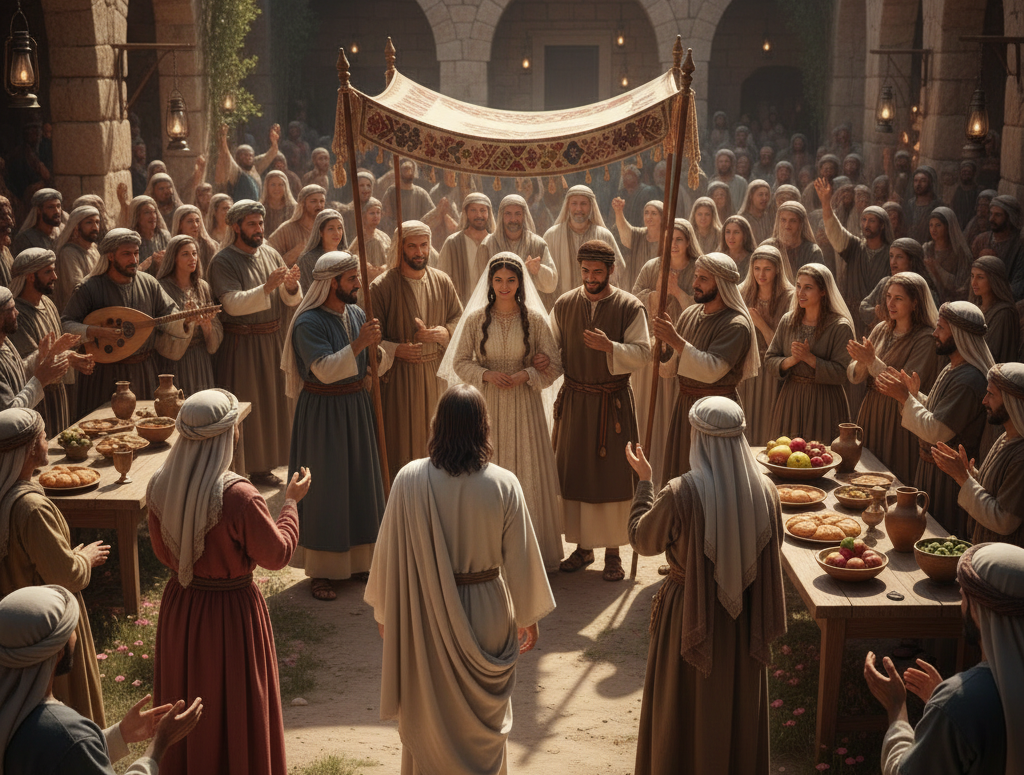
The of the ten virgins, reported by Matthew 25.1, illustrates the final stage of marriage and its celebrations, a happiness shared with family and friends, as also demonstrated by the account of the wedding at in Galilee in John 2.1.

Finally, the account in John 8.3 of the woman caught in adultery emphasises the severity of the law at the time, while raising questions about unequal treatment of men and women.

II. Divorce and first-century Jewish society

Separation of spouses, and thus the breakdown of the family unit on which continuing support for ageing parents depended, was generally unthinkable. A woman’s livelihood depended essentially on her husband, making marriage a guarantee of a life that, although not always happy, was at least bearable.

Divorce, which challenged the foundations of this society, was therefore rare at the time. Unlike a man, an adulterous woman risked . Only a man had the power to dismiss his wife by giving her a certificate of divorce.

We limit ourselves here to analysing divorce in first-century Jewish society, without addressing its application in the Church. In an account reported by Mark, Jesus the Messiah recalls a specific aspect of Moses’ law: ‘It was because of the hardness of your hearts that Moses prescribed this law for you.’ The implication is that divorce was not part of Yahweh’s original design.

The texts of Matthew 22.28, Mark 12.23 and Luke 20.33 mention a woman who married seven times, specifying, however, that she was widowed. At that time, marked by religious fundamentalism, remarriage after divorce was almost impossible without incurring an accusation of adultery.

It is clear that, in a separation, the man had the advantage while the woman bore all responsibility and consequences. It is understandable to feel indignation at the unequal treatment of men and women in this society. Nevertheless, the biblical message, notably in Ephesians 5.25, brought radical change by advocating balance, something revolutionary at the time.

III. Marriage in the Bible

We must distinguish between rules applied by human beings, particularly in Jesus the Messiah’s time, and biblical prescriptions, which remain timeless. Moreover, Jesus the Messiah’s approach to these rules provides a precedent to be considered.
The Bible introduces marriage in the book of Genesis. Adam and Eve are presented as the first couple, with their union intended as an equal partnership.

Marriage is governed by various Old Testament laws, particularly in Leviticus and Deuteronomy. They cover matters such as the prohibition of adultery, rules for divorce, and spouses’ rights and duties.

Polygamy is a common practice among certain biblical figures, although interpreters debate its morality and legitimacy.

In the New Testament, Jesus elevates and reinforces the importance of marriage. In Matthew 19.4-6, he quotes Genesis and affirms the permanence and sacredness of marriage.

Jesus teaches about the indissolubility of marriage and addresses divorce, restricting it considerably compared with the laws of Deuteronomy.

IV. Divorce in the Bible

In the Old Testament, Mosaic law makes certain provisions for divorce. Deuteronomy 24.1-4 mentions that a man may write a certificate of divorce if he finds something displeasing in his wife.

This legislation sought to regulate divorce and protect the rights of divorced women.

These laws also reflected the hardness of the and the social realities of the time, rather than a divine ideal. Divorce had significant social and economic consequences, especially for women, who often found themselves in precarious circumstances.

Jesus addresses divorce in the Gospels, notably in Matthew 19.3-9 and Mark 10.2-12. He cites the creation of man and woman and affirms that what God has joined together, no human being should separate.
Jesus elevates the understanding of marriage above Moses’ concessions, emphasising that divorce was not part of God’s original plan and that the hardness of the caused it.
In Matthew 19.9, Jesus mentions unfaithfulness as a legitimate ground for divorce. However, this exception has been interpreted differently over time and among different Christian denominations.

V. Same-sex marriage in the Bible

In this analysis, we will address what Mosaic law says about same-sex marriage rather than the controversy surrounding it. Our aim is to recall biblical teachings and understand the social context of Jesus the Messiah’s time, without examining contemporary debates about new same-sex marriage legislation in Western countries in detail.

The passages often cited are found in Leviticus Leviticus 18.22 and Leviticus 20.13, where sexual relations between men are expressly forbidden and described as an abomination. These prescriptions form part of a broader body of laws intended to distinguish Israel from neighbouring peoples in religious and moral practices.

In a Jewish society strictly observing these laws, the very idea of a same-sex union would have been unimaginable. It is therefore unsurprising that Jesus the Messiah does not directly address this issue in the Gospels, concentrating instead on the broader principles of love, mercy and justice.

VI. Inferring the age of the married apostles

You can consult the studies FDS002 – Homosexuality and FDS003 : Same-sex marriage, where we examine these two subjects in detail.

It seems culturally evident that the apostles were young when Jesus the Messiah called them. If the was Nathanael’s, as we suppose, he was then about eighteen to twenty years old.

Simon Peter, living with his mother-in-law in Capernaum, appears to be newly married and childless when the Messiah calls him. His age is similar to Nathanael’s, within a year or two.

In families of that time, births followed regularly and rapidly, often every year. Despite high infant mortality, Simon Peter and his brother Andrew were probably close in age. It is reasonable to suppose the same of Zebedee and Salome’s sons, John and James.

This information suggests that these men were young, most around twenty, about ten years younger than Jesus and John the Baptist. Given his professional position in Capernaum, Matthew may have been slightly older than his companions.

In these circumstances, Mary, Jesus’ mother, and Joseph would have been very young when Jesus was born. Joseph’s supposed advanced age, up to 111 at his death according to the text ‘History of Joseph the Carpenter’, seems wholly unrealistic to us.

Conclusion

We have discussed these details of Jewish marriage in Jesus the Messiah’s time to highlight cultural differences from our present society. This social context also helps us estimate the ages of Jesus’ parents and disciples.

We know the Master’s age at his baptism: about thirty, according to Luke 3.23. We can also deduce John the Baptist’s age at that time: about thirty years and six months.

However, we have no precise information about the apostles’ ages. Knowledge of first-century Jewish society leads us to understand that they were very young, most probably around eighteen when they met Jesus the Messiah.

This age difference from the Messiah explains why they saw him from the outset as a Master rather than simply a peer in their group.

We can also suppose that Mary gave birth to her firstborn before she was sixteen, or even earlier, at fourteen.

Their youth may surprise us today, but it is essential not to project our present society’s norms onto that of Jesus’ time.