ANN062

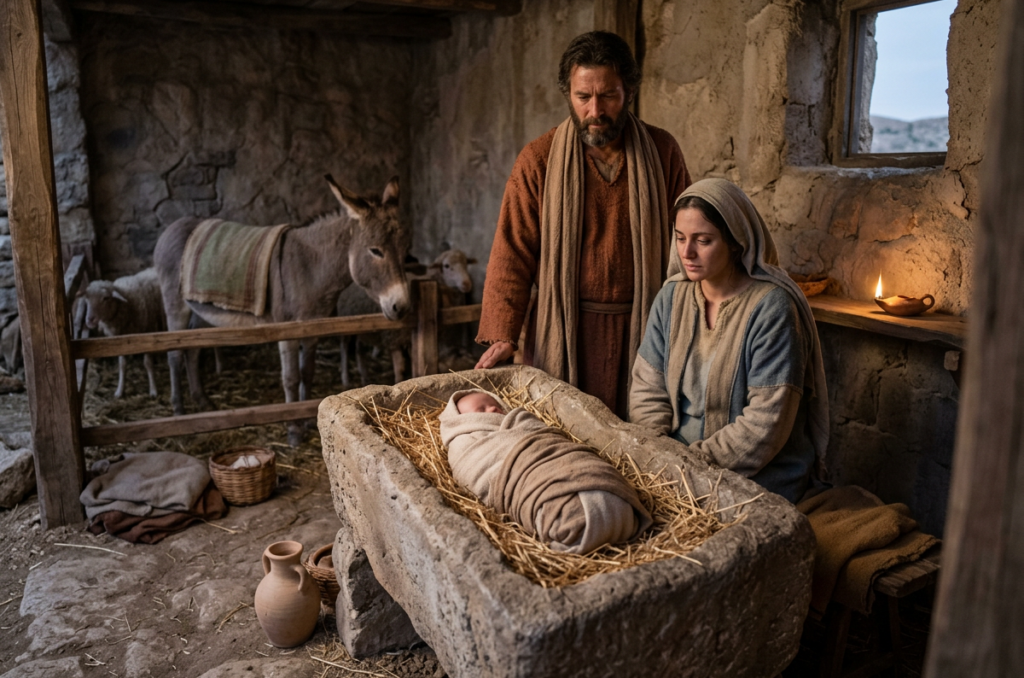
The manger in Bethlehem

The article analyses the Christmas Nativity scene tradition, comparing historical accounts with its modern cultural representation. It draws on Luke’s Gospel, which describes the birth in a manger, and discusses the issues this tradition raises in France’s secular landscape.

7 min Christmas Nativity scene Nativity Gospel of Luke culture

For more information

Introduction

Although widespread and cherished, the Christmas Nativity scene tradition departs from historical reality in several respects. In Provence, this custom has acquired the status of a cultural institution, transcending religious beliefs.

It is therefore not unusual to see Nativity scenes beneath in people’s homes, regardless of the residents’ faith.

This practice is also found in some municipalities in France, a country that values secularism. However, displaying Nativity scenes in public places sometimes causes controversy, particularly among atheist citizens.

This article seeks to revisit the history and development of the Christmas Nativity scene, exploring its origins and cultural impact.

I. The historical evidence

Research into Jesus the Messiah’s birthplace is fairly straightforward, since Luke’s Gospel alone explicitly mentions the event. In their respective accounts, Matthew, Mark and John do not discuss the details of Jesus’ birth and the manger.

Matthew, in particular, concentrates on other aspects of Jesus’ birth and early life, while Mark begins his account with Jesus’ ministry.

John’s Gospel takes a more theological approach, without going into the details of Jesus’ birth. Thus the only biblical source providing detailed information about Jesus’ birth in a manger is Luke’s Gospel.

In his account, Luke mentions the shepherds’ visit at Jesus the Messiah’s birth. He again uses the word ‘manger’ to indicate where Jesus was laid, but provides no further details.

Matthew describes the visit of the Magi from the East, but does not mention the manger. Instead, his account places Jesus’ family in a house.

It therefore appears that Joseph, Mary and the infant Jesus left the initial birthplace, generally described as a stable or cave with a manger, to settle somewhere more suitable, a house, as Matthew reports.

This difference between Luke’s and Matthew’s accounts highlights the successive stages following Jesus’ birth.

We have observed that Jesus’ family moved from a place initially reserved for animals to a house. Analysing the information about Jesus’ Nativity in the Gospels reveals no explicit mention of animals present at his birth.

Moreover, the Magi, who played an important part in the Nativity story, arrived only later and are therefore not mentioned in the immediate context of Jesus’ birth. The place is described only by the word ‘manger’, or ‘crib’ in some translations, deriving from the Latin ‘crispia’, meaning ‘manger’.

Joseph and Mary arrived in Bethlehem during an evidently very busy period, owing to the celebration of and the census ordered by Quirinius.

Finding accommodation difficult, they had to adapt and find suitable shelter, perhaps a cave usually used to house animals, as Luke’s use of ‘manger’ suggests.

The shepherds, alerted by the angels, came to visit Jesus in this humble place. The Magi visited a few weeks later, once the family had settled in a house that became available after the celebrations ended.

This sequence of events forms the historical account of Jesus’ birth according to the Gospels.

II. The Nativity scene as culture

Today the Nativity scene is a significant cultural representation, especially for Christians, symbolising the Saviour’s birth. Artistic depictions of the Nativity scene began to appear as paintings only about four centuries after Jesus’ birth. Sculptures depicting the Nativity scene appeared in the sixth century.

The figures of the Magi, by then recognised as kings, were added to the Nativity scene only in the twelfth century. A notable turning point came in 1223, when Saint Francis of Assisi organised what is considered the first living Nativity scene in the Italian village of Greccio. This event marked the beginning of the spread of living Nativity scenes, with real actors and animals, in Italy and Provence.

The modern Nativity scene, with figurines representing the various characters, began developing in the sixteenth century. In 1775, a Nativity scene in Marseille introduced the innovation of mannequins dressed in local costumes.

During the French Revolution, however, this custom temporarily went underground, before returning to Catholic homes once the revolutionary period ended. Protestant families did not adopt this tradition.

The Nativity scene has become a worldwide practice, with each country adding its own cultural touch. In Catholic tradition, it is generally set up on Saint Nicholas’ Day or the first Sunday of Advent, in early December, and put away after the Presentation of Jesus in the Temple on 2 February. Note that, according to our analyses, these dates do not correspond to historical reality.

Thus what began as a simple mention by Luke in the Gospels has become a universally recognised theatrical representation, transcending its scriptural origins.

Conclusion

This artistic and cultural development takes us significantly away from the simple historical reality described in the biblical texts. It is therefore essential to return to these writings to grasp the truth of the event.

The gradual addition of legendary elements surrounding Jesus the Messiah’s birth has led some people to regard it as a myth. Yet the biblical truth is much simpler: Jesus, regarded in Christian faith as God incarnate, was born like any human child. Over time, the unostentatious nature of his birth prompted people to enrich the account with additional, often fanciful details to lend it greater splendour.

Although culturally significant, these embellishments must not obscure the essence of the biblical message: Jesus’ coming into the world, a fundamental historical truth for Christian faith, marked by a simplicity that contrasts with the complexity of the traditions that developed later.