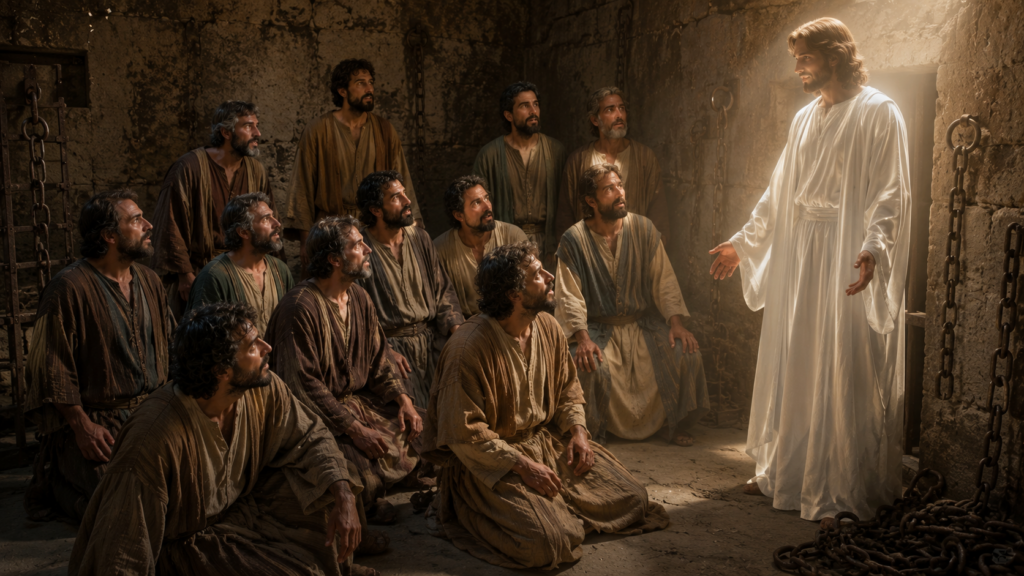

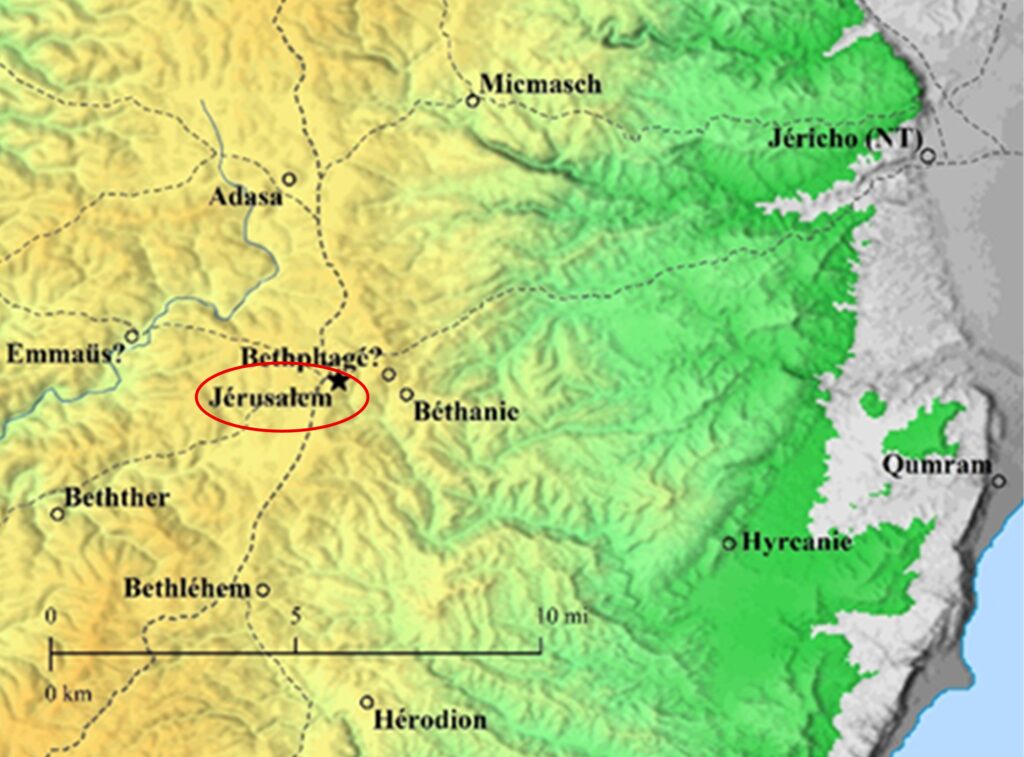
Having been seized with jealousy at the spectacular growth of the Church, the high priest and the members of the decide to take action. The apostles are arrested and put in the public prison (Acts 5.18). This measure marks a new stage in the opposition of the religious authorities to the Christian movement. After the threats made to Peter and John at their first appearance before the (Acts 4.17-18), the Jewish leaders now resort to imprisonment.
However, this arrest seems to have been carried out with a certain caution. A few verses later, Luke specifies that the Temple guards feared a hostile reaction from the crowd (Acts 5.26). This precaution bears witness to the growing influence of the apostles among the people. Despite a certain reserve on the part of the population (Acts 5.13), many men and women continue to join the believers (Acts 5.14), and the miracles performed by the apostles earn them considerable esteem.
This fear on the part of the authorities is not new. Already at the first arrest of Peter and John, the members of the had hesitated to take harsher measures “because of the people” (Acts 4.21). The religious leaders are thus faced with a delicate situation: they wish to put an end to the apostolic preaching without provoking disturbances that might bring about an intervention by the Roman authorities.
2- The angelic intervention
During the night, an extraordinary event upsets the plans of the religious leaders. Luke reports with remarkable restraint that “an opened the prison doors during the night” (Acts 5.19). True to his usual manner, the author does not dwell on the spectacular details of the miracle, but above all emphasizes its theological significance.
This heavenly intervention recalls several deliverances reported in the Old Testament. Joseph was brought out of his prison in order to fulfill the mission God had prepared for him (Genesis 41.14). Daniel was preserved in the lions' den (Daniel 6.21-22), while the three young Hebrews were miraculously protected in the midst of the furnace (Daniel 3.24-25). Through these accounts, Scripture emphasizes that God remains sovereign and that he is able to preserve his servants when this accords with his purpose.
Later, Peter himself will experience another miraculous deliverance (Acts 12.6-11), while Paul and Silas will be freed from their prison at Philippi (Acts 16.25-26). However, these extraordinary interventions do not mean the end of persecutions. They rather remind us that human opposition cannot prevent the accomplishment of God's plan (Acts 4.27-28 ; Acts 5.39).
3- The words of this life
The angel does not merely free the prisoners. He also gives them a precise command:
“Go, stand in the temple, and speak to the people all the words of this life” (Acts 5.20).
The expression “the words of this life” deserves particular attention. It probably refers to the message of salvation in Jesus Christ and the new life offered through his death and resurrection. The Greek term ζωή (life) frequently evokes, in the New Testament, eternal life and communion with God (John 3.16 ; John 10.10 ; John 17.3 ; 1 John 5.11-12).
This wording also recalls the words of Peter reported in the Gospel of John: “Lord, to whom shall we go? You have the words of eternal life” (John 6.68). Jesus himself is presented as “the Prince of life” (Acts 3.15) and as “the way, the truth, and the life” (John 14.6). Thus, the angel's command consists above all in continuing the proclamation of the salvation offered in Christ.
4- The obedience of the apostles
The apostles show immediate obedience to the instructions they received. Luke emphasizes that they enter the Temple at daybreak in order to teach the people there (Acts 5.21). It is remarkable that they return precisely to the place where they had been arrested a few hours earlier.
This promptness concretely illustrates the principle that Peter will express a few moments later before the : “We must obey God rather than men” (Acts 5.29). Imprisonment has not in the least altered their determination. On the contrary, they resume their mission as if nothing had happened, convinced that the work of God cannot be stopped by human decisions.
This attitude recalls that of Jesus himself. During his earthly ministry, he taught daily in the Temple despite the growing hostility of the religious leaders (Luke 19.47 ; Luke 21.37-38). From Luke's perspective, the apostles thus continue the work of their Master.
5- The community in prayer
Luke does not explicitly mention the reaction of the Christian community during this night of imprisonment. It is nevertheless permissible to suppose that the believers interceded on behalf of the apostles. A few years later, when Peter is imprisoned by Herod, the Church will pray earnestly for him (Acts 12.5).
It is also possible that one of the freed apostles warned the other believers before returning to the Temple. Such a hypothesis nevertheless remains conjectural, and the account does not allow us to go further. As often, Luke concentrates his attention on the elements essential to his theological purpose.
6- The priority of preaching
It is striking to note that Luke gives relatively little space to the miracle itself. A few words suffice to describe the angel's intervention, whereas the emphasis is immediately placed on the mission entrusted to the apostles. This contrast is revealing of the author's theological perspective.
What is essential is not the wonder itself, but the proclamation of the Gospel made possible by this deliverance. Throughout the book of Acts, the preaching of the Word occupies a central place (Acts 6.4 ; Acts 8.4 ; Acts 13.44-49 ; Acts 28.30-31). The miracles themselves appear mainly as signs that authenticate the apostolic testimony (Mark 16.20 ; Hebrews 2.3-4).
7- A work that men cannot stop
At the end of this account, the impression that emerges is one of remarkable continuity. The arrest and the night spent in prison ultimately appear as a temporary episode, unable to interrupt the apostles' program of evangelization.
Luke thus suggests that the opposition of the religious authorities, however determined, cannot prevail against the advance of the Gospel. This theme runs through the whole book of Acts and will find particularly explicit expression in the words of : “If this work is from God, you will not be able to destroy it” (Acts 5.39). From Jerusalem to , the rest of the account will show that neither threats, nor persecutions, nor imprisonments will be able to prevent the spread of the Word of God (Acts 6.7 ; Acts 12.24 ; Acts 19.20 ; Acts 28.30-31).
An
The