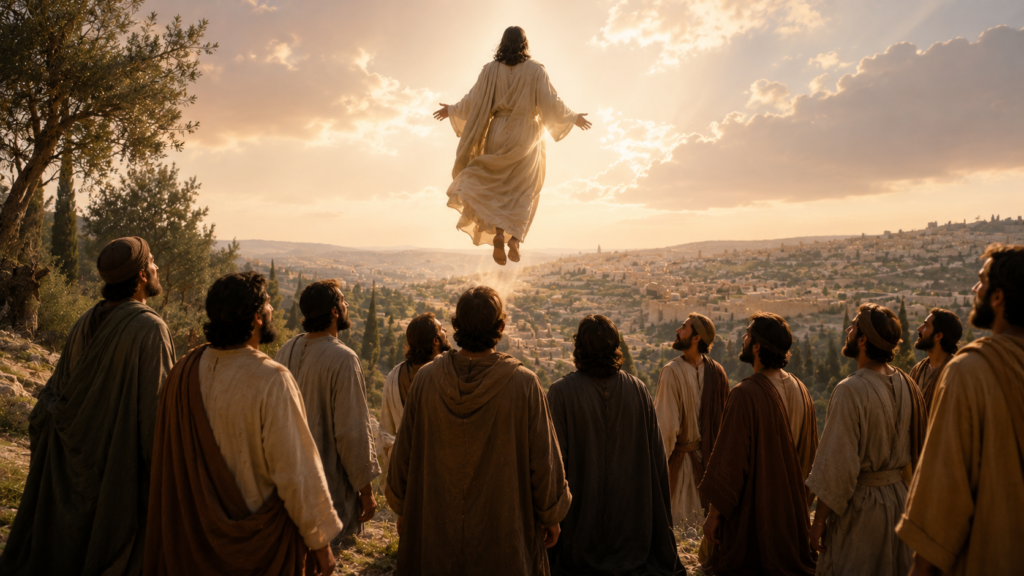

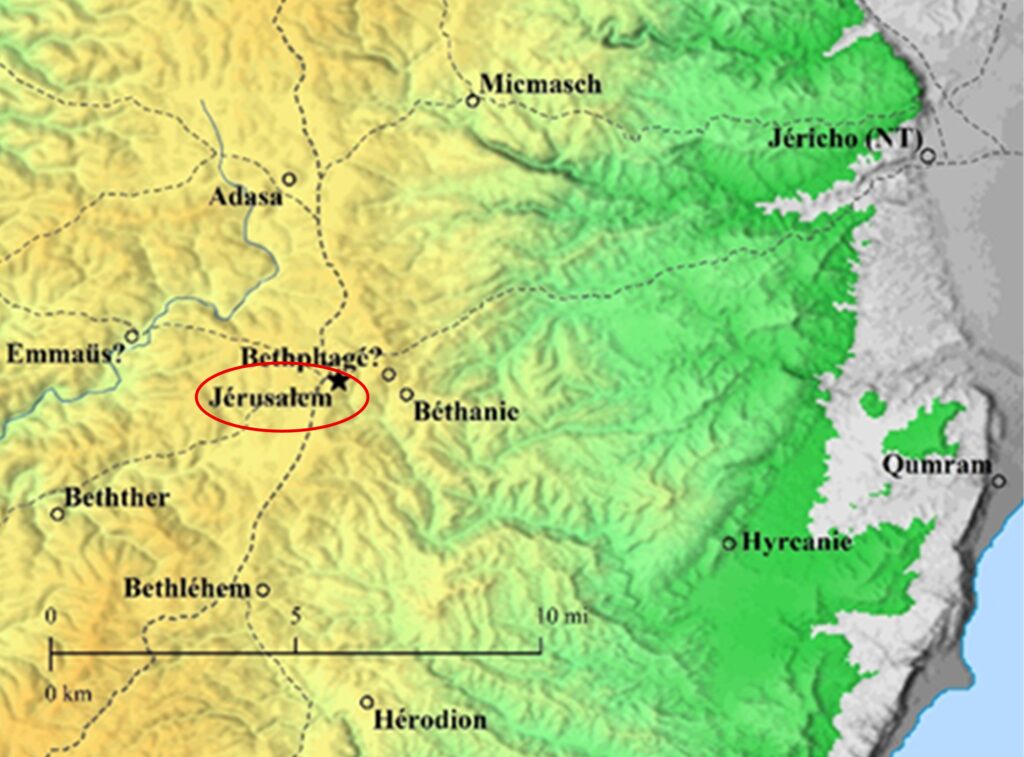
Here we witness the last moments of the earthly ministry of Jesus the Messiah. On Thursday, May 12, 33, Jesus and his disciples are on the , on the way to Bethany, the village of Martha, Mary and Lazarus (Luke 24.50; John 11.1). This place was probably not chosen at random. Jesus had often stayed there (Luke 21.37), had delivered his discourse on the end times there (Matthew 24.3), and it was also on its slopes, in the garden of Gethsemane, that he had lived through the hours of anguish before his arrest (Matthew 26.36-46).
After speaking at length with his disciples and giving them his final instructions, notably the command to wait for the Father's promise and to become his witnesses to the ends of the earth (Acts 1.4-8), Jesus the Messiah is suddenly lifted up into heaven. A cloud gradually takes him out of their sight (Acts 1.9). This extraordinary event marks the end of his earthly appearances and his return to the Father.
2- The amazement of the disciples
The disciples knew that Jesus was to return to the one who had sent him (John 14.2-3; John 16.28; John 20.17). However, nothing suggests that they expected to witness such a supernatural manifestation. Their amazement is evident, since they stand motionless, their eyes fixed on the sky (Acts 1.10). Their last question shows, moreover, that they still hoped for an imminent restoration of the kingdom of Israel (Acts 1.6). The manner in which this separation took place therefore had everything to surprise them.
3- The testimony of the heavenly messengers
While the disciples are still gazing at the sky, two men dressed in white appear beside them (Acts 1.10). Luke presents them as heavenly messengers. They may be the same angels who had announced the resurrection to the women a few weeks earlier (Luke 24.4-7), but this identification remains hypothetical, and the text does not allow us to affirm it with certainty.
These messengers then deliver a declaration of considerable importance for Christian hope: “This Jesus, who was taken up from you into heaven, will come in the same way as you saw him go into heaven” (Acts 1.11). This promise would deeply mark the faith of the early Church. The first Christians lived in expectation of the glorious return of the Lord (1 Thessalonians 1.9-10; Philippians 3.20).
4- The hope of Christ's return
This announcement also recalls the prophecy of Zechariah, according to which the Lord will set his feet on the at the time of his final intervention (Zechariah 14.4). According to a widespread interpretation in Christianity, the mountain that witnessed the Messiah's departure could also be the one of his glorious return.
However, this hope soon gave rise to certain questions and sometimes to excessive expectations. Some believers seemed to envisage an immediate return of the Lord. The apostle Paul then had to give several clarifications in order to frame this expectation and to remind them that certain events had yet to take place before the coming of Christ (1 Thessalonians 4.13-18; 2 Thessalonians 2.1-12).
5- A new phase in the work of Christ
The ascension is therefore not the completion of the work of Jesus the Messiah, but a decisive stage in its fulfillment. It marks the transition between his earthly ministry and his heavenly activity. Now exalted at the Father's side, Christ continues his work through the Holy Spirit and the witness of his disciples, while awaiting his glorious return announced by the heavenly messengers.
On substance, this text seems to me entirely worthy of a serious biblical commentary. It belongs more to the register of an accessible evangelical work of exegesis than to that of a specialized academic article, which seems to me particularly suited to the project of a continuous commentary on the Acts of the Apostles intended for a wide readership.
The
The
The
A