
We will now take up the text of the Acts of the Apostles, examining it progressively, event by event. The account opens with a short introduction that establishes the link between this second work and the Gospel of Luke.
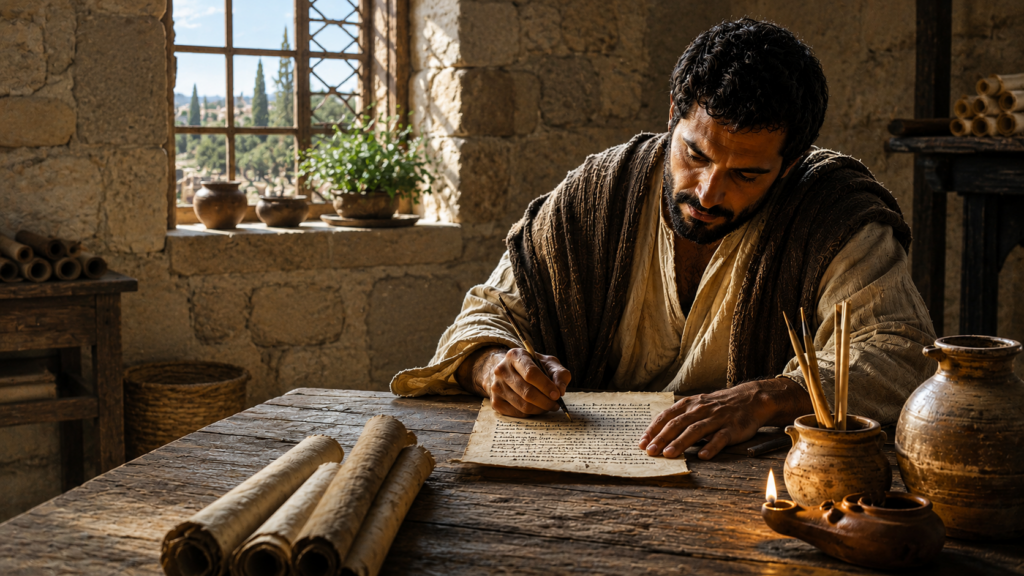
Luke, whom Paul calls "the beloved physician" (Colossians 4.14), continues here his work devoted to the origins of Christianity. He had already composed a first volume relating the ministry of Jesus the Messiah, from its beginnings to his resurrection and ascension (Luke 24.50-53). Like the Gospel, this second work is addressed to a certain Theophilus (Luke 1.3; Acts 1.1), probably an influential and well-to-do person who had embraced the Christian faith.
2- Theophilus, recipient and perhaps patron of the work
We have already mentioned the hypothesis that Theophilus may have been the one who commissioned this work. Eager to preserve the memory of the founding events of Christianity, he may have encouraged Luke to undertake a thorough investigation into the life of Jesus the Messiah, and then into the beginnings of the Church.
This hypothesis remains conjectural, however, as the text gives no further indication on the matter. It should therefore be presented with caution, without giving it more weight than the data we actually have.
3- Forty days of teaching after the resurrection
In the opening lines of Acts, Luke briefly recalls the situation in which his first account ends and the second begins. He stresses in particular that the risen Jesus the Messiah continued to appear to his disciples over a period of forty days (Acts 1.3). This chronological detail, absent from the Gospels, is valuable information for reconstructing the sequence of events that followed the resurrection.
Luke also specifies that Jesus did not cease to instruct his disciples during this period. His teaching concerned chiefly the Kingdom of God (Acts 1.3), a major theme of his preaching since the beginning of his ministry (Mark 1.14-15). Thus, far from marking the end of his work, the resurrection inaugurates a final period of teaching intended to prepare the apostles for the mission that would soon be entrusted to them.
4- A transition between the Gospel and the history of the Church
These first verses of Acts therefore form a transition between the earthly ministry of Jesus the Messiah and the history of the nascent Church. Before his ascension, Jesus completes the training of his disciples and prepares them to become witnesses of the Gospel. From the very first lines of his account, Luke thus shows that the Acts of the Apostles stand in direct continuity with the work accomplished by Christ and that they relate the beginnings of the expansion of Christianity under the guidance of the Holy Spirit.
?