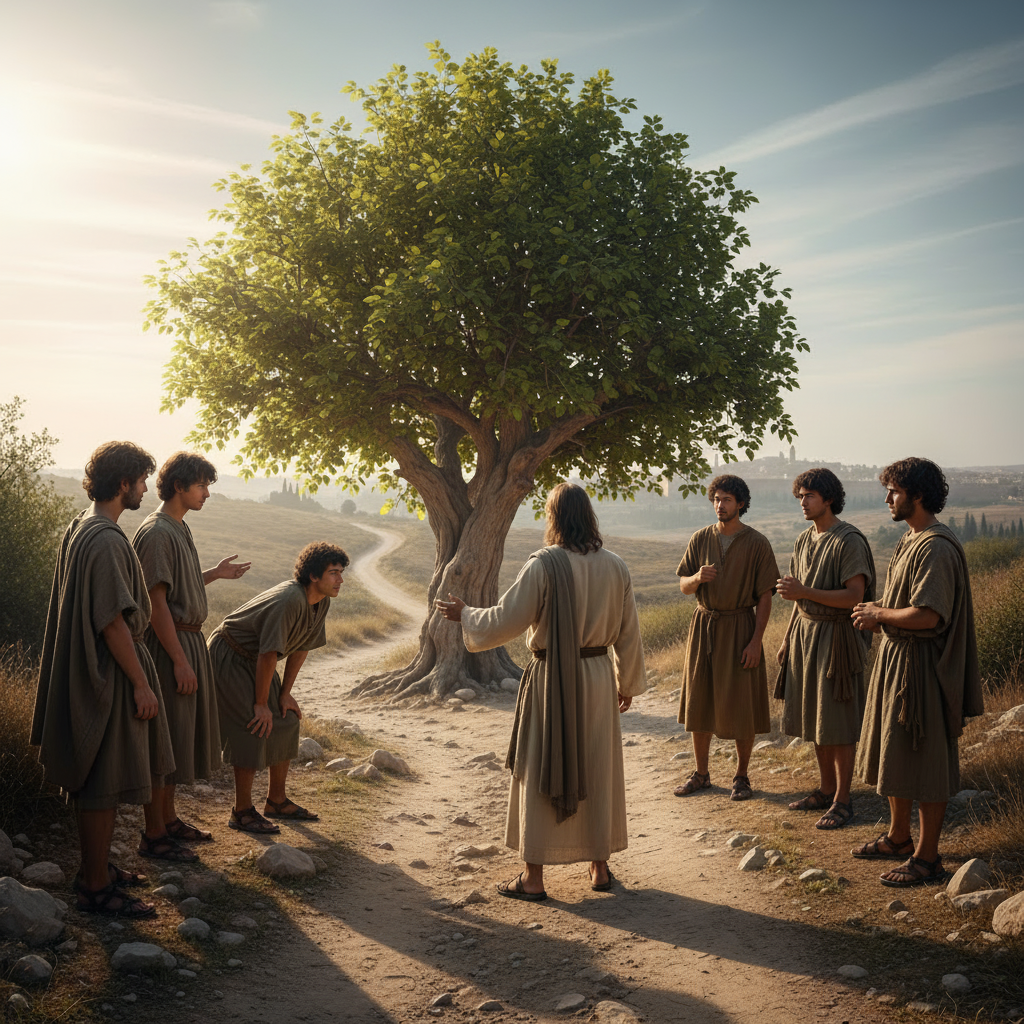

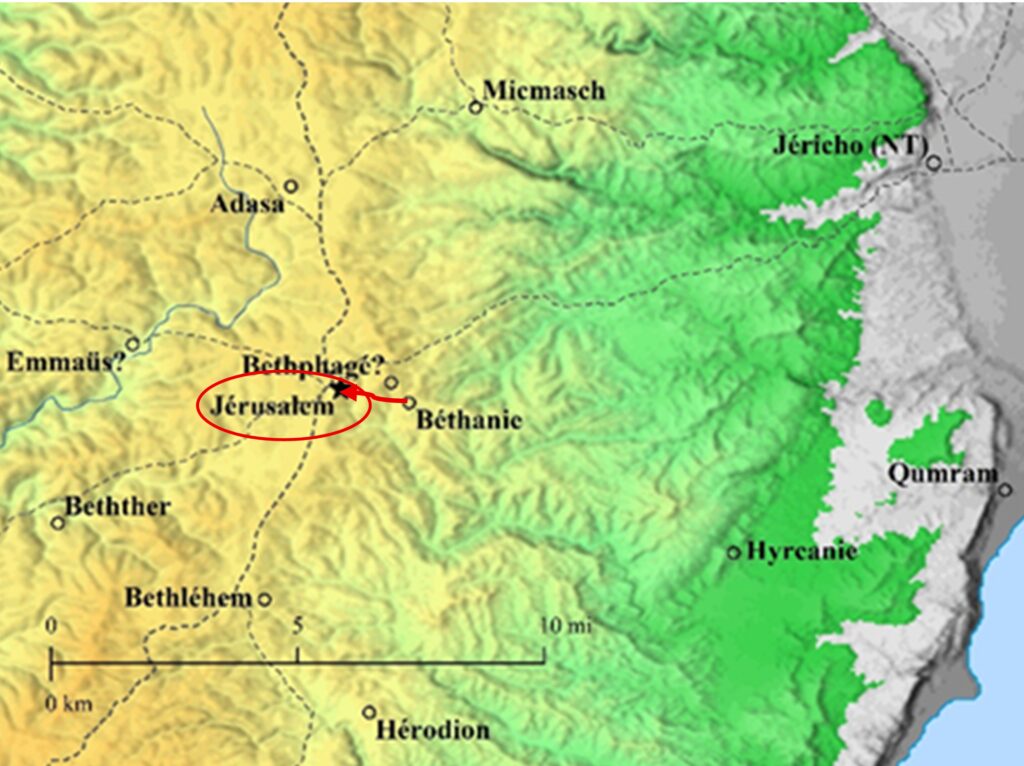

Matthew and Mark place the episode of the on the day after the Messiah Jesus' triumphal entry into Jerusalem, when he sat on a colt. So it is Monday, March 28, AD 33, early in the morning, as the Messiah Jesus leaves Bethany with his twelve apostles and probably some disciples to go to Jerusalem. On the way, he sees a covered with leaves and wishes to pick a fig from it.
In Matthew 21.18-19 and Mark 11.12-14, the Messiah Jesus is hungry, approaches the tree, but finds no fruit. He curses it, and the quickly withers, which astonishes the disciples. This scene raises two questions: did the Messiah Jesus not know that there would be no fruit, or does he discover it while looking for a fig? And why does he curse this tree?
The act of the Messiah Jesus must not be understood as an arbitrary deed, for he never performs a miracle merely to produce something extraordinary. His miracles always have a meaning and aim to reveal a truth. The withering of the is thus a miracle-: it conveys an essential spiritual message. The laden with leaves but without fruit becomes the symbol of a religious appearance lacking true fruitfulness. In Mark, the episode surrounds the cleansing of the Temple, reinforcing this theme of discernment, divine judgment and spiritual authenticity.
The geographical context also sheds light on the scene. The village of Bethphage, located on the eastern slope of the , lies on the road connecting Bethany to Jerusalem. Mark and Luke, moreover, associate Bethphage with Bethany to stress their closeness. The Messiah Jesus and his disciples, staying near Bethany, therefore necessarily pass through this area on their way to Jerusalem.
The name Bethphage, which means "house of ", reinforces the idea that the mentioned in the accounts of Matthew and Mark was located in this region. Furthermore, given the nature of the , the fruit normally appears before the leaves. Thus, the presence of a tree covered with leaves should have indicated that it also bore . The absence of fruit, followed by the withering of the tree, gives the act of the Messiah Jesus a symbolic significance that the disciples will see confirmed with their own eyes the very next day.
Matthew and Mark thus highlight the importance of this event. The represents Israel: many leaves, but no fruit. The only true fruit to come from Israel is the Messiah Jesus himself, and there will be no other.