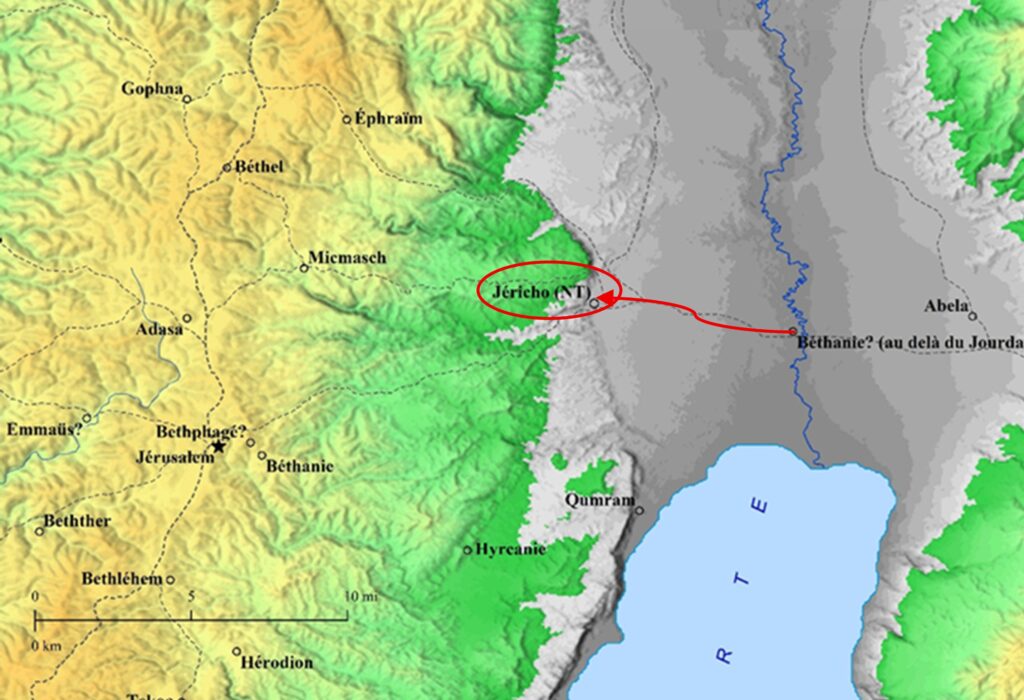
It is likely that the episode with the rich young man took place at the entrance to Jericho. This location suggests that the Messiah Jesus had set out for Bethany, near Jerusalem, in order to raise Lazarus. This journey would have begun around February, or at the latest at the beginning of March, AD 33.
PER264
The rich young man
This article examines the encounter of the rich young man with Jesus, a pericope from the Gospels of Matthew, Mark and Luke. It highlights Jesus’ teaching on material detachment and faith, while placing the event in a historical context between Hanukkah and Passover.
7 min
rich young man
Jesus
Gospels
5 verses
3 books
Resources
You can consult:
Biblical texts
Matthew
Matthew 19.16-22 (King James Version)
And, behold, one came and said unto him, Good Master, what good thing shall I do, that I may have eternal life?
And he said unto him, Why callest thou me good? there is none good but one, that is, God: but if thou wilt enter into life, keep the commandments.
He saith unto him, Which? Jesus said, Thou shalt do no murder, Thou shalt not commit adultery, Thou shalt not steal, Thou shalt not bear false witness,
Honour thy father and thy mother: and, Thou shalt love thy neighbour as thyself.
The young man saith unto him, All these things have I kept from my youth up: what lack I yet?
Jesus said unto him, If thou wilt be perfect, go and sell that thou hast, and give to the poor, and thou shalt have treasure in heaven: and come and follow me.
But when the young man heard that saying, he went away sorrowful: for he had great possessions.
King James Version (1769), domaine public — texte : eBible.org
Mark
Mark 10.17-22 (King James Version)
And when he was gone forth into the way, there came one running, and kneeled to him, and asked him, Good Master, what shall I do that I may inherit eternal life?
And Jesus said unto him, Why callest thou me good? there is none good but one, that is, God.
Thou knowest the commandments, Do not commit adultery, Do not kill, Do not steal, Do not bear false witness, Defraud not, Honour thy father and mother.
And he answered and said unto him, Master, all these have I observed from my youth.
Then Jesus beholding him loved him, and said unto him, One thing thou lackest: go thy way, sell whatsoever thou hast, and give to the poor, and thou shalt have treasure in heaven: and come, take up the cross, and follow me.
And he was sad at that saying, and went away grieved: for he had great possessions.
King James Version (1769), domaine public — texte : eBible.org
Luke
Luke 18.18-23 (King James Version)
And a certain ruler asked him, saying, Good Master, what shall I do to inherit eternal life?
And Jesus said unto him, Why callest thou me good? none is good, save one, that is, God.
Thou knowest the commandments, Do not commit adultery, Do not kill, Do not steal, Do not bear false witness, Honour thy father and thy mother.
And he said, All these have I kept from my youth up.
Now when Jesus heard these things, he said unto him, Yet lackest thou one thing: sell all that thou hast, and distribute unto the poor, and thou shalt have treasure in heaven: and come, follow me.
And when he heard this, he was very sorrowful: for he was very rich.
King James Version (1769), domaine public — texte : eBible.org
John
John (King James Version) not cited in the book
Technical details

Location: Road between Bethany beyond the Jordan and Jericho
Date: February AD 33
Method: We continue with Mark
Note on the method: Matthew and Luke confirm Mark’s account
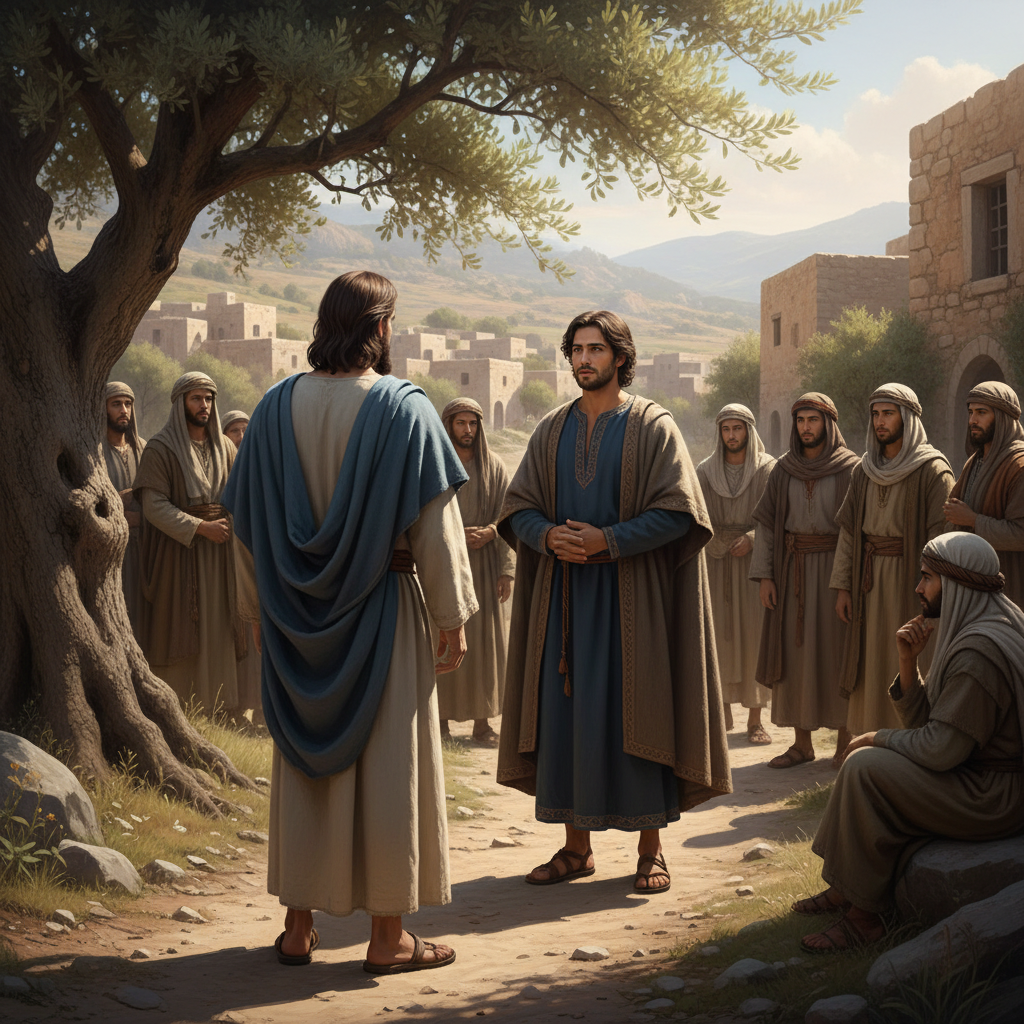
A rich man comes to speak with the Messiah Jesus.
Chronology
Comments
The conversation between the Messiah Jesus and the rich young man takes place on the road linking Bethany, located beyond the Jordan, where the Messiah Jesus and his disciples are staying (PER261), to Jerusalem. It is the journey made to go to the home of , when Lazarus has died, before the Messiah Jesus and his disciples leave for Ephraim (PER274), after the resurrection of Lazarus (PER273).
The conversation precedes the arrival in Jericho, where the Messiah Jesus will heal two blind men. During this journey, the Messiah Jesus takes advantage of various moments, notably the rests, to teach the crowd that follows him. These stops become privileged opportunities for instruction and exchange with those who accompany him.
It is reasonable to think that this rich young man, mentioned in Matthew 19.20, probably came from a large town in the region. Having learned that the Messiah Jesus and his disciples were passing nearby, he would have gone to meet them, motivated by the desire to speak with the Messiah Jesus.
The fact that he is described as a ruler, according to Luke 18.18, indicates that he belongs to the local elite. He could be a leader of the , a magistrate or an influential member of a Jewish community. Since these functions are tied to a specific territory, this confirms that he is a man established in the region and recognized within his community.
This man comes to Jesus with an essential question: he wants to know what he must do to have eternal life. In Matthew he is described as a young man; in Luke, as a ruler; in Mark, he runs up and kneels, which underlines the urgency and sincerity of his approach. This man is religious, earnest, respected, and he seeks a definitive answer on how to enter into life.
The Messiah Jesus begins by pointing him to God alone as truly good, then invites him to remember the commandments. The man states that he has kept them since his youth. The Gospels thus show someone who is morally blameless, but who nevertheless senses that something is missing. Mark adds a moving detail: the Messiah Jesus looks at him and loves him. This look of love prepares the demanding word that follows.
The Messiah Jesus then tells him that he lacks one thing: he must sell his possessions, give to the poor, then come and follow him. The call is not a general rule imposed on everyone, but a word addressed to this particular man, whose wealth is the inner obstacle. The Messiah Jesus does not merely ask him to give up his possessions; he invites him to enter into a relationship as a disciple, to walk behind him.
The man’s reaction is tragic: he goes away very sad, for he has great possessions. His sadness shows that he understands the beauty of the call but cannot bring himself to let go. The three Gospels stress the same tension: this man desires eternal life, but he is not ready to release what prevents him from receiving it.
In these accounts, the Messiah Jesus reveals that the real obstacle is not wealth itself, but the heart’s attachment. The rich man becomes the image of one who wants to enter the Kingdom while keeping control of his life. The Messiah Jesus, for his part, calls for a radical freedom, founded on trust and detachment. The contrast between the love of the Messiah Jesus and the sadness of the man gives the scene an exceptional human and spiritual depth.