

We invite you to consult the following studies on the parables: PAR039 : The and the publican, and PAR000 : The parables.
The discourse reported by Luke may be set at different times and in various places, which suggests that no strict chronology is followed in his narrative. It even seems very likely that Luke deliberately chose this point in the account to gather several teachings together. This approach allows him not only to omit certain contextual elements in order to make his account more concise, but also to enrich and develop his argument on the theme of the kingdom of heaven.
Thus, Luke presents accounts that do not necessarily follow a formal chronological order. On the contrary, he arranges his material according to a precise logic, structured around his theological aims. This organizing principle is explored further in the section titled “The ”. It is therefore essential, in studying these chapters, to take into account the author’s intention in the composition and structuring of his gospel.
The
The
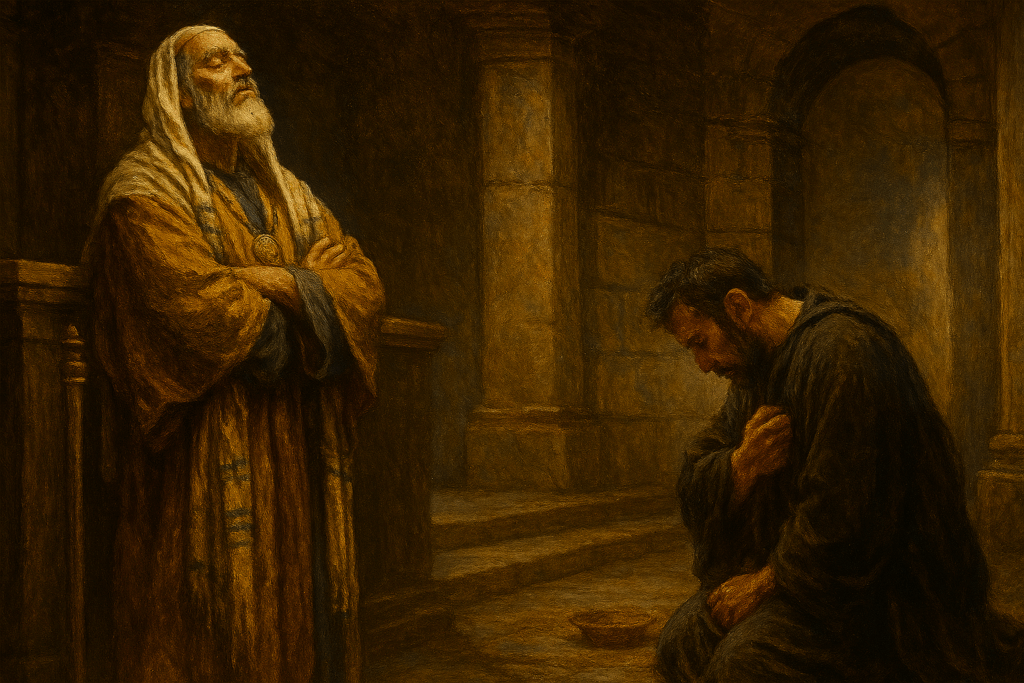
This text is therefore a according to Luke 18.9, but its realism might suggest the description of a scene actually observed in the temple.
Note that the is not lying: he makes all these efforts in order to conform to the precepts of his religion. He compares himself, and this reminds us of the famous aphorism: “When I look at myself, I despair; when I compare myself, I take comfort.” (Charles-Maurice de Talleyrand-Périgord, 1754‑1838). It expresses with irony the fact that our own judgment can be harsh, but that by comparing ourselves with others, we make light of our faults.
This text from Luke 18.9-14 highlights the contrast between false righteousness founded on pride and true righteousness founded on humility. Jesus teaches there that it is the attitude of the heart, and not religious appearances, that justifies before God.
Context and purpose of the parable
Audience: the Messiah Jesus addresses those who consider themselves righteous and despise others (Luke 18.9). It is a direct criticism of spiritual pride.
Setting: The temple, a place of prayer and of meeting with God.
Characters: A , representing outward religious piety, and a tax collector (publican), a symbol of the despised sinner.
Analysis of the two prayers
The (Luke 18.11-12)
Posture: Standing, self-assured.
Content: He thanks God… but for his own moral superiority.
Tone: Self-justification, contempt for others.
Religious acts: Fasting and tithing, beyond the requirements of the Law.
Problem: He asks nothing of God. He acknowledges no spiritual need.
The tax collector (Luke 18.13)
Posture: At a distance, head bowed, beating his chest.
Content: A short, intense prayer, full of repentance.
Tone: Humility, awareness of sin.
Request: Divine mercy, without any personal justification.
The final reversal (Luke 18.14)
The Messiah Jesus concludes with a radical reversal of expectations: the despised publican is justified before God. The admired is not.
Theological principle: “Everyone who exalts himself will be humbled, and he who humbles himself will be exalted.”
This principle recurs in the Gospel of Luke (cf. Luke 14.11) and reflects the logic of the Kingdom of God: God lifts up the humble and brings down the proud.
Links with other texts
Luke 15.1-32 : The parables of the prodigal son and the lost sheep also show mercy toward repentant sinners.
Luke 7.36-50 : The sinful woman who weeps at the feet of Jesus is forgiven for her love and faith.
Luke 5.32 : “I have not come to call the righteous, but sinners to repentance.”
Spiritual stakes
Prayer as a place of truth: This text shows that authentic prayer is born from recognizing our need of God.
Justification by grace: It is not religious performance that saves, but humility and faith.
A call to self-examination: Are we like the , sure of our righteousness? Or like the publican, aware of our need of mercy?
The of the and the tax collector teaches us that God does not look at religious appearances, but at humility of heart (1 Samuel 16.7). The one who acknowledges himself a sinner and implores divine mercy is justified, while the proud person remains far from grace. In the Kingdom of God, to be humbled is to be lifted up.